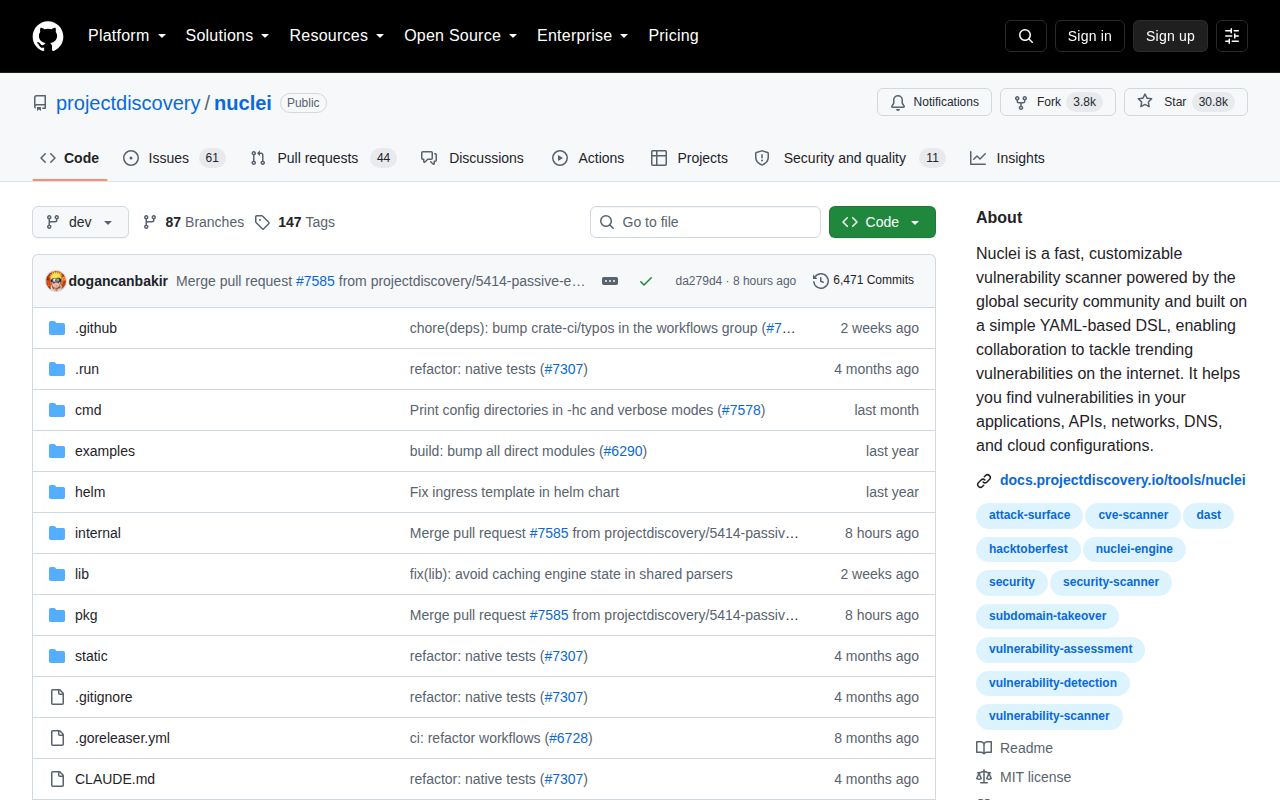
It is a rule library for Nuclei, not the scanner itself
Nuclei Templates is the content layer behind ProjectDiscovery's Nuclei engine. The repository holds YAML and related templates for HTTP, network, DNS, cloud, file, JavaScript, workflow, and other checks. You install or run Nuclei separately, then tell the engine which templates, tags, severities, or directories it may use against systems you are authorized to test. That distinction matters because cloning this repository alone does not give you a scanner command or service.
The README counted 11,997 files across 873 directories when we fetched it. It also listed 1,496 unique templates tied to CISA or VulnCheck known-exploited-vulnerability catalogs. Those figures describe catalog breadth, not detection accuracy. A template is executable security logic: request paths, matchers, extractors, payloads, and sometimes multi-step flows. Sensible use starts with choosing a relevant slice and reading the checks that can change state or send exploit-shaped traffic.
The catalog moves fast because contributors keep changing the checks
GitHub showed 12,845 stars, 106 combined open issues and pull requests, and a last push on August 26, 2026. Release v10.4.8 arrived two days earlier. Its notes list 112 new templates, including 101 CVE entries and 22 first-time contributors. That is the appeal: a team can pick up new detection work without writing every request sequence itself.
Fast movement also means operational change. The same release corrected broken matchers, malformed variables, false negatives, and false positives. It moved 22 invalid or rejected CVE templates into a different area, removed one CVE file, and added an intrusive tag to 43 printer checks. Pin the template version for repeatable jobs, review release notes before updating, and test important rules against assets where you already know the expected answer.
What happened when we ran it
We did not run Nuclei Templates at commit ed8fed8. Our sandbox workflow classified the repository's language as JavaScript, but this checkout is a content corpus rather than a supported JavaScript package in that workflow. It also had no Dockerfile. We therefore have no install duration, dependency count, build outcome, test count, or vulnerability audit to report.
That absence should not be read as a failed scanner result. It says our standard harness had no supported execution path for this repository. A useful future test would require a pinned Nuclei engine, defined targets, expected findings, and safety limits. Without those inputs, running every template would prove little and could send inappropriate requests. The honest setup result is that the repository cannot be judged like a normal Node application.
Open reports show why a match still needs a human
Issue 7575 reports that a MongoDB unauthenticated-access check did not work on a newer MongoDB version. Issue 8590 describes an invalid PATCH request in the CVE-2023-46747 flow and says the original sequence failed across four tested BIG-IP versions. Issue 14750 argues that a CVE-2025-52970 template exercised a different, already-covered FortiWeb flaw. These are specific disputes about detector behavior, not generic complaints about documentation.
The v10.4.8 notes show maintainers doing the other half of that story. They fixed regexes that could never fire, narrowed conditions that matched web-application-firewall block pages, and marked setup-stage matchers internal so they stopped appearing as findings. A current repository can still contain a stale assumption for one product version. Route material findings through reproduction, evidence capture, and vendor-specific checking before escalating them.
Tag selection controls both noise and risk
The catalog spans 6,468 templates tagged vuln, 3,587 tagged cve, and 4,353 with informational severity in the README's summary. Running broad sets against every host can produce a large amount of low-priority output. Start from an inventory question, such as which internet-facing products need a known-exploited check, then choose tags and exclusions that answer it. A giant scan is easier to launch than to review well.
Safety deserves the same care. Some checks are detection-only, while others reproduce parts of an exploit or test default credentials. Release v10.4.8 explicitly labeled 43 printer templates intrusive. Read template metadata and requests before putting them into scheduled production scans. Run under an agreed scope, rate limits, maintenance expectations, and a record of the exact engine and template revisions used.
Pick it for coverage, then build your own trust layer
Nuclei Templates is hard to replace if Nuclei is already part of your security workflow. Its MIT license, August 2026 activity, 11,997 files, and frequent corrections make it a practical source of checks. The repository is less persuasive as an automatic verdict system. Its own issue queue and release notes document both false positives and checks that could never match.
OWASP ZAP is a better choice for an integrated web proxy and crawler. Nikto is simpler for a narrow web server pass. Metasploit fits controlled exploit validation after a finding. For Nuclei users, keep this catalog, pin it, inspect risky templates, and preserve the raw response behind each alert. That process turns a fast community feed into evidence your team can defend.