A successful nested build leaves the console unvalidated
Metasploit Framework is an open-source security-testing tool whose primary interface is msfconsole. An authorized assessment team considering its console and modules needs evidence about that workflow. Our sandbox result answers a narrower question: a nested npm project installed and built successfully.
Keep those decisions separate. The measured build is useful evidence about the selected project, but it cannot establish that Metasploit's Ruby console starts, connects to a database or works with a particular target.
What happened when we ran it
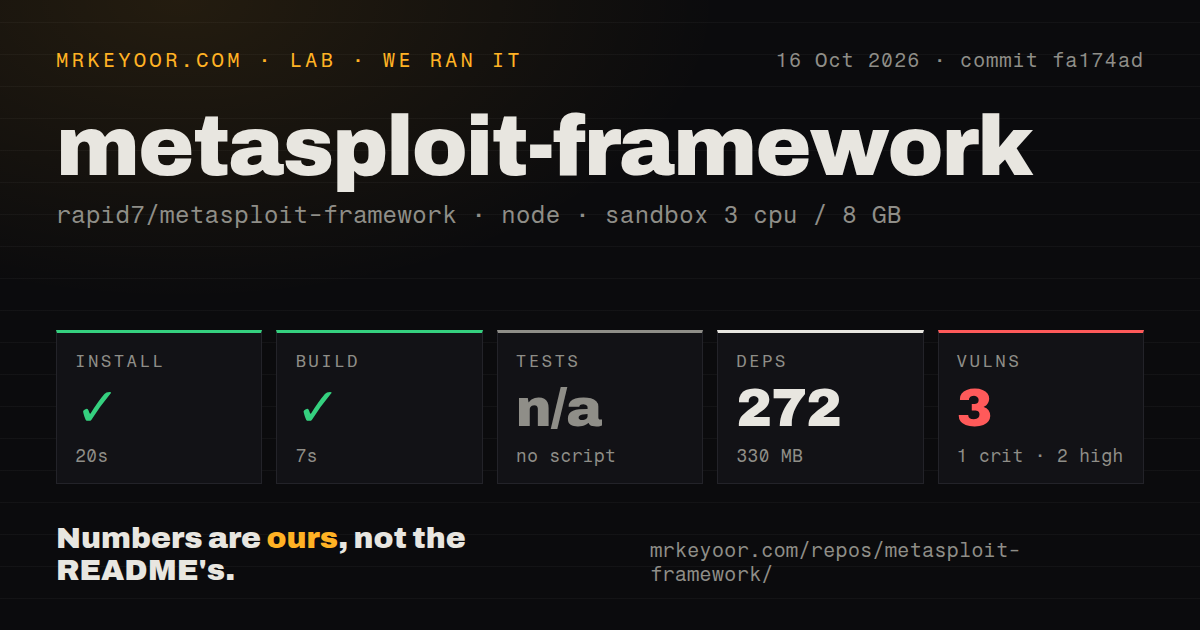
On October 16, 2026, our sandbox selected ./data/exploits/CVE-2026-75604/ at commit fa174ad. Installation succeeded in 20 seconds, recording 272 dependencies and 330 MB on disk. The build succeeded in 7 seconds.
Tests were skipped because the selected project had no test script or target. Npm audit reported 3 known vulnerabilities: 1 critical and 2 high. The supplied measurements do not identify affected packages or establish exploitability. These audit findings belong to the nested npm environment; they are not a vulnerability assessment of every Metasploit installation.
The checkout contained 15,062 files, approximately 1,686,280 source lines and occupied 204.6 MB. Detection found 20 CI workflow files, no Dockerfile and a tests directory. A tests directory is not evidence that the Framework test suite ran.
The recorded sandbox configuration was 3 CPUs, 8 GB RAM and image label lab-node:22. Actual runtime and operating-system versions require the raw toolchain logs. We did not validate the Ruby Framework console, database integration or module effectiveness.
Choose the user or contributor setup route
Rapid7's README recommends official installers on Linux or macOS and says Metasploit is pre-installed with Kali. The nightly installer guide says its packages include dependencies such as Ruby and PostgreSQL and integrate with the package manager. It also describes database setup on first startup. These are documented behaviors, not results reproduced by our sandbox.
For contributors, the development environment guide lists native build dependencies, Ruby setup, Bundler and gems. Match Ruby to the checkout's .ruby-version file. The guide explicitly warns against relying on the version shown in its example, so this review does not substitute an example version for the checkout's requirement.
Database and REST API setup is optional in that guide and requires a regular account rather than root. Decide whether you need those features before adding the services. None of those setup paths was exercised by the nested npm build.
Check Windows endpoint policy first
Rapid7's installer documentation warns that antivirus programs often flag and automatically remove Metasploit content because it resembles malicious tooling. Its Windows instructions ask users to adjust antivirus handling for the installation directory.
That requirement can rule out a managed endpoint. Confirm that the proposed assessment environment fits your organization's policy before installation. The sandbox result provides no evidence about Windows installation or antivirus behavior on your workstation.
Choose alternatives by the assessment task
Nmap provides network discovery and security auditing. Its project description includes identifying available hosts and the services they offer. Consider it when you need a host inventory or service map. This recommendation follows its documented purpose; we did not compare scan speed or detection rates.
sqlmap automates SQL injection detection and exploitation. Consider it when that vulnerability class defines the authorized assessment. We did not compare its effectiveness with Metasploit or reproduce its documented examples.
These tools address different task scopes. Choose the workflow your assessment requires, then validate it against the relevant target conditions.
Repository activity and distribution
GitHub records an October 23, 2026 push. The README directs users to nightly installers for the latest version. The supplied evidence does not establish latest-release endpoint status: its null lastRelease value may reflect a failed lookup. It also supplies no dated issue-feed records from which to describe October 23 reports or pull requests.
For adoption, start with the documented user route and validate the exact console and module path you need. For contribution, plan for the Ruby development environment separately. Our 7-second build remains a result for the nested npm project.