The working product is a software contract
NovoWeave looks like a protein-design project until you reach its first example. The call to pipeline.design(brief) intentionally raises NotImplementedError. Its four conceptual stages cover backbone proposals, structure-conditioned sequence design, evaluation, and selection, yet none contains a trained model or numerical implementation. That distinction is the whole review. NovoWeave can help a research group argue about where components meet, what each stage must return, and which records survive a run. It cannot produce a candidate protein.
The README's project-status section is admirably direct about the missing pieces. There are no weights, datasets, checkpoints, samplers, experimentally validated scores, synthesis instructions, or biological claims. The package contains 32 files and roughly 428 lines of source in our measured checkout, which is small enough to read in one sitting. Calling it an AI model would mislead a buyer. It is closer to an architectural sketch whose boxes happen to be typed Python.
Eight passing tests cover the scaffold, not protein design
The implemented layer defines a design brief, configuration objects, component protocols, validation behavior, logging conventions, and repository tooling. That can still be useful. A team deciding whether its evaluator may invent a missing score, for example, gets a clear answer from the architecture's failure model: schema mismatches, unknown model revisions, missing provenance, and evaluation-service failures should stop the pipeline, while partial results stay out of default ranking.
Those rules create a sensible vocabulary before expensive model work begins. Planned candidates carry identifiers, configuration digests, code and model revisions, random seeds, data lineage, transformations, warnings, and reviewer decisions. The design also ends at ranked computational hypotheses. It excludes synthesis and laboratory automation. None of this has been tested against a scientific workload, and the model card says type hints do not establish scientific correctness. Treat the contracts as prompts for review, not inherited proof.
What happened when we ran it
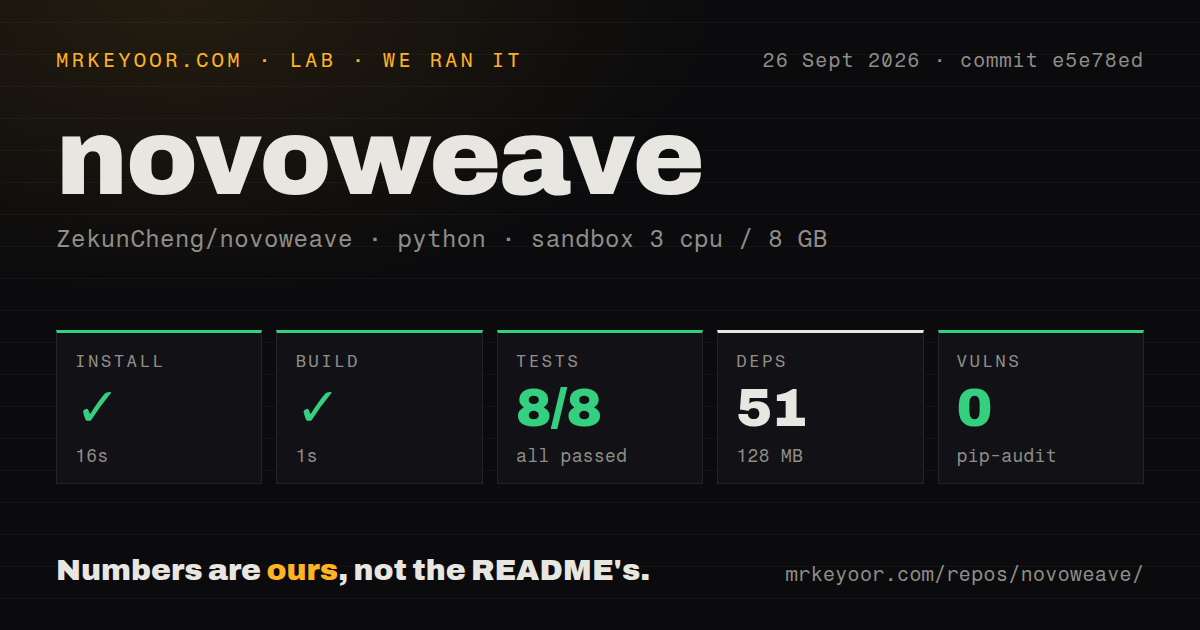
Our sandbox installed commit e5e78ed in 16 seconds. Pip added 51 packages, and the environment occupied 128 MB. The build finished successfully in 1 second. Pytest then passed all 8 supplied tests in 2 seconds, with 0 failures, and pip-audit reported 0 known vulnerabilities. The unprivileged Debian container had 3 CPUs, 8 GB of RAM, Python 3.12, and no secrets.
That is a clean result for the thing NovoWeave actually ships. It does not measure structure quality, sequence recovery, binding, toxicity, manufacturability, inference speed, or GPU demand because the repository implements none of those capabilities. The tests exercise scaffolding contracts. A buyer should read “8 passed” as evidence that this small package installs and checks cleanly at the measured commit, then stop there. Turning it into a protein-design system would require the missing scientific code, data, models, and validation program.
The hypothetical roadmap starts after the easy part
The roadmap labels the current repository Phase 0. Later phases describe dataset cards, license audits, immutable preprocessing records, baseline adapters, checkpoint loading, resource estimates, numerical-stability tests, preregistered evaluation, uncertainty analysis, independent review, and signed releases. The document explicitly calls that sequence hypothetical and gives no delivery dates. Readers should not convert those headings into promised features.
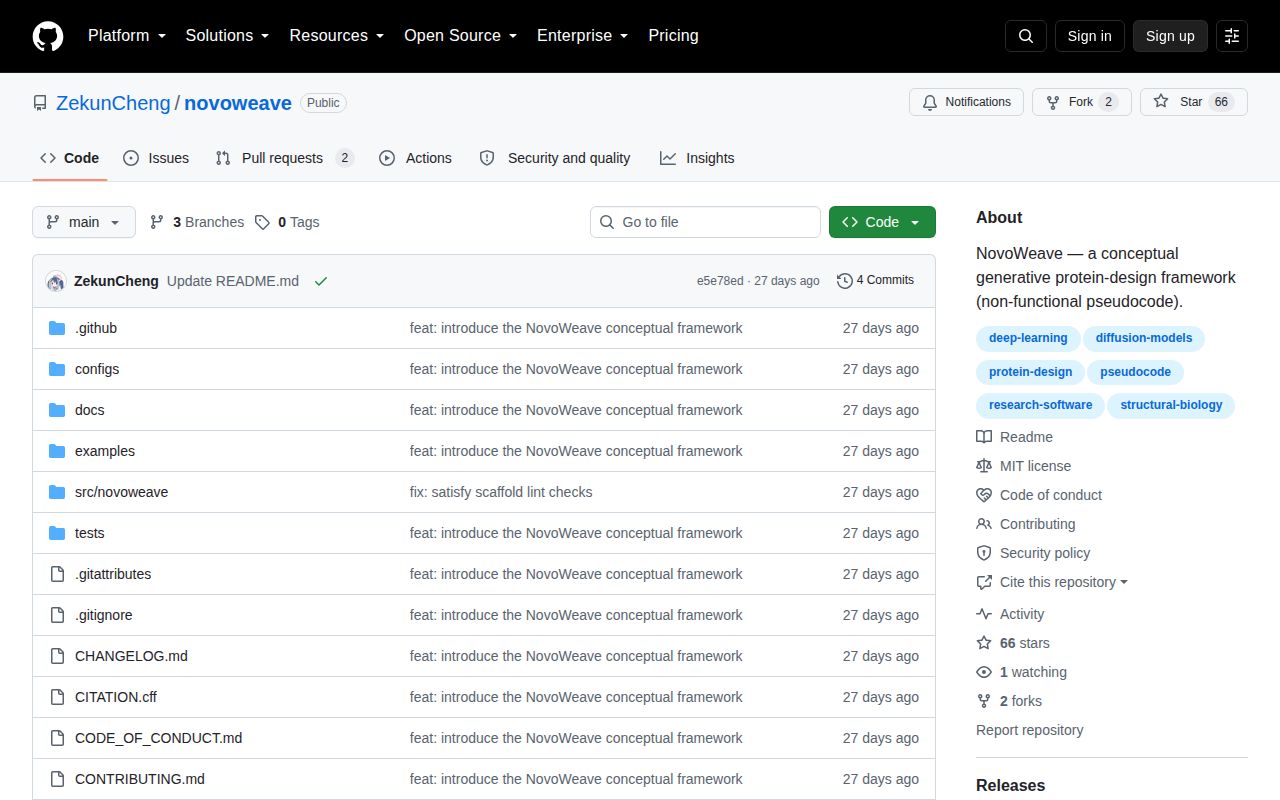
The repository was created and last pushed on September 2, 2026, and GitHub listed 66 stars when we checked. Its 2 open items were Dependabot pull requests, not user bug reports, and the API returned no latest release. That history is too short and too quiet to establish a working maintenance loop. The clean docs matter more than star count here, but a production team would still need tagged artifacts, compatibility policy, scientific review, and evidence from actual adopters.
Choose it for design review, then choose an implemented model
NovoWeave makes one responsible choice repeatedly: it refuses to blur a neat interface with scientific evidence. The model card names teaching, architecture discussion, and provenance prototyping as intended uses. It rules out real sequence selection and any claim about function, safety, binding, toxicity, or manufacture. That honesty makes the repository more useful in a classroom or early design meeting than a half-working demo would be.
For executable work, RFdiffusion, ProteinMPNN, and Chroma address different implemented parts of the problem. They also bring much larger setup, model, hardware, and scientific-evaluation questions that NovoWeave avoids by design. Start with NovoWeave only when the deliverable is a shared contract or review checklist. Our 16-second install and 8 passing tests show that its scaffold is easy to pick up. They also mark the exact boundary of the evidence: after the contracts pass, the protein-design work has yet to begin.