One photo becomes a Blender import through four moving parts
Camera to Blender has a pleasingly direct goal. You open its web camera on a phone, take a picture, let a hosted model service turn the object into a mesh, and send the result into Blender. The repository connects those steps with a FastAPI server, a browser interface, and a Blender add-on. For rough props, blocking, or visual experiments, that is easier than exporting and importing files by hand.
The convenience depends on outside services. Tripo generates the 3D asset and requires an API key. Gemini can remove the background, though the server passes the original image through when that key is absent. Phone cameras require an HTTPS origin, so the documented route adds ngrok between the handset and your computer. Blender then connects to that public address over WebSocket and waits for a model URL.
The 19-second install leaves most setup outside Python
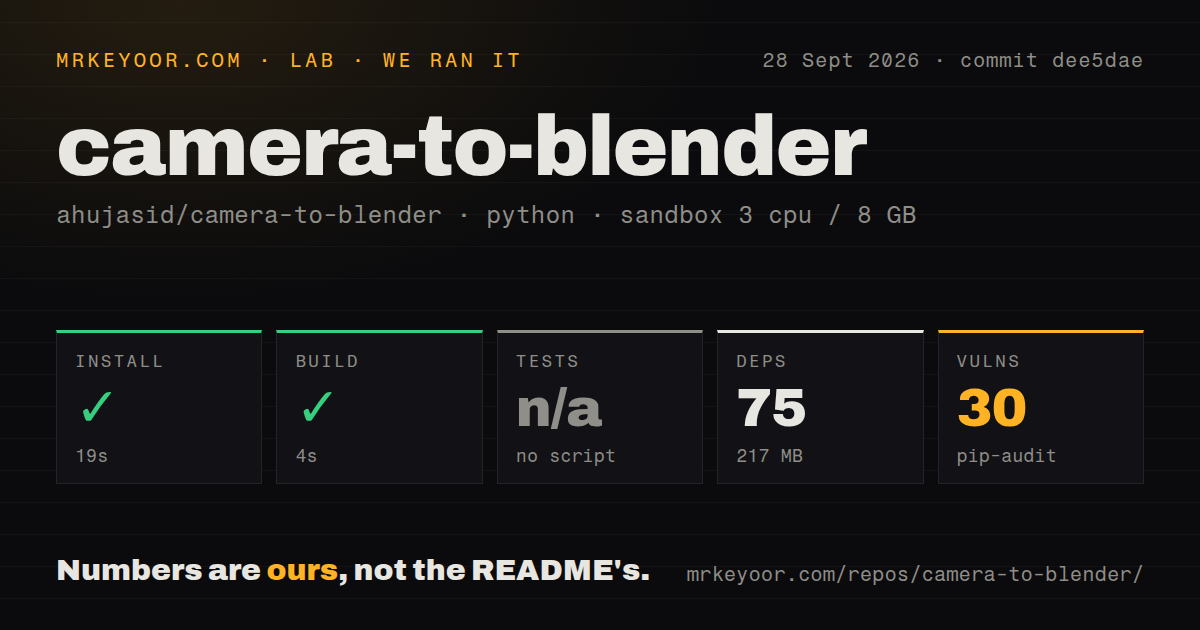
Our commit dee5dae checkout held 12 files, about 2,092 lines of source, and occupied 0.1 MB. Installing its Python environment took 19 seconds, added 75 packages, and grew the environment to 217 MB. That is modest beside many image and 3D projects because the expensive generation happens through Tripo instead of a local model loaded into the repository.
A real session still crosses 4 boundaries: phone browser, relay server, hosted generation API, and Blender. You need Python 3.10 or newer and Blender 3.0 or newer. The required Tripo key belongs in .env; a Gemini key is optional. For phone use, a second terminal runs ngrok, and its HTTPS address must be rewritten as a WSS URL before it is pasted into the Blender panel.
What happened when we ran it
Our sandbox installed 75 packages in 19 seconds and completed the available build step in 4 seconds. Pip-audit reported 30 known vulnerabilities. The run used a fresh unprivileged Python 3.12 Debian container with 3 CPUs, 8 GB of RAM, and no secrets. It did not have the Tripo or Gemini credentials needed to generate or isolate an image.
The repository had no test script or target, so we skipped tests. Our scan also found 0 CI workflow files, no Dockerfile, and no tests directory among its 12 files. The successful 4-second build therefore says the checked step completed; it does not show that Blender accepted the add-on, ngrok carried a phone session, or either hosted API returned a usable mesh.
Free ngrok URLs turn each restart into a reconnection
The README is candid about the most visible operational snag: a free ngrok address changes whenever ngrok restarts. Both ends depend on that address. The phone opens its HTTPS form, while Blender needs the matching wss:// endpoint with the client query attached. After a restart, you copy the new URL into Blender and reconnect before another model can arrive.
That is manageable for one artist at a desk. It is poor plumbing for a shared studio service, classroom, or unattended capture station. The relay code at commit dee5dae accepts browser calls and WebSocket clients without an application login. Anyone designing a persistent deployment should place access control in front of it, restrict who can trigger paid generation, and decide how uploaded photos and temporary models are handled.
Two early fixes show responsiveness, not a maintenance record
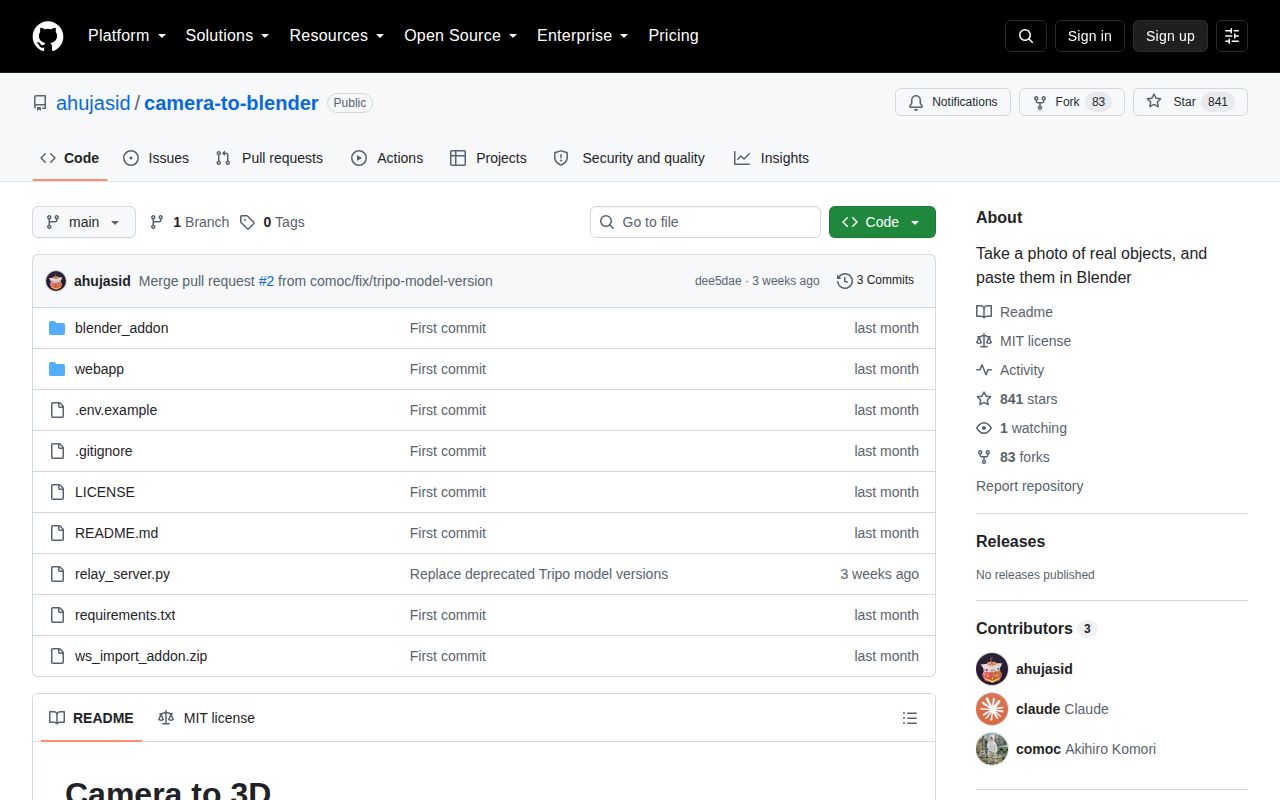
The repository was created on September 3, 2026, pushed on September 5, and had 841 stars plus 83 forks when checked. GitHub listed 0 open issues and 0 open pull requests. There was no published release. Those numbers show quick attention around launch, while 2 days of code history cannot answer how the project handles a future Blender or Tripo API change.
Its first closed issue found that Blender's private Python environment could not see websocket-client installed into system Python. The same day's change vendored the dependency into the add-on archive. A merged pull request also replaced model versions that Tripo had deprecated. That fix still used Tripo API v2, and the contributor noted a November 1, 2026 shutdown date for that API family. A migration will be required if that provider schedule holds.
The tool is best treated as a hackable creative bridge
Camera to Blender is appealing because its 2,092 lines expose the whole trip from shutter button to imported object. An artist can understand the pieces, change the browser, or alter the Blender behavior without entering a large framework. The MIT license also permits that adaptation. Its value comes from connecting services that already do the difficult generation work.
Our run proved that the Python side installs and the supplied build step completes, but 30 audit findings and 0 test targets keep it out of an unattended production path. Try it when a rough mesh arriving directly in Blender saves creative time. Choose local generation or photogrammetry when image privacy, repeatable endpoints, geometric control, or provider independence matters more than the one-photo flow.