One MCP tool scores 19 software-quality dimensions
Jev Review exposes 1 tool, jev_review, instead of pretending to be another programmer in the room. The caller supplies a task, a focused diff, complete files when needed, and optional repository context. Jev scores areas such as correctness, readability, coupling, testability, security, and reliability. The response also includes confidence and marks a dimension inapplicable when the submitted context cannot support it.
That narrow contract is the reason to consider the project. A coding agent can check a coherent change, inspect a weak score, make one justified revision, and compare the next evaluation with the previous one. There is no synthetic overall grade. A move from 6.3 to 8.1 in readability says more than an 82 out of 100 badge, provided both calls used comparable inputs and the same evaluator.
Nineteen scores point to weak areas, but the agent diagnoses them
Across 19 possible dimensions, Jev returns typed Score, Choice, and Noul decisions. Jev Review converts them into metric scores, confidence values, preset hints, and deltas. It does not return a prose explanation for a low score. Your agent still has to read the implementation, form a hypothesis, change the code, and run the project's actual checks. That separation keeps a weak signal from becoming an automatic rewrite.
The README lists 15 dimensions that are evaluated when context is sufficient and 4 more that apply only when relevant evidence is present. That breadth is useful, but the result depends on what the caller sends. The server does not discover repository files on its own. A carefully selected diff and surrounding types may support a useful review; a detached snippet can earn precise-looking numbers without enough evidence behind them.
What happened when we ran it
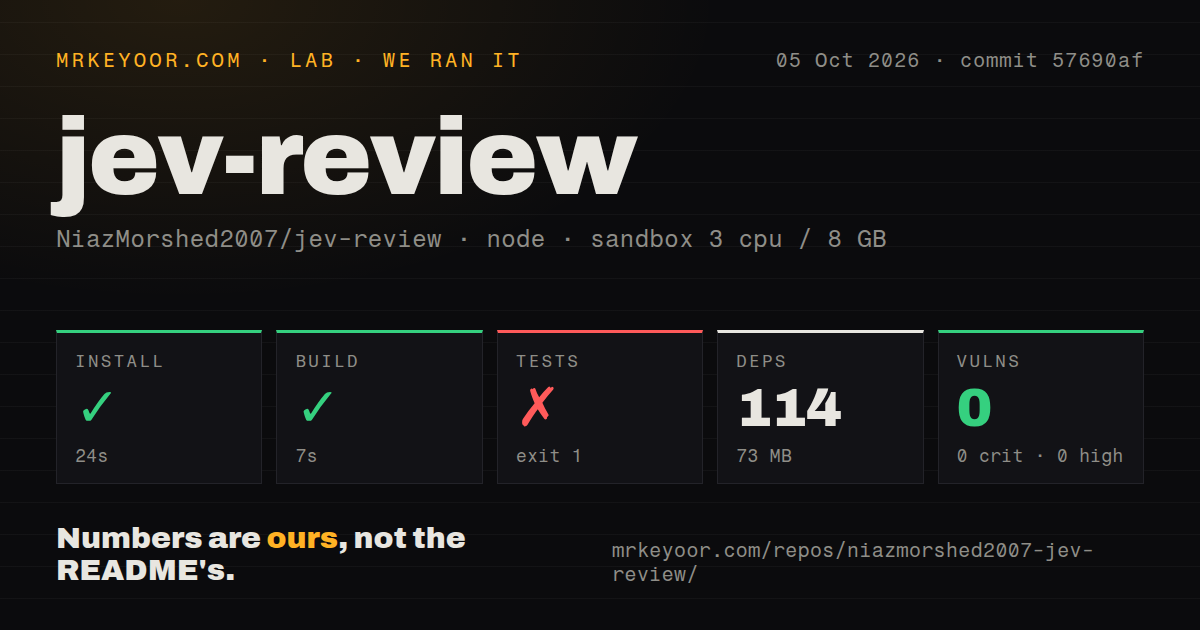
In our unprivileged container with 3 CPUs and 8 GB of RAM, we measured a 24-second install for commit 57690af. Npm added 114 packages and occupied 73 MB. The build finished successfully in 7 seconds, and npm audit reported 0 known vulnerabilities. The repository had 31 files, about 1,253 lines of source, no CI workflow, no Dockerfile, and a tests directory.
The test step failed after 6 seconds with exit code 1. TypeScript compilation ran first, then Node was asked to execute .test-dist/test/**/*.test.js. The final error says it could not find that path. The repository tree does contain TypeScript test files, but the supplied log does not establish whether the failure comes from shell glob handling, compiler output placement, or another cause. The defensible finding is that the documented test command did not pass in our container.
This was a repository check, not a live Jev evaluation. We used no secrets and made no paid API call, so our run says nothing about scoring quality, API latency, or how well the 19 dimensions track a senior review. Those need a labeled set of real changes and human comparison. The clean build proves that the bundle can be produced; it does not validate the remote judgment.
One remote API call carries the code context you select
The local MCP process makes 1 direct remote request to TypeSafe, with no database, telemetry service, or proxy operated by this repository's author. A real call sends the supplied task, diff, file contents, and repository context to https://api.typesafe.ai/v1/systemone using JEV_API_KEY. Previous evaluation data is compared locally.
For proprietary code, the practical rule is simple: include the smallest coherent slice and remove secrets before sending it. The README says the Jev API currently behaves as though it has a roughly 32,768-token ceiling, while noting that the number is unpublished and may change. Oversized changes therefore need to be divided into reviewable units. That can improve focus, but it also makes coverage the caller's responsibility.
Four coding clients share the same bundled server
Node.js 20 or newer can launch the same bundled dist/server.js for Claude Code, Codex, Cursor, and OpenCode. Claude Code, Codex, and Cursor can use the portable plugin installer, while OpenCode needs a clone plus manual MCP and skill configuration. Cursor launched from the macOS Dock may also need launchctl to inherit the API key.
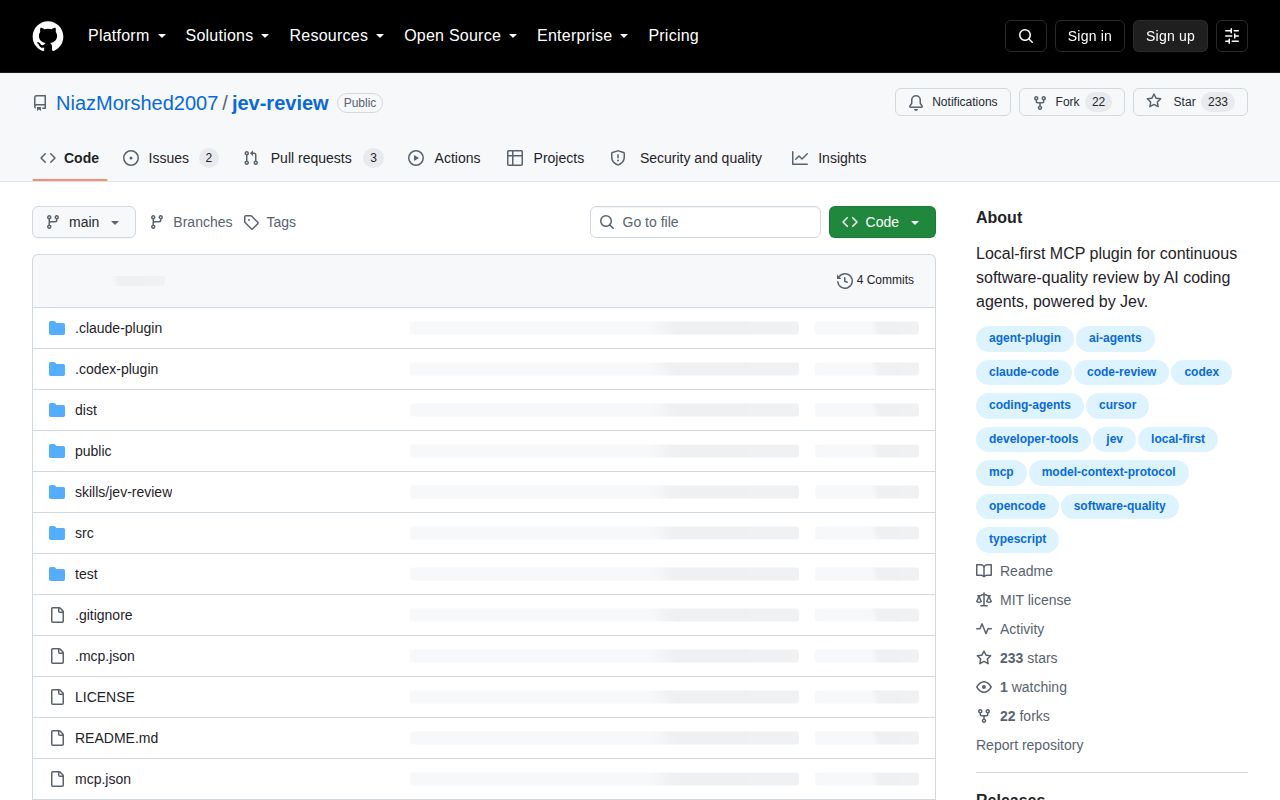
There is no npm release, so installation points directly at GitHub. GitHub showed 233 stars, 22 forks, and 5 open issues and pull requests on October 6, 2026. The last repository push was September 17, the day it was created, while issue and pull-request activity continued through September 21. That is enough activity to call the project attended, but too little history to infer a dependable release cadence.
Two open changes expose a repeatability gap
Issue 3 says every call currently goes to a hard-coded TypeSafe endpoint; pull request 4 proposes JEV_API_BASE_URL for compatible deployments. Pull request 2 addresses a separate comparison problem: jev-latest can change between calls, yet the current evaluation does not retain the answering model. A score delta is hard to trust when the evaluator may have changed too.
Jev Review has a sensible boundary for developers who already work inside an agent and want a compact second opinion. Our 7-second build and 0-advisory audit make it easy to inspect, while the failed test command blocks a stronger recommendation. Try it on non-sensitive, focused changes, verify every suggested weakness in the code, and keep your normal tests and security tools in charge of the release.