The panel can edit, validate, reload, and restore Nginx
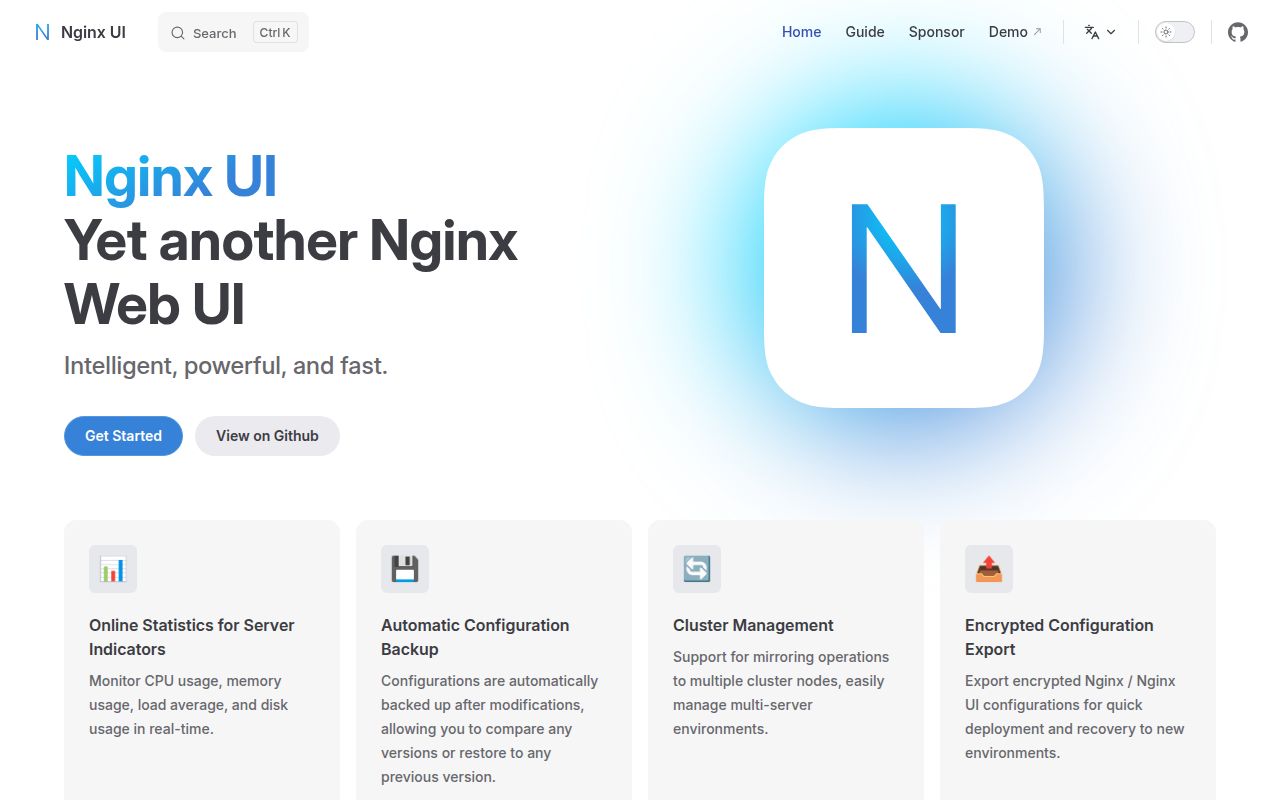
Nginx UI puts the daily work of running Nginx behind a browser. It edits site configuration with either a block editor or Ace, checks the configuration before saving, reloads Nginx, shows logs, and backs up changes with comparison and restore. Certificate issuance and renewal are built in. Server CPU, memory, load, and disk statistics sit in the same interface. For a self-hoster who already understands Nginx syntax, that can remove a lot of repetitive shell work.
The panel reaches beyond one machine. Cluster management can mirror changes to child nodes, and encrypted exports cover Nginx plus Nginx UI configuration for recovery elsewhere. GitHub listed 11,450 stars and 47 combined issues and pull requests when we fetched it. That is meaningful usage for an administrative panel, but popularity does not reduce the care required when a browser can write proxy rules, reload a network service, and handle certificate material.
AI controls can change the proxy through MCP
The README describes a ChatGPT assistant with multiple model choices, LLM completion inside the configuration editor, and an MCP interface for agent access. These are operational capabilities rather than a chat ornament. An agent can interact with Nginx UI for configuration management and service control. That could be useful when an internal assistant needs to inspect a failing site or prepare a change, provided every tool is scoped, authenticated, logged, and reviewed.
MCP is also the feature that raises the stakes. The same interface that saves typing can expose configuration and reload actions to an AI client. The repository contains 10 CI workflow files, a Dockerfile, a tests directory, and monorepo workspaces, yet our source install did not get far enough to exercise any of them. Before connecting an agent, operators should first validate ordinary account boundaries, backups, rollback, network exposure, and the exact commands available through MCP.
What happened when we ran it
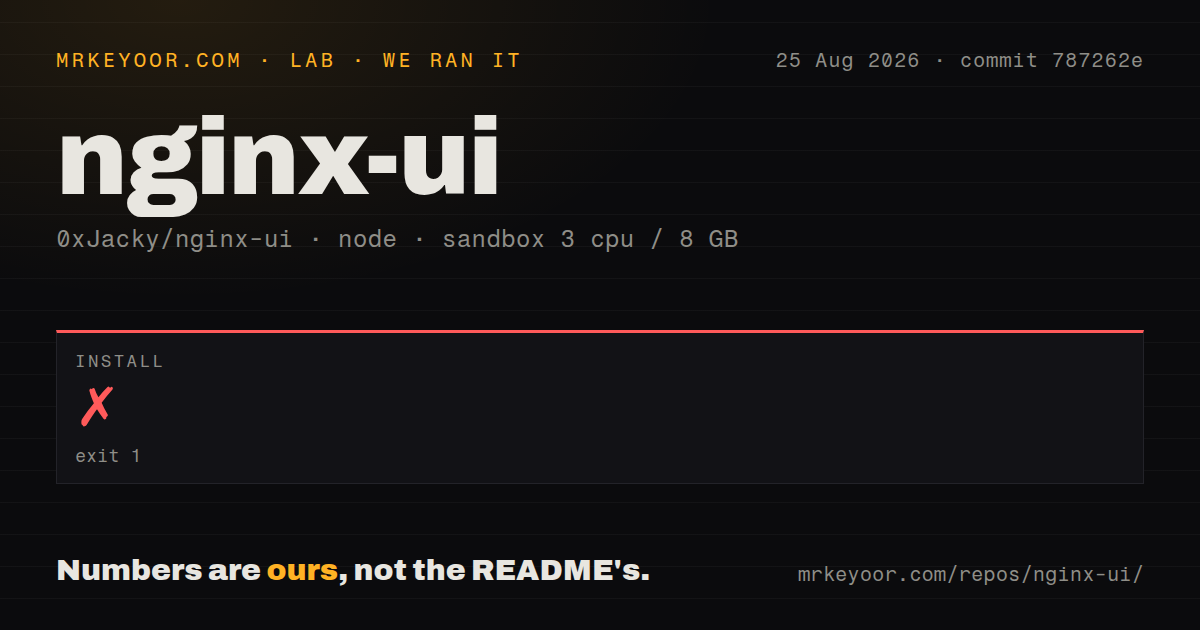
Our sandbox cloned commit 787262e and attempted installation in an unprivileged Node 22 container with 3 CPUs and 8 GB of RAM. npm exited with code 1 after 6 seconds. Its final message rejected @uozi-admin/curd@4.19.5>xlsx, saying the 4.19.5>xlsx tag contains characters that npm cannot accept. Installation ended there, so we did not reach a build or test command.
That result applies to the checkout and command our harness used. The ecosystem is identified as Bun, and the README's manual frontend route explicitly says bun install followed by bun run build. The visible error does not establish whether Bun, a pinned package-manager version, a release binary, or the published container would avoid the failure. It does establish that the 1,801-file, roughly 199,116-line checkout did not install through our fresh measured path.
Debian layout assumptions affect every managed site
Nginx UI expects Debian's sites-available directory with enabled sites linked into sites-enabled. The README warns that non-Debian systems may need their main nginx.conf changed to include that layout. This is easy to overlook because the project publishes binaries for Linux, macOS, Windows, BSD variants, and OpenWrt. A binary may launch on many systems while the Nginx file organization still needs deliberate adaptation.
The Docker route is convenient but powerful. Its example publishes ports 8080 and 8443, mounts /etc/nginx, stores panel data separately, maps /var/www, and mounts /var/run/docker.sock. The image is based on Nginx and is described as a replacement for the host's existing server. The README also says the first /etc/nginx volume should be empty. Migrating a live host therefore calls for a tested backup and rollback plan, not an in-place experiment.
Shared teams still lack fine-grained user permissions
Open issue 1478 asks for a read-only user because current users have broad configuration access and can make accidental changes. Related permission requests in the queue ask for site ownership and administrator levels. This is a concrete reason for a team to walk away. A panel that can edit files and reload Nginx needs roles that match on-call, developer, and administrator duties if several people will use it.
OIDC does not remove all local identity work either. Issue 1633 reports that an identity-provider-authenticated username must also exist in Nginx UI's local SQLite user table. The requested modes would either trust OIDC directly or create a local user on first login. Until that behavior changes, an organization with LDAP-backed SSO must keep the panel's local user list synchronized or accept failed logins for otherwise valid users.
v2.5.10 is current, with operational fixes landing in August
The repository was pushed on August 26, 2026. Release v2.5.10 arrived on August 21 with changes around certificate WebSockets, DNS propagation, Cloudflare token separation, certificate path migration, TLS upstream checks, cluster errors, log classification, and an S3 backup panic. Those are the sorts of details a production control panel has to get right, and the active release history is a positive health signal.
Nginx UI is best evaluated as privileged infrastructure software with AI entry points, not as a friendly dashboard alone. Use a pinned artifact, put it behind strict network and identity controls, and confirm backup restoration before allowing edits. The 6-second install failure leaves the source path unproven in our environment, while the open permission requests make a single trusted operator a safer starting audience than a broad engineering team.