Thirty skills turn a local agent into a PR workbench
The current repository contains 30 skill files covering news detection, pitch angles, fact checks, media research, crisis holding statements, and AI visibility work. Newsjack installs those instructions beside a small command-line tool so Codex, Claude Code, Hermes, or OpenClaw can use a shared process. That is the useful distinction: the project supplies judgment prompts, saved artifacts, and routing rules around an agent you already use. It does not supply a new model or a finished outreach service.
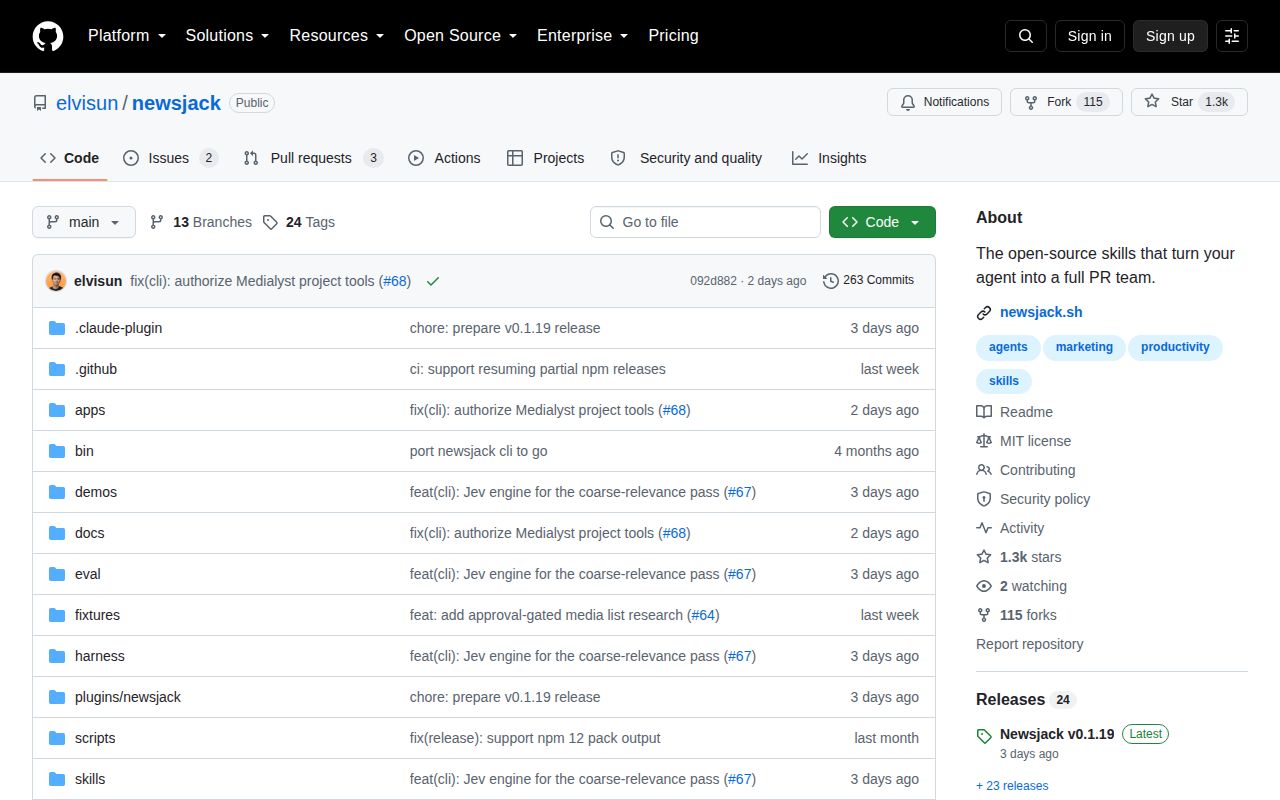
The breadth needs some discipline from the operator. A founder can ask for a newsworthiness check without configuring anything, while recurring detection combines a profile, feeds, optional news services, filtering, saved history, and delivery. The repository was 54.5 MB at commit 092d882, with 4,281 files and roughly 38,192 lines of source. Much of the value lives in Markdown skills and evaluation fixtures, while the Go CLI handles state, sources, authentication, installation, and monitoring.
Browser chat loses saved monitoring and repeat suppression
Newsjack documents 2 runtime modes. Full Mode runs in local agents with shell access, filesystem storage, credentials, and scheduled jobs. Limited Mode works inside browser chat for tasks such as strategy, critique, fact checking, and a manual news scan. It cannot run the canonical detector, save a monitor, remember previously seen stories, write the normal local artifacts, or schedule another pass. That makes the local runtime a product requirement for the feature the name most strongly promises.
The optional services are presented with reasonable boundaries. Medialyst supplies dated news search and journalist enrichment, an X bearer token adds X sources, and a Slack webhook delivers finished monitor reports. The base set can still draft and assess material without those accounts. Credentials and client state live under the user's Newsjack directory, so a team should decide who can read that local data before sharing a workstation or 24-hour monitoring host.
What happened when we ran it
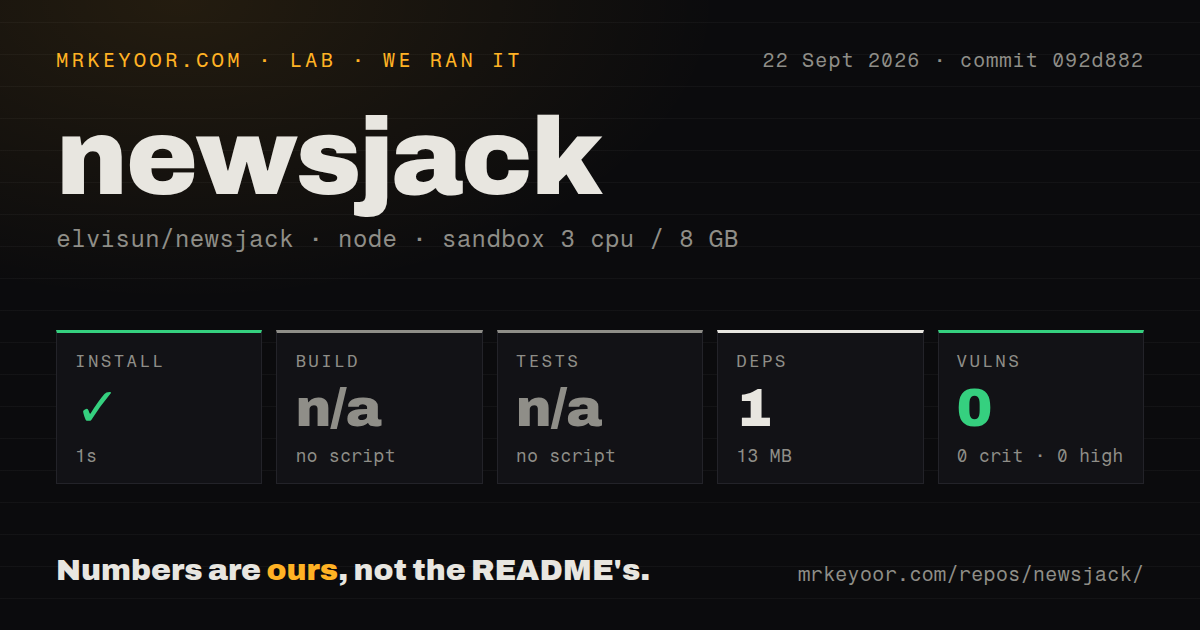
Our sandbox installed Newsjack in 1 second. Npm added 1 package and the installed result occupied 13 MB. The checkout itself contained 4,281 files and about 38,192 lines of source. That is a pleasantly small dependency result for the package entry point, especially beside repositories that pull an entire web stack just to expose agent instructions. Npm audit reported 0 known vulnerabilities in what our clean Node 22 container installed.
There was no npm build script or target, so our harness skipped the build. It also found no npm test script or target and skipped tests. Those are neutral results, not successful checks. The repository does contain 6 GitHub Actions workflow files and Go test files for the CLI, but our stated run did not execute them. Anyone evaluating the source should run the Go checks separately instead of treating the 1-second npm installation as proof that the command-line behavior is sound.
RSS freshness is broken in v0.1.19
Issue 69 reports a concrete defect in release v0.1.19: the RSS parser drops pubDate, leaving feed items without a publication timestamp. According to the reproduction, that also stops the age filter from rejecting old feed entries. Pull request 70 identifies a case mismatch in the parser and proposes a fix, but it remained open when checked on September 22, 2026. A feed-only monitor should therefore be considered unreliable for freshness until that fix lands and is released.
This matters more here than it would in a casual feed reader. Newsjacking depends on knowing whether a story is new enough to justify a response. An undated item forces later research to recover the clock, and the issue report says this can prevent a feed-only run from producing a pitch-ready result. The project had 5 open issues and pull requests, including the defect and its proposed repair. Small queue, important bug.
Feed security work has not reached the current release
Pull request 61 proposes an SSRF guard and a 10 MiB body limit for profile-supplied feed URLs. Its author says the current fetch path can follow a profile or redirect toward private network addresses and read response bodies without a cap. The same change would keep implicit updates out of unattended runs unless explicitly enabled. Because the pull request is open, operators accepting feed URLs from other people should review the current network path or restrict where the CLI can connect.
The installer does verify release checksums, which is a good control, and NEWSJACK_AUTO_UPDATE=0 disables the documented automatic update behavior. Still, curl | bash plus updates before runs will conflict with environments that require pinned artifacts and reviewed promotion. The npm fallback and downloadable release binaries offer other routes. Pick one deliberately, record v0.1.19 or the commit you approved, and avoid letting a scheduled agent change its own executable without your deployment policy.
September releases show activity, not settled behavior
GitHub recorded the last push on September 19, 2026, one day after v0.1.19 was published. The project had 1,289 stars and 5 combined open issues and pull requests when fetched. Three releases appeared between September 14 and September 18, so this is an actively changing young tool rather than an idle repository. Issue 55, however, has reported a broken Claude.ai and Cowork marketplace sync path since July 15. Recent commits do not guarantee every documented runtime works.
Newsjack earns a trial when a team already conducts PR work through a local agent and wants that work to follow repeatable checks. The 30 skills cover more of the job than a feed monitor, and the 13 MB install makes experimentation cheap. Keep a human responsible for claims, recipient fit, and final wording. For recurring monitoring, pin the install and verify RSS dates on real inputs before trusting the alert queue.