Netty 4.2 is a foundation, not a ready-made application
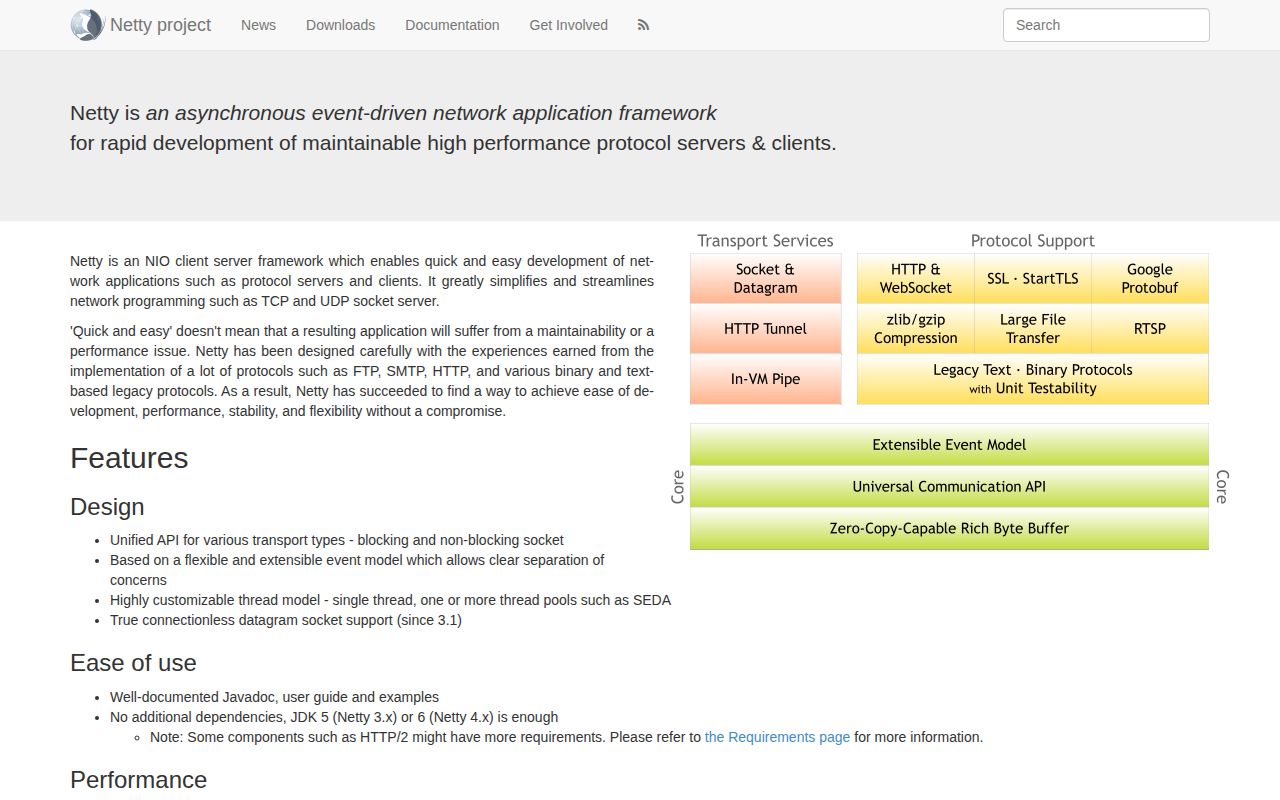
Netty 4.2 is an asynchronous, event-driven networking framework for Java servers and clients. It sits below most business logic and provides machinery for handling connections and protocols without the thread-per-connection model. That makes it relevant to gateways, proxies, custom protocol endpoints, and heavily connected clients.
The project has been around since 2010 and has 35,047 GitHub stars, which signals broad awareness, but popularity is not a setup guide. Netty expects its users to understand Java, Maven, asynchronous control flow, and the operating-system details behind native transports. It saves time only after a team learns its model and establishes dependable build practices.
Java 8 requirements are stated, but the easy path is narrow
The README says Netty 4.2 requires Java 8 or newer, while the optional io_uring native transport requires Java 9 or newer. Building calls for the latest stable OpenJDK 8 and Apache Maven, plus additional development packages on Linux or macOS when native transport is involved. Those warnings prevent the false impression that every module is pure Java.
There is also a modular Netty guide for JDK 9 and newer, with material for users and contributors. Version development happens on branches named for the major and minor line, such as 4.1, which helps teams maintaining long-lived integrations. Newcomers still must match the branch and documentation line to the dependency they plan to ship.
What happened in our 3-CPU run
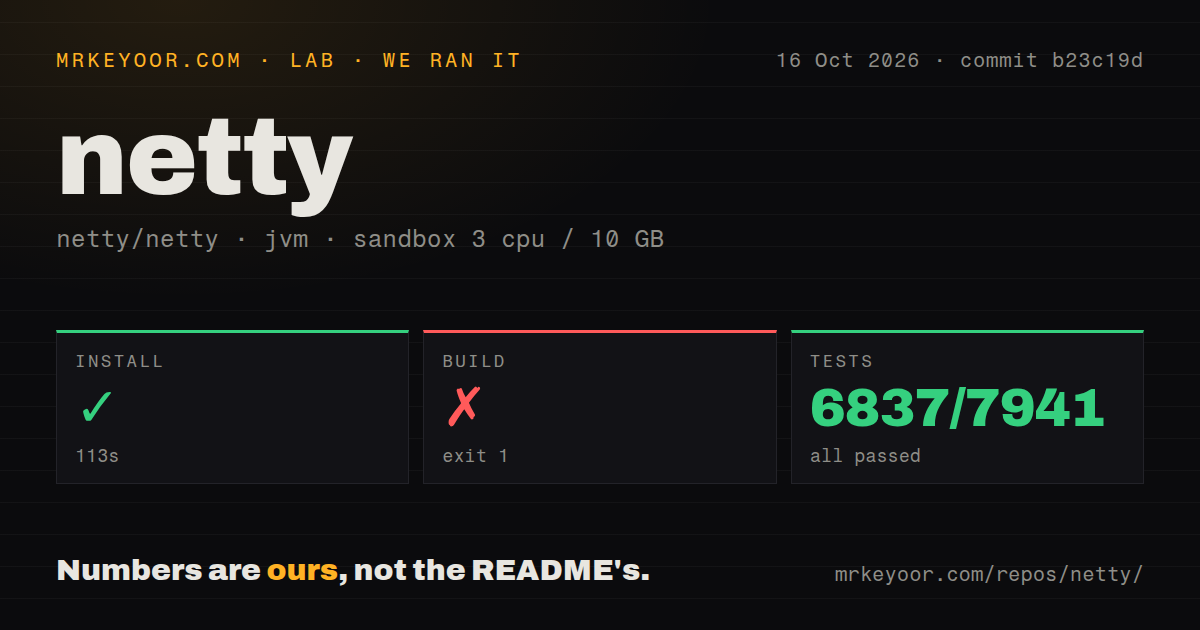
Our install step succeeded in 132 seconds in a fresh unprivileged Debian container with 3 CPUs, 10 GB of RAM, and JDK 21. The checkout at commit 87eb426 contained 4,193 files, roughly 665,972 lines of source, and occupied 27.3 MB. The build then failed with exit code 1 after 112 seconds. Its final visible lines listed the Sonatype snapshots and Maven Central repositories, ended with Maven's MojoExecutionException help reference, and suggested resuming from the netty-transport-native-epoll module. Those lines do not establish the underlying cause, so attributing it to a missing package, repository outage, or permissions problem would be guesswork.
The test run also exited with code 1 after 590 seconds. Maven Surefire recorded 8,471 tests: 6,941 passed, none failed assertions, 1,419 were skipped, and 111 ended as collection or setup errors. The tail shows individual handler tests completing, including a 823-test JDK SSL engine group, but later reports 39 errors in a 2,261-test group and skips native Unix and BlockHound test modules. This is a meaningful distinction: the exercised assertions were not failing, but our run still was not green because tests could not all be set up or collected.
The 15 CI workflows are a strong maintenance signal
Netty's core proposition is focused: maintainable, high-performance protocol servers and clients built around asynchronous events. The README points users to downloads, documentation, developer and modularity guides, native-transport guidance, Discord, and the project's social channel. That is a useful map for a framework spanning multiple 4.x development lines and optional platform-specific code.
The repository contains 15 CI workflow files, evidence that automation is part of maintenance. Our scanner found no Dockerfile and no directory literally named tests, but neither observation means the project lacks tests: Maven discovered thousands across the module tree. There is no repository-provided container recipe in the measured checkout for one blessed environment. Teams should capture system packages, JDK selection, Maven options, and enabled native modules in their own CI.
The 4,193-file scale creates real rough edges
A framework with 4,193 files and several hundred thousand lines of source is not something most teams should casually fork. Native transports expand the compatibility matrix across operating systems, architectures, development headers, and Java versions. The README acknowledges extra packages, yet our failed build shows that reading the requirements is not the same as proving the multi-module build on a specific image.
There are 679 open issues, a substantial backlog but not proof that maintainers are unresponsive. The latest push was on September 10, 2026, and release 4.2.18.Final arrived on September 9, 2026. Those dates show current code and release activity alongside a large support surface. One recent tag cannot establish long-term cadence, and the open count cannot establish response time, but this does not look dormant.
Netty 4.2 belongs beneath frameworks needing networking control
In a real Netty 4.2 stack, the framework belongs close to TCP, UDP, HTTP, TLS, and custom protocol handling, with application services above it. Reactor Netty fits teams already using Reactor that want reactive HTTP or TCP APIs. Vert.x offers broader application structure, Undertow narrows the problem toward an embeddable web server, and Apache MINA competes more directly in asynchronous protocol applications.
Choose Netty 4.2 when the networking layer is part of your product and engineers need to shape it deliberately. For a simple HTTP endpoint, start higher in the stack and let that framework carry Netty indirectly if it chooses. Our 590-second test run is the warning: even with 6,941 passing tests and zero assertion failures, environment-sensitive setup can keep a native-aware project from going green. Netty looks mature and active, but adopting it responsibly means owning that complexity.