NetBox records intended network state instead of configuring devices
NetBox gives network teams one structured place for sites, racks, devices, interfaces, cables, IP addresses, VLANs, circuits, power, VPNs, and virtual machines. It treats those records as intended state. Ansible, monitoring systems, provisioning services, and internal tools can read them through REST or GraphQL APIs. The boundary is explicit in the README: NetBox does not connect to network nodes or apply configurations itself.
That separation is useful when spreadsheets, ticket notes, and device commands disagree. A cable trace, prefix assignment, device role, or rack position can have validation and change history instead of living in one engineer's workbook. It also creates a responsibility that buyers sometimes miss. NetBox only becomes a source of truth when people and automation keep it accurate. Installing it does not discover an estate or settle who owns updates.
The data model covers more than IP address management
A plain IPAM product may be enough for subnets and addresses. NetBox reaches further into physical connectivity, equipment, circuits, tenancy, power, virtualization, and configuration context. Custom fields and tags extend existing objects, while plugins can add models, views, and integrations. Fine-grained permissions can limit a team to specific object types or tenants, and custom validation rules can reject changes or protect objects from deletion.
The system can render Jinja2 device configurations from stored data and expose the result through its API. Custom scripts support guided workflows such as adding a branch office. Event rules can invoke a script or send a webhook when an object changes. Those features connect inventory to automation, but the last step still belongs to an external tool such as Ansible or Salt. That is a good safety boundary, provided your operating model accounts for it.
What happened when we ran it
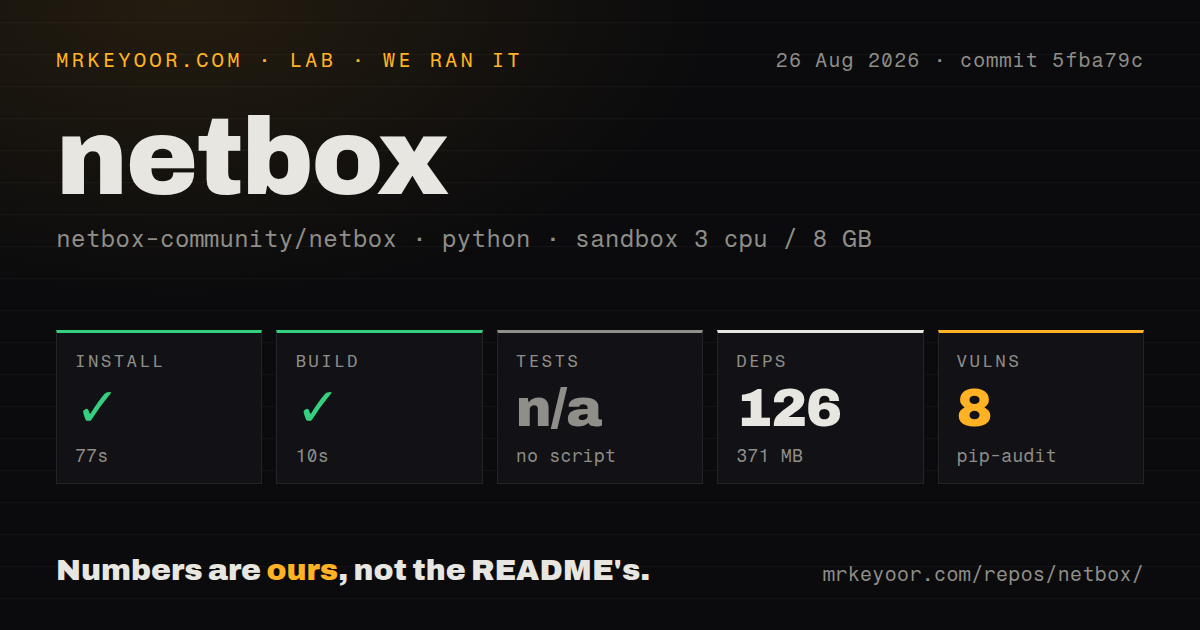
Our sandbox installed 126 Python packages in 77 seconds and used 371 MB on disk. The build completed successfully in 10 seconds at commit 5fba79c. The checkout contained 2,157 files, about 256,542 lines of source, and occupied 49.4 MB. Ten CI workflow files were present, while our scan found no Dockerfile and no top-level tests directory.
Tests were skipped because the repository did not expose a test script or target to our runner. That is different from a passing suite, and it is also different from evidence that NetBox has no tests. The honest result is that our standard harness could install and build this checkout but could not invoke its test suite. A team modifying the Python application should identify the maintained test command before accepting changes.
Pip-audit reported 8 known vulnerabilities in the installed dependency set. The supplied measurement does not identify their packages, severities, reachability, or available fixes, so none of those details should be inferred. It does justify a dependency review before deployment. Pin the intended NetBox release, reproduce the audit against that deployment image, and decide each advisory from the package path and exposed behavior rather than the count alone.
Self-hosting means at least 6 moving parts
The official installation guide was tested on Ubuntu 24.04. It lists Python 3.12, 3.13, or 3.14, PostgreSQL 14 or newer, and Redis 5.0 or newer. The reference stack also includes NetBox's Django application, a background worker, Gunicorn or uWSGI, static asset storage, and an HTTP server such as Nginx or Apache. Backups must cover the database plus uploaded or generated files relevant to your configuration.
Starting at the minimum versions would be shortsighted. The docs say PostgreSQL 14 support and Redis versions before 6.0 will be removed in NetBox 4.7. A fresh installation should begin with PostgreSQL 15 or later and Redis 6.0 or later, then pin supported versions through upgrades. The same guide warns that non-Ubuntu package commands can differ significantly, so Debian compatibility in our lab does not validate every production distribution.
Configuration adds secrets and policy choices that a source build never exercises. Administrators need database credentials, a Django secret key, host and origin settings, authentication, outbound email where used, worker supervision, TLS termination, static files, backups, and restore drills. LDAP is optional. Plugins add their own compatibility and upgrade work, especially when they introduce database models. Test the exact plugin set before every NetBox upgrade rather than assuming the core release covers it.
Change history helps only when writes have clear owners
NetBox logs object creation, edits, and deletion, attributes changes to a user, and groups related writes by request ID. That gives an operations team a useful audit trail. Permissions can divide responsibility by tenant or object type. Event rules can notify another system when data changes, and custom validation can encode local rules such as preventing deletion of an active device.
Those controls do not decide whether a discovery import, a human edit, or an automation job wins during a conflict. Establish ownership for each field and a reconciliation process before connecting writers. If device facts flow in automatically while engineers also edit them by hand, history will explain the disagreement but will not prevent churn. A source of truth works best when write paths are few, reviewed, and documented.
August 2026 activity shows a maintained, busy project
GitHub recorded 21,389 stars, 214 combined open issues and pull requests, and a last push on August 26, 2026. Release v4.6.9 shipped one day earlier. Its fixes covered bulk import errors, job deletion memory use, event rollback behavior, navigation, hierarchy display, cached scopes, and GraphQL cable queries. The open queue also showed active triage on cable paths, prefix counts, filters, and custom scripts.
That pace supports a strong community score, though it raises the cost of casual upgrades. The latest release had 19 listed bug fixes alongside interface additions and one performance change. Read release notes for the object types and plugins you use, run migrations on a copy of production data, and verify API clients before rollout. NetBox is a sensible choice for a serious network inventory program. It is much less convincing as an unattended appliance that nobody owns.