It is a private network built around host identity
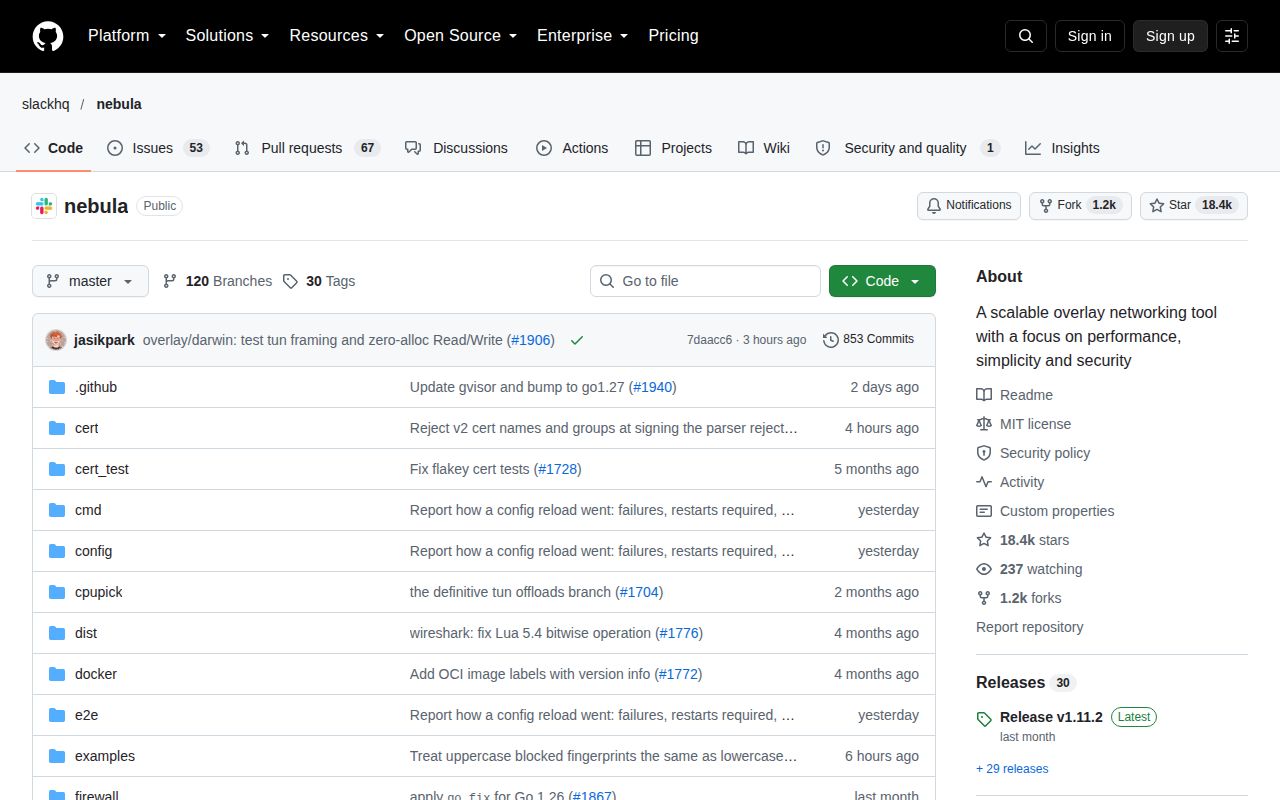
Nebula solves a familiar infrastructure problem: machines that belong together often sit behind different NATs, firewalls, cloud networks, and office connections. It gives those machines stable addresses on an encrypted overlay, allowing them to communicate without forcing the underlying providers into one addressing scheme. The project is written in Go, carries an MIT license, and has 18,239 GitHub stars, so this is not an obscure networking experiment.
The important design choice is certificate-based identity. A Nebula certificate asserts a node's name, overlay IP address, and membership in administrator-defined groups. Those groups feed firewall rules that resemble cloud security groups, so policy can describe roles such as laptops or servers instead of chasing changing public addresses. In its default configuration, Nebula uses Curve25519 for handshakes and signatures, with ECDH key exchange and AES-256-GCM encryption described in the README.
Discovery is centralized, but traffic can stay peer to peer
Lighthouses help peers discover one another, while optional UDP hole punching lets many nodes establish direct connections through NAT. The lighthouse is not presented as the place all application traffic must traverse. That distinction matters at scale: discovery has a stable rendezvous point, but data can move between peers across cloud providers, datacenters, and endpoints. The default public-facing requirement is UDP port 4242 on a lighthouse whose address should remain stable.
What happened when we ran it
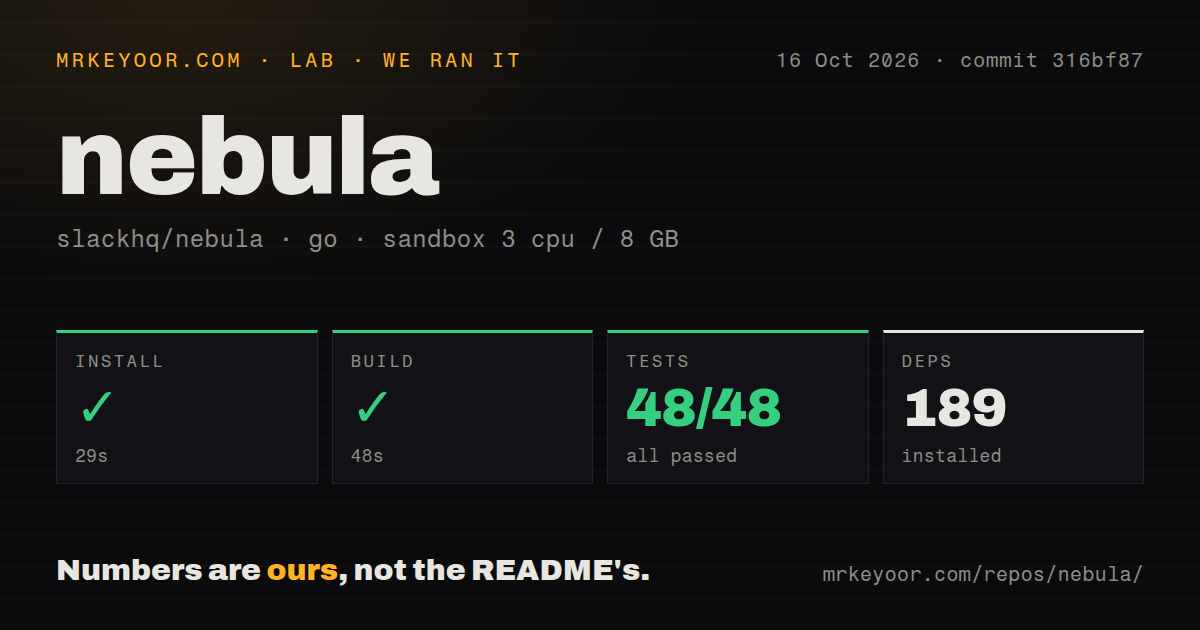
Our run used the repository at commit dd8f660 in an unprivileged Debian container with 3 CPUs and 8 GB of RAM. Installation succeeded in 32 seconds and installed 141 packages. The build then completed successfully in 46 seconds. That is a reassuring result for a networking project because there were no undocumented system-package failures or secret-dependent build steps in the supplied log.
The test step also succeeded, taking 30 seconds. Go reported 44 passing tests and 0 failures out of 44 measured tests. We found 4 CI workflow files and a tests directory among 329 repository files, covering about 68,921 lines of source in the supplied scan. The checkout occupied 2.3 MB, and there was no Dockerfile, although the README points users to the published nebulaoss/nebula container image.
These figures describe build and test readiness, not networking performance. We did not measure throughput, latency, NAT success rates, certificate rotation, mobile behavior, or recovery after a lighthouse failure. The fair conclusion from our box is narrower: Nebula compiled and its available measured test run passed cleanly under fresh, resource-bounded conditions in a total of 108 seconds across install, build, and tests.
The strongest feature is coherent control without a cloud lock-in
Nebula brings several necessary pieces into one operational model: authenticated encryption, overlay addresses, signed host identity, discovery, NAT traversal, and group-aware filtering. That cohesion is its best argument over assembling a raw tunnel plus separate scripts. Linux, Windows, macOS, FreeBSD, iOS, and Android are represented, and the README lists packages for 5 desktop or server distribution channels plus Docker.
There is also useful restraint in the quick start. It explicitly warns never to copy ca.key to individual nodes, calls that file the most sensitive asset in the network, and explains that certificate authorities expire after 1 year by default. The example signs 4 named hosts into a 192.168.100.0/24 overlay and demonstrates groups at issuance time. Those details make the trust model concrete instead of hiding it behind a single magic command.
The operational rough edges are the product
Nebula is simple only if the team already understands private networking and PKI. Every node needs the binary, a configuration file, the CA certificate, its own certificate, and its private key. Adding, revoking, replacing, and rotating those credentials becomes an ongoing process. The 1-year default CA lifetime can turn into an outage deadline if ownership is vague, so rotation practice belongs in the launch checklist, not a future cleanup task.
Connectivity also depends on conditions outside the binary. A lighthouse needs a stable routable address, UDP/4242 must reach it, and restrictive networks may frustrate direct paths. The README offers Managed Nebula for teams that do not want to manage PKI and lighthouses, which is an honest signal about the burden. The open-source edition gives control, but it does not remove the work required to distribute secrets safely or observe a multi-site network.
Recent activity supports confidence, but issue count needs context
The latest supplied release is v1.11.1 from August 21, 2026, while the last push was September 1, 2026, one day before our review date. Taken together, those dates show current code activity rather than a repository living only on old popularity. There are 103 open issues, a meaningful queue but not enough information by itself to judge response quality, maintainer capacity, or time to resolution.
It belongs beneath services and beside network policy
In a real stack, Nebula sits below applications and service discovery. Give hosts overlay addresses, express which certificate groups may talk, and let databases, SSH, monitoring agents, and internal APIs bind to or permit that private network. Keep public ingress, application authentication, DNS, secrets management, and observability as separate layers; an encrypted 192.168.100.0/24 does not replace them.
Choose Nebula when control of trust and topology is worth operating at least 1 lighthouse and a CA lifecycle. Choose a managed mesh when rapid user onboarding and centralized administration matter more. Choose a lower-level WireGuard component when you specifically want to build the missing coordination yourself. Nebula's value is not zero configuration, it is a coherent and inspectable network system whose 44 measured tests passed on our box.