What people use navier-stokes for
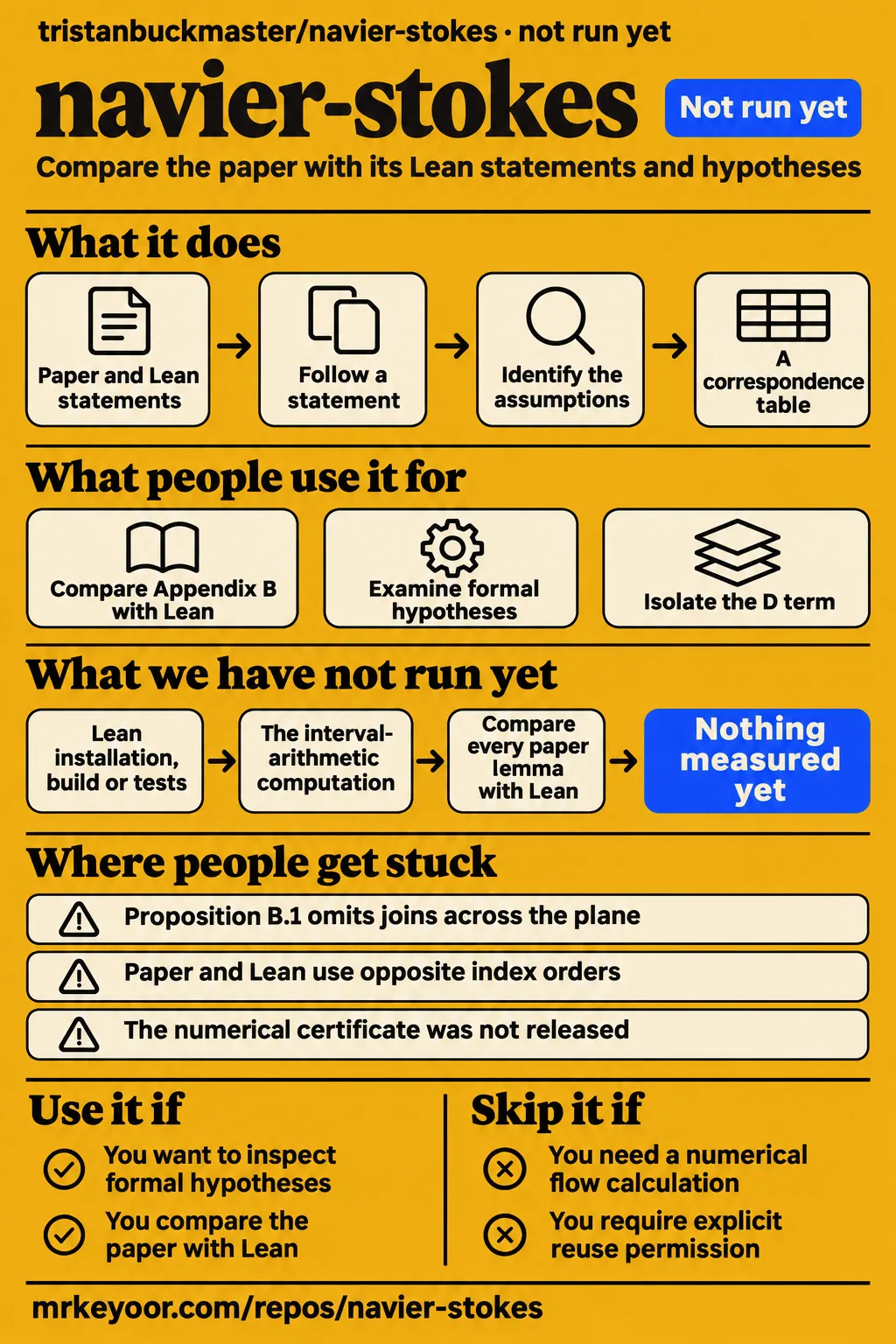
Mathematical readers use this repository to compare the November paper with its Lean statements and required hypotheses. Buckmaster and Alpöge's repository contains the paper and its accompanying formalization, giving readers two presentations of the proposed argument to examine together. The practical task is to follow a statement from the PDF into its formal counterpart, identify the assumptions on each side and understand the passage the authors describe between them. The issue tracker records specific examples of readers doing that comparison.
- The GitHub issue #2 reporter compared Appendix B at commit ad53419 with the Lean statements. They reported missing joins across y₃ = 0 in the PDF and an index-order discrepancy, while saying Lean includes the joins and Theorem 1.1 is unaffected. Their Appendix B comparison in issue #2 identifies a particular proposition and its formal hypotheses.
- The GitHub issue #3 reporter constructed an axisymmetric test to isolate the D term in inequality B.20. They reported a surface contribution from a derivative jump and said Lean's order-one plane_joins condition excludes their D. Their D-term test in issue #3 examines the printed inequality under its written assumptions.
- Buckmaster and Alpöge released the research write-up associated with the claimed unforced blowup proof. Scientific American's November 20 report describes their AI-aided announcement. The r/mathematics submission linking the repository calls it a claimed proof of unforced Navier-Stokes blowup.
Issue #2 offers a concrete starting point because it names Proposition B.1, the dividing plane and the assumptions under discussion. A reader can make a correspondence table containing the paper statement, the Lean statement and the explanation connecting them. That task keeps the PDF's wording separate from the formal hypothesis and gives the reader a specific mathematical question to follow through the repository.
What happened when we ran it
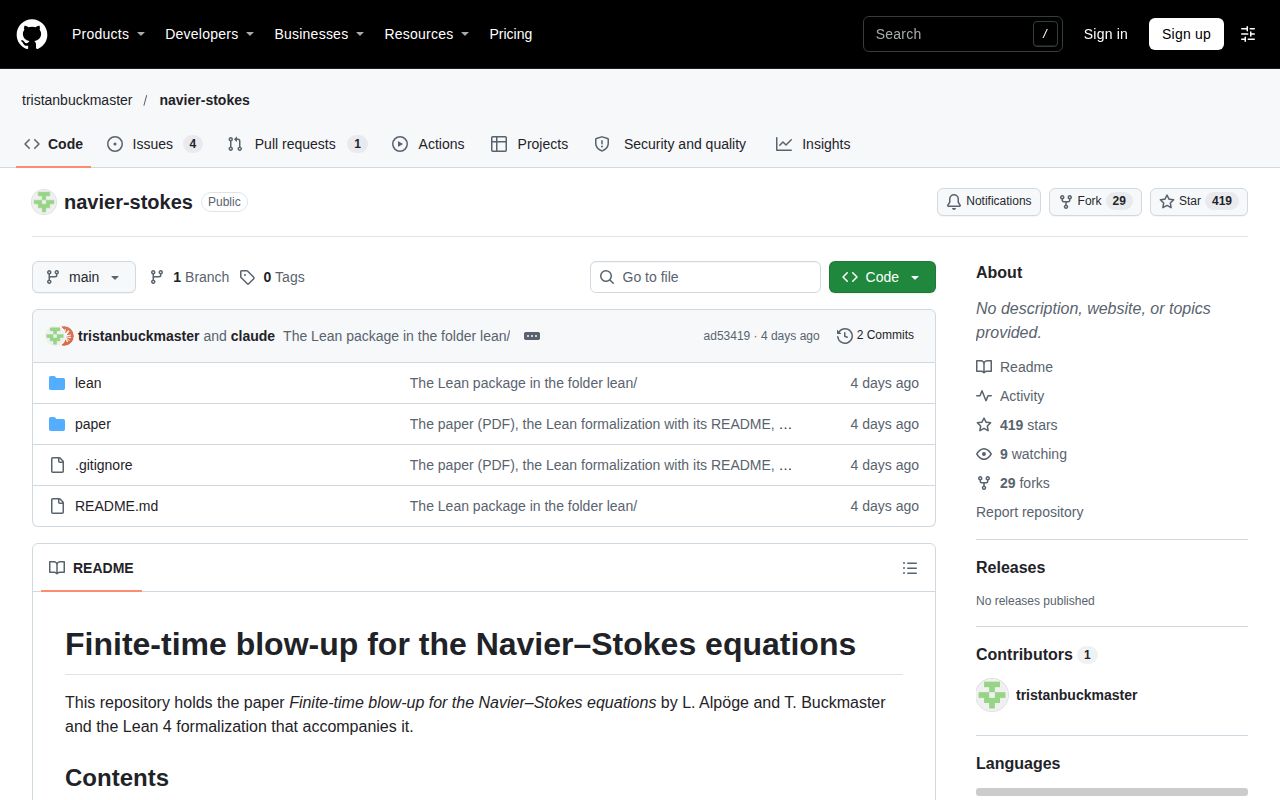
Our November 24, 2026 attempt at commit ad53419 stopped before execution because the harness did not support Lean and the repository had no Dockerfile. We measured a checkout containing 2,285 files and 35.8 MB. The recorded sandbox configuration was 3 CPUs and 8 GB RAM, with image n/a. The detailed deployment record also contains a failed Compose safety step, followed by a successful cleanup entry.
| Question or check | Recorded answer | Verdict | Why |
|---|---|---|---|
| Could the build/test harness execute the project? | NOT RUN: Lean unsupported; no Dockerfile | Stopped before execution | The harness had no supported route for this repository |
| What did the repository measurement record? | 2,285 files; 35.8 MB | Checkout size recorded | These describe repository contents |
| Did the separate deployment safety step pass? | FAILED: no supported Compose filename exists | Deployment attempt stopped | The safety rule required a Compose file |
| What did the generic hands-on run label say? | Deployed with its own Docker Compose; every port bound to 127.0.0.1 | Conflicting record | The detailed safety step reports failure |
| Did teardown complete? | ok | Cleanup reported success | Cleanup has its own recorded outcome |
The detailed safety step reports failure because none of compose.yaml, compose.yml, docker-compose.yaml or docker-compose.yml existed. The message calls the repository unsafe under a rule requiring a Compose file; the stated cause is the missing filename. This identifies the stopping point of that deployment attempt and explains the label through the harness rule that produced it.
The generic run entry describes deployment with the repository's own Docker Compose and every port bound to 127.0.0.1. That description conflicts with the detailed safety failure, so the detailed step determines the reported deployment outcome here. The teardown entry records cleanup as ok. A successful cleanup does not change the earlier failed safety step into a successful deployment.
Where people get stuck: issue #2 reports joins missing from the PDF
Issue #2 reports that Proposition B.1 omits conditions connecting the weights across y₃ = 0, while the Lean statement includes them. A join condition specifies how expressions defined on opposite sides of a plane agree at that plane. The reporter describes weights that satisfy the PDF's separate conditions on each side but have a kink at the plane, and reports that inequality B.20 fails for that example.
The reporter proposes a shared partition in σ, globally C² D and Z, and globally continuous λ and μ. C² requires continuity of the function and its derivatives through second order. The proposed paper corrections in issue #2 therefore connect the separately described weights across the plane. The reporter explicitly says Theorem 1.1 is unaffected because the Lean statement already contains the joins.
| Report | Practical reading aid | Recorded status |
|---|---|---|
| #2: missing joins in Proposition B.1 | Compare global smoothness assumptions with the PDF's separately defined weights | Open; reporter says Lean already has the joins and Theorem 1.1 is unaffected |
| #3: D-term counterexample to B.20 | Follow the derivative jump and resulting surface term | Reporter says Lean excludes this D and requests certificate coefficients |
| #1: paper-to-Lean links | Track individual lemmas alongside the top-level theorem | Open request, with no comments in the captured thread |
| #5: reuse permission | Look for an explicit license before incorporating code | Open request for a LICENSE file |
The issue #3 reporter isolates the D term by setting Z to zero. They report a surface term of order ε and a bulk error of order ε², making the right-hand side of B.20 exceed the left for small ε. Their report then identifies the order-one plane_joins condition that excludes this D in Lean. The distinction is between the printed inequality's stated assumptions and the additional condition in its formal counterpart.
The paper and Lean follow different proof routes
The Lean README says the formalization came first and the paper was subsequently rewritten, replacing some proofs with standard results and simplifying other arguments. Its paper-to-Lean correspondence guide discusses Theorem 1.1, Theorem 7.1, Corollary 7.2 and Appendix B. The authors describe passages between differently expressed statements, so matching theorem names is only the beginning of a comparison.
The guide says the formal certificate result stops at a weak profile, whereas the paper's Theorem 7.1 states a smooth profile with further properties. It describes the weak profile using integrability bounds and an equation interpreted in distributions. It then explains how the library obtains the breakdown conclusions, including a route on three-dimensional space that proceeds directly from a weak profile. These details give a reader identifiable definitions and conclusions to compare.
The author of issue #1 requests links from every paper lemma to its formal counterpart, asking to assess alignment at every step rather than only at the top-level theorem. The captured request is open with no comments. The existing guide discusses major correspondences; the request asks for navigation at the level of individual lemmas. Recording those two levels separately avoids treating an overview as a complete lemma map.
The documented build uses Lean v4.33.1
The README specifies Lean v4.33.1 with Mathlib pinned in lean/lakefile.toml and gives two build commands to run from lean/. It describes the formal library as about 2,270 files and 600,000 lines, with a full build requiring substantial memory and time. Those are the authors' library figures. Our checkout measurement is 2,285 files and 35.8 MB across the repository.
The documented commands, from lean/, are:
lake exe cache get
lake build
The README's package description explains that top-level statement files use sorry in place of proofs, while Solution.lean proves the theorems from lean/Breakdown/. Each comparator*.json pairs a statement file with Solution.lean and names the statements that must agree. The permitted axioms are propext, Quot.sound and Classical.choice. Reading a statement file therefore serves a different purpose from following its proof through Solution.lean and the library.
The README reports a November 20 patch to cell-layer statements and dependent proofs. One bound's weight changed, one cell constant could be zero, and the model's harmonics were restricted to those that do not vanish in the cell. The authors also state that the patched package was not rebuilt when the repository was assembled. That statement describes the package's build history; it does not report a failed build.
The certificate is separate from the formal implication
The project README says the formalization contains no data and places the numerical certificate and its checking computation outside this repository. It describes the computation as rigorous interval arithmetic using 128 bits of precision, with Arb through FLINT. The certificate is the numerical data intended to meet the mathematical conditions. The paper gives its hash, while the README says the data themselves will be released.
The Lean guide's Appendix B explanation describes data of seven kinds satisfying CellSystemCondition, which contains fifteen conditions on finitely many functions and numbers. The formal route proceeds from those conditions to a certificate, then to a weak profile and the breakdown conclusions. This makes the division explicit: one part concerns what follows from the conditions, and another concerns whether particular numerical data satisfy them.
Issue #2 also reports an index-order difference relevant to comparing certificate arrays with the paper. According to the reporter's notation comparison, Lean puts the component first, while the corresponding paper expression puts differentiation direction first. The reporter matches comp K ι a b to the paper's expression with ba indices and flags the same convention for the cell model of the curl-gradient expression.
navier-stokes vs OpenAI's construction and numerical solvers
OpenAI's announcement describes a fluid with a smooth applied force, while the November repository is associated with a claimed unforced blowup proof. OpenAI's account of its construction says the fluid starts at rest and retains finite energy through singularity formation. The mathematical assumptions distinguish those two announcements. Numerical-solver tutorials address a separate task: calculating velocity and pressure for a specified flow problem.
| Route | What it addresses | Choose it when |
|---|---|---|
| Buckmaster and Alpöge's repository | Paper and Lean material associated with the November unforced blowup claim | You want to inspect formal hypotheses and reported PDF discrepancies |
| OpenAI's September construction | Finite-time singularity with a smooth applied force | You want the forced construction for comparison |
| Reading the November PDF alone | The written argument containing the omissions reported in #2 | You want the paper's presentation, with Lean alongside it for hypothesis comparisons |
| FEniCSx / DOLFINx tutorial | Incompressible Navier-Stokes equations for velocity and pressure | You want a numerical flow tutorial |
| MoFEM tutorial | Implementation of a viscous fluid model using hierarchical basis functions | You want a finite-element implementation example |
The FEniCSx tutorial treats incompressible Navier-Stokes equations for velocity and pressure. Its equation explanation identifies stress, dynamic viscosity and acceleration balanced by force per unit volume. The MoFEM tutorial discusses implementing a viscous fluid model using hierarchical basis functions. Its implementation introduction explains how that approach permits increasing approximation order locally while preserving conformity across finite-element boundaries. Those documented tasks make the tutorials relevant alternatives for readers arriving in search of flow computation.
Outdated claims, corrected
Scientific American's November 20 headline presents the problem as solved, while the article describes what Buckmaster and Alpöge claim. Its account of the announcement uses the authors' belief to describe the proposed result. The README also says the numerical certificate is outside the repository and will be released. A summary should therefore call this a claimed unforced blowup proof rather than turn the headline into an unconditional mathematical conclusion.
The September status statements in navier-stokes.org's Euler vs. Navier-Stokes explanation and Exact Navier-Stokes Solutions page predate the November announcement. Their statement that the unforced question remains open concerns the earlier status of the problem. An update should acknowledge the November claim and keep its unforced setting distinct from the September forced construction. The exact-solutions page also distinguishes special symmetric flows from the general regularity question.
The r/mathematics submission describes the November result as a claimed unforced proof. That wording preserves the nature of the announcement without treating the repository's existence as a mathematical verdict. The September and November records concern different assumptions and different releases. Their dates and forcing conditions belong beside any comparison, rather than being compressed into a single statement that the equations have been solved.
FAQ
Buckmaster and Alpöge announced a claimed unforced blowup proof; the repository contains the paper and its accompanying Lean formalization. That answers the central ambiguity behind the question of whether the equations have been solved. The practical questions here concern reading that research release: where the PDF lives, how formal statements relate to the paper, which assumptions issue reporters identify and what permission is recorded for reuse.
Have the Navier-Stokes equations actually been solved, and what does that mean for a non-mathematician?
The November announcement concerns a claimed unforced blowup proof, according to Scientific American's report. A blowup claim concerns whether a fluid solution can lose smoothness under specified mathematical conditions. Computing a particular flow is a different task, illustrated by the FEniCSx tutorial's velocity and pressure equations. This repository gives readers a proposed research argument and formal statements to examine together.
Where can I read a PDF of the Navier-Stokes equations or a proposed solution?
The repository's paper/finite-time-blow-up-navier-stokes.pdf is the 79-page paper dated November 20, 2026, according to the project README. It is the proposed research argument associated with this repository. The Lean correspondence guide discusses its principal theorems and Appendix B. For that appendix, issue #2 identifies a specific comparison between Proposition B.1's printed assumptions and the joins in Lean.
Does a successful Lean check immediately confirm the mathematical claim made in the paper?
The README separates the formal statements from the numerical data and checking computation required by the certificate conditions. The Lean correspondence guide also describes differences between the written paper and the formal presentation. Issue #2 illustrates why that comparison matters: its reporter identifies joins present in Lean but omitted from Proposition B.1's printed conditions. A formal check and a paper-to-formal-statement comparison answer different questions.
Can every lemma and theorem in the PDF link to its formal proof so readers can check semantic alignment?
Issue #1 requests links from every paper lemma to its formal version, and the captured request is open with no comments. The requester wants readers to assess individual steps as well as the top-level theorem. The Lean README already explains major correspondences, so readers have an overview of the principal statements while the issue asks for more detailed navigation.
Which joins across y₃ = 0 does Proposition B.1 require?
The issue #2 reporter proposes a shared partition in σ, globally C² D and Z, and globally continuous λ and μ. Their proposed correction connects the weights on the two sides of the plane. The issue #3 report isolates a derivative jump in D and identifies Lean's order-one plane_joins condition as excluding that example. Both answers come from the issue authors' analyses.
When will the numerical certificate for the November 20 paper be released?
The README says the certificate will be released, and issue #3 asks the authors for a rough date. The requester specifically wants to inspect the join using the upper and lower spline coefficients. That question concerns identifiable numerical data, rather than the formal theorem alone. The README distinguishes those data from the interval-arithmetic computation used to check the Appendix B conditions.
How do the certificate's array indices correspond to the paper's notation?
The issue #2 reporter says Lean puts the component first and matches comp K ι a b to the paper's expression with ba indices. Their index-order comparison also flags the convention for the cell model of the curl-gradient expression. A reading table can record this correspondence beside the relevant expressions, keeping component order separate from differentiation direction when moving between the paper and Lean.
What license permits reuse of this repository?
Issue #5 asks for a LICENSE file to clarify reusability, and the captured request is open with no comments. The November 24 repository metadata records no license. Those records identify an unresolved permission question for readers incorporating code into another project. Public access to the repository is not an explicit license statement, and the review assigns no reuse license to the authors' work.
What we have not tested yet
Our ad53419 attempt executed no Lean installation, build or tests. It supplies no execution timing, peak-memory use, passing-test count or runtime compatibility result; checkout size is not build cost. The image was recorded as n/a, so the sandbox configuration establishes no operating-system or runtime version. Lean v4.33.1 is the README's declared toolchain. The commands above are documented instructions, not commands executed in our run, and we did not rebuild the November 20 patch.
The certificate and its checking computation are outside this repository, and the captured release statements give no certificate release date or completed coefficient-level reproduction. This review does not reproduce the interval-arithmetic computation, independently check the proposed counterexamples, compare every paper lemma with Lean or establish every mathematical passage described in the guide. The issue analyses are reports by their authors; their captured threads do not establish a maintainer-endorsed paper correction or an independently reproduced proof.
The comparisons describe the documented purposes of FEniCSx, MoFEM and OpenAI's construction. They include no execution of those alternatives or comparative correctness result. Support responsiveness, downstream adoption, security behavior and long-term maintenance are also outside the checks described here. The November 20 last-push timestamp and open mapping and licensing requests form a snapshot, not evidence of a support promise or abandonment.