NativeScript trades abstraction for direct native reach
NativeScript lets developers write JavaScript or TypeScript, render native interfaces, and call iOS, Android, or visionOS APIs directly. That differs from shipping a website inside a mobile shell, especially when an app needs platform capabilities a browser bridge cannot expose cleanly. With 2,912 files and about 716,849 lines of source, this is a framework ecosystem rather than a small compatibility layer.
Its history and scope make it credible for long-lived products. The project has 25,638 GitHub stars, an MIT license, and OpenJS Foundation governance. The README points to separate iOS, Android, CLI, documentation, plugin, Firebase, ML Kit, and payments repositories. That breadth also means the core repository cannot reveal every dependency or platform-specific failure a production team may encounter.
What happened when we ran it
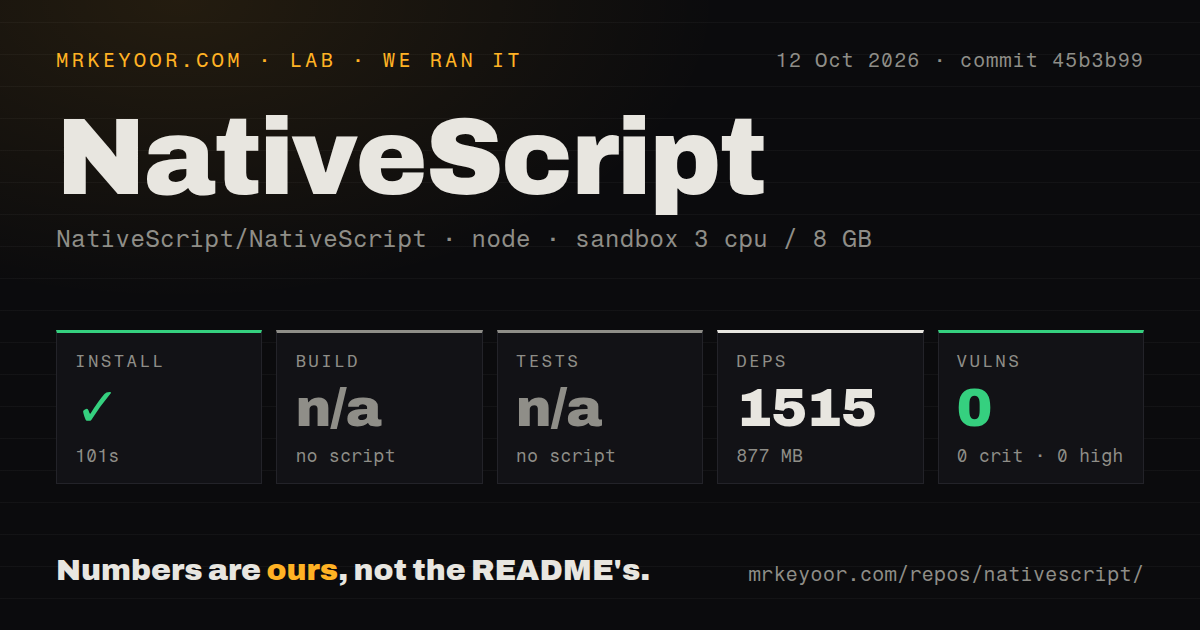
Our run used commit 9a7ae4e in a fresh, unprivileged Debian container with 3 CPUs, 8 GB of RAM, Node 22, and no secrets. Installation succeeded in 91 seconds, installing 1,515 packages and occupying 877 MB. That proves the dependency graph resolved on our box, not that an Android or iOS application compiled.
The repository exposed no build script or target, so the build stage was skipped. It also exposed no test script or target, so tests were skipped. Those are findings, not passes: we cannot report a compiled artifact or passing test count. An npm audit found 0 known vulnerabilities at any severity. We also found 11 CI workflow files, no Dockerfile, and no tests directory.
The contributor path looks less direct than the app quick start. The README tells application developers to install the CLI, run ns create my-app, and use ns run android or ns run ios. Contributors run npm run setup and then npm start to discover commands. For a 118.6 MB checkout, explicit top-level build and test commands would make independent validation easier.
Direct API access is the reason to choose it
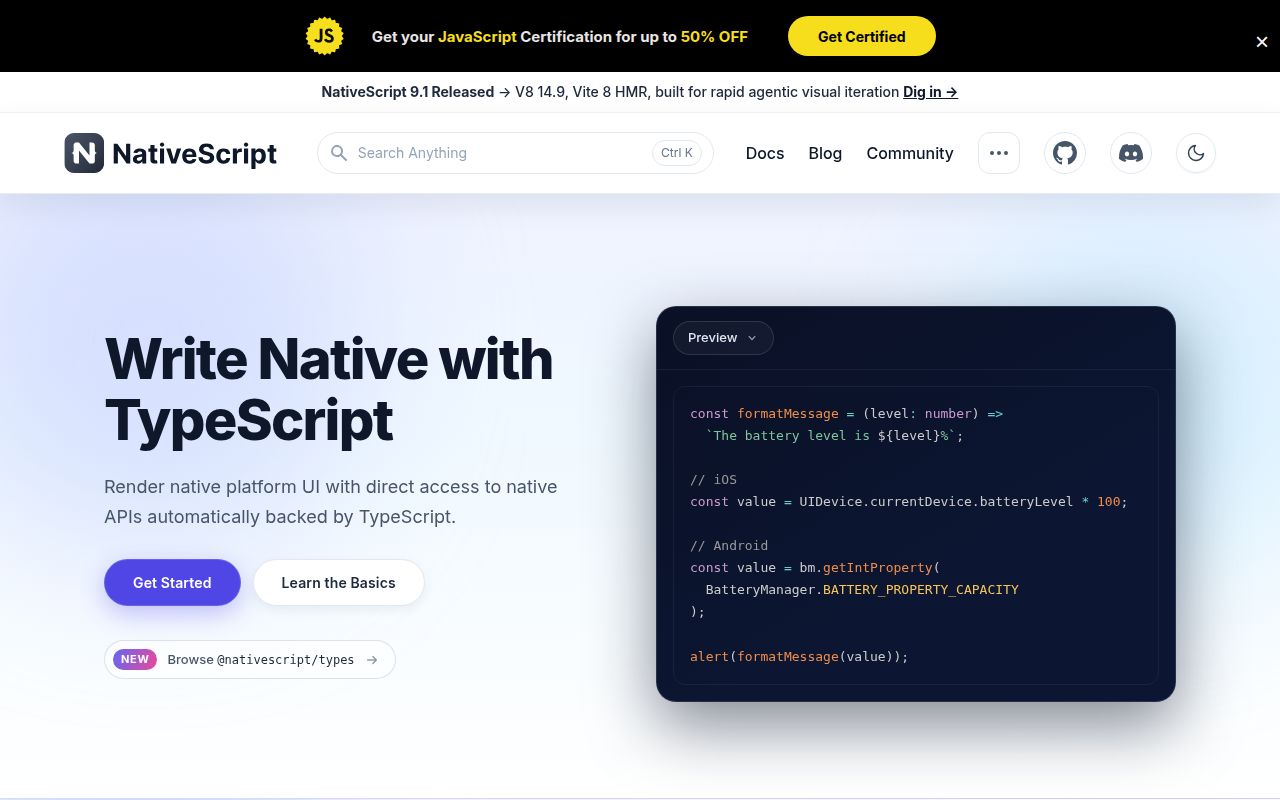
The strongest feature is direct native API access from JavaScript. NativeScript supplies runtimes for 3 targets: iOS, Android, and visionOS. Its core package provides native primitives, while separate type packages cover iOS, Android, and a minimal set designed to reduce editor load. Experienced mobile teams can cross the abstraction boundary when a requirement demands it.
Framework choice is another advantage. The README links starters for JavaScript, TypeScript, Angular, React, Solid, Svelte, Vue, and Vue 3. Teams can retain familiar component patterns while adopting native rendering, and the webpack package supplies build utilities. Android and iOS automation badges, tutorials, setup documentation, Discord, Stack Overflow, and a plugin marketplace provide several support routes.
The surrounding repositories address production needs including Firebase, ML Kit, payments, in-app purchases, subscriptions, Google Pay, and Apple Pay. These are useful signals for teams planning real products. Still, a README link is not a compatibility guarantee: before choosing NativeScript 9.1.1-core, verify that each required plugin, operating-system SDK, and UI integration supports your release versions.
The rough edges are operational, not conceptual
The dependency footprint is the first caution. Pulling 1,515 packages took 91 seconds and 877 MB in our controlled environment. That may be acceptable for a mature mobile framework, but it raises the cost of clean CI workers, updates, and supply-chain review. No Dockerfile is not inherently a mobile-development flaw, but it leaves fewer clues for reproducing repository checks on Linux.
Validation discoverability is the second caution. There are 11 CI workflows, but our generic runner found no direct build or test target and no tests directory. Contributors can follow the documented setup workflow, yet evaluators cannot turn the README into a simple build plus test sequence. Teams with strict release gates should map the CLI, runtime, and app test commands before approval.
Active maintenance offsets the large issue queue
The supplied 9.1.1-core release was published on August 31, 2026, and the repository was pushed on September 5, 2026, one day before our review. Those dates show current work, although one supplied release cannot establish a cadence. The 842 open issues are a substantial queue, though the count alone cannot show response speed or relevance to current versions. Treat it as review work, not automatic disqualification.
Adoption and governance strengthen the case. A 25,638-star repository with OpenJS Foundation governance, contribution instructions, mobile automation, and several support channels has more structure than a single-maintainer experiment. The architecture spans multiple repositories, so check health per runtime and plugin. A fresh core release cannot prove every community package is ready for the same SDK upgrade.
It belongs in the mobile application layer
NativeScript fits as the client framework in a stack, consuming HTTP or realtime services while owning native screens and device integrations. Keep authentication rules and durable data on the server, then use the 3 platform runtimes where device APIs justify them. In CI, cache the Node dependencies and create separate Android and iOS gates because our repository-only run compiled neither target.
Choose it when the team knows JavaScript or TypeScript, needs native API reach, and accepts platform toolchains as part of the job. Choose React Native for a React-centered organization, Flutter for a Dart-led custom UI system, Ionic for browser-first reuse, or .NET MAUI for a C# shop. NativeScript merits a prototype, but first build your hardest native integration on 2 mobile platforms, iOS and Android.