Nacos now registers AI resources beside microservices
Nacos began as naming and configuration infrastructure. Services register instances, clients discover healthy endpoints, and operators change configuration without rebuilding each application. It also provides dynamic DNS, weighted routing, service metadata, and a management console. The 3.x codebase adds modules and controllers for MCP servers, A2A agents, agent specifications, prompts, skills, and an AI resource registry.
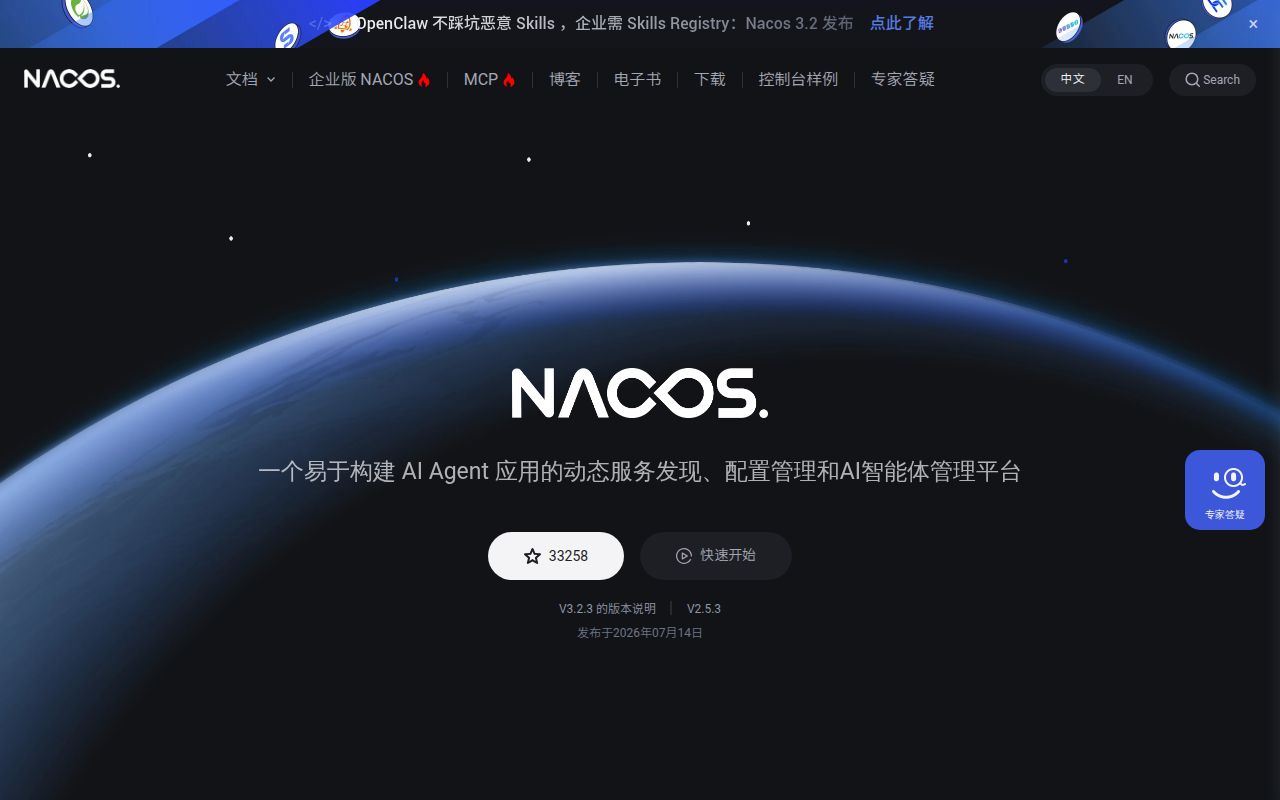
This combined role makes sense inside a platform already using Nacos. An MCP endpoint is still a service with versions, metadata, health, access rules, and lifecycle changes. Release 3.2.3 improved nested skill-package uploads, preserved nested SKILL.md resources, refined AI version diffs, and fixed cases where deleting a registry version broke A2A or MCP queries. It also repaired query parameters and transport protocols that were lost when MCP endpoints were published.
The quick start hides a large stateful control plane
The README downloads a binary package and starts standalone mode with startup.sh -m standalone or the Windows command file. Its example still uses nacos-server-1.0.0.zip, though the current release is 3.2.3. The release notes supply a more useful compatibility fact: server and console require Java 17, while the standard and maintainer clients require Java 8.
Standalone mode is suitable for learning the console and APIs. Production means choosing database storage, cluster members, namespaces, credentials, network exposure, and client rollout behavior. Configuration and discovery sit on the startup path of every dependent service, so backup and upgrade mistakes spread widely. Teams should test losing a node, restarting pods, rotating credentials, restoring state, and serving clients during a rolling upgrade.
What happened when we ran it
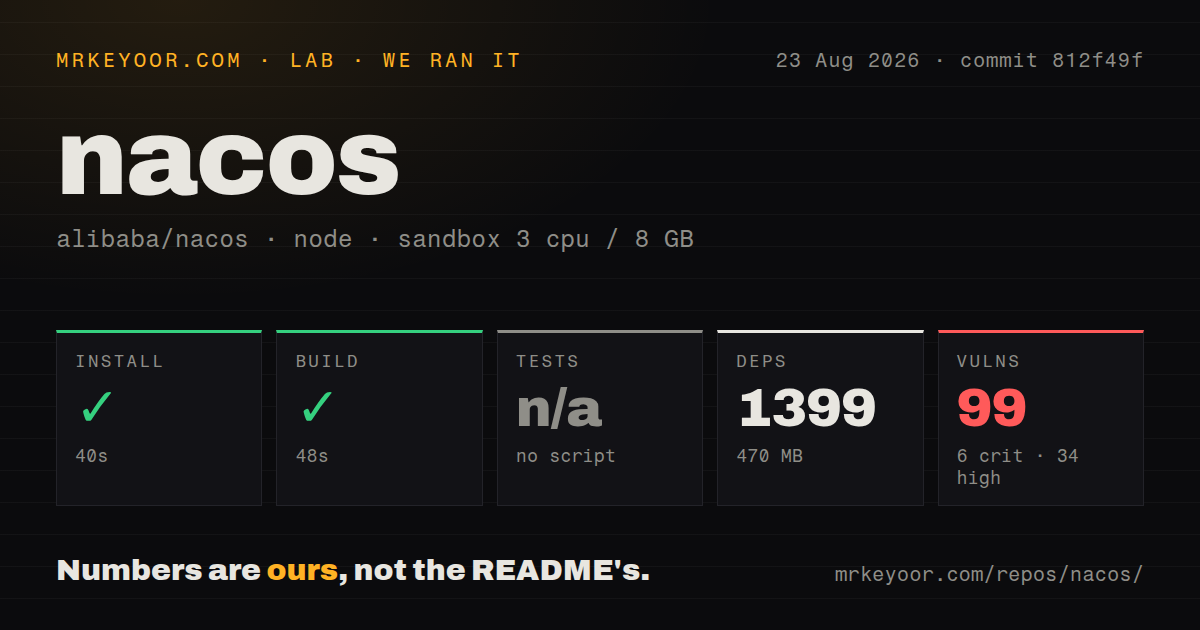
Our sandbox targeted the npm application under ./console-ui/. Installing 1,399 packages took 40 seconds and consumed 470 MB. The build then succeeded in 48 seconds. The entire checkout at commit 812f49f was 95.8 MB, with 6,491 files and about 827,424 source lines. These figures describe a large repository and a heavy frontend dependency graph, even before the Java server is considered.
There was no test script or target in the measured npm project, so our tests were skipped. The repository did contain a tests directory and 10 CI workflow files, but the harness could not invoke those through the console package. npm audit reported 99 known vulnerabilities: 6 critical, 34 high, 51 moderate, and 8 low. The supplied measurement does not identify affected packages, so we cannot say which console paths are exploitable.
Our 48-second success only establishes that console-ui built in a fresh Node 22 Debian container. We did not start the Java 17 server, connect a database, form a cluster, register services, publish configuration, or exercise MCP and A2A operations. Passing the frontend build does not validate persistence or client compatibility, and the missing npm test target leaves the measured UI without an executed suite.
The 99 audit findings need named owners
Ninety-nine audit findings are too many to wave through, particularly the 40 rated critical or high. Some may sit in build tooling or have no reachable path in the shipped static assets; the measurement does not answer that. Produce the dependency paths, determine what ships, update or replace reachable packages, and document any accepted exception. A successful build says only that bundling worked.
AI registry value depends on using the older core
The AI features are management features, not a model runtime. Nacos does not replace an MCP server, an agent, or a language model. It stores and exposes their descriptions and endpoints, applies lifecycle operations, and brings them into the console. That can reduce duplicated registries when a company already trusts Nacos namespaces, discovery, and configuration. For a team with 3 MCP servers and no existing Nacos cluster, the control plane may be larger than the problem.
A current issue asks whether the console copilot can use a local model or an OpenAI-compatible endpoint instead of only Alibaba's Bailian key. Another active report concerns an SSE HTTP-to-MCP server remaining unhealthy in a 3.2.2 cluster. The 3.2.3 release fixes several adjacent MCP publishing problems, but it does not claim to resolve every registry or console issue.
August activity is high, while the README needs upkeep
The repository was pushed on August 26, 2026, and release 3.2.3 arrived July 14. GitHub reports 183 open issues and pull requests combined; a search excluding pull requests found 169 open issues. Recent discussions span Java clients, MCP health, skill metrics, IPv6 validation, dependencies, and Kubernetes membership. That combination shows active users and regular triage.
The Nacos website covers standalone operation, Kubernetes, Spring Cloud, and Dubbo. The English README is weaker as a versioned quick start because its package example is from 1.0.0. New adopters should use the 3.2.3 requirements and current website, then pin server and client versions in an upgrade plan.
Adopt the AI layer only with a platform owner
Consul is the closer alternative for service discovery with a service-network emphasis. etcd provides a smaller coordination substrate, leaving the application to build its own configuration and registry experience. ZooKeeper suits systems already designed around its coordination model. None is a direct replacement for Nacos's combination of console, dynamic configuration, naming, and newer AI resource types.
Our measurements favor a conditional recommendation. The console built, the repository is current, and release work covers real AI registry failure modes. The 99 npm findings and absent console test target need resolution before exposing that UI. Choose Nacos when a platform team will own it and the same organization benefits from both service management and MCP or agent metadata. Otherwise, use a smaller registry and avoid adding a central dependency.