A control room for terminals you already use
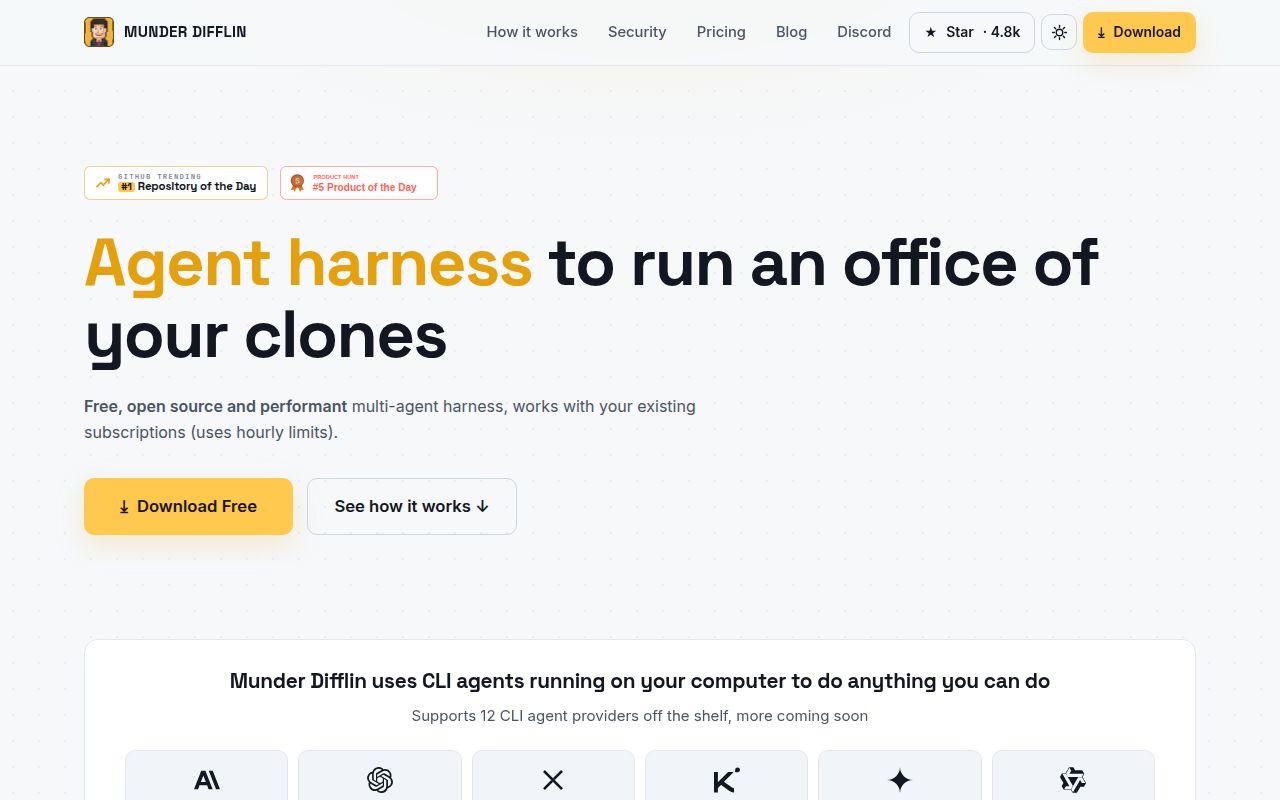
Munder Difflin does not invent another coding model. It wraps agent command-line tools already installed on your computer, including Claude Code, Codex, Copilot CLI, Antigravity, Grok, Kimi, Qwen, OpenCode, Crush, and pi. Every worker is a real process in a pseudo-terminal. The Electron app renders those sessions as characters in a small office, while an orchestrator called Michael accepts the main request and routes work across the floor.
The joke would wear thin if the office were only animation. Underneath it is a serious attempt to solve multi-agent coordination. Each worker gets an identity, working directory, mailbox, memory, and optional git worktree. A shared hive stores tasks, a blackboard, an append-only log, and messages as local files. The app exposes live terminals, agent state, tasks, costs, git history, branch comparisons, and a Monaco editor.
That visibility is the project's best idea. With several coding agents active, the difficult questions are mundane: who owns which branch, which terminal is waiting, whether a message arrived, where a result lives, and what the group has spent. Munder Difflin gives those questions one home.
Coordination is designed, not merely claimed
Agents do not all write to one git index. The hive uses a single committer for its coordination repository, while optional worktrees isolate code changes. Workers write outgoing messages to their own directories, and the router moves them into recipients' inboxes. This file-based design is easier to inspect than a hidden orchestration database.
The terminal delivery rules show similar care. Automatic writers share one queue, which waits for an agent to be idle and tries to detect whether the human has a draft or picker open. Messages are acknowledged only after the text and submit writes succeed. The documentation also describes the imperfection: prompt state is inferred from keystrokes and the rendered terminal, and after a long expiry a queued message can join text still sitting at the prompt.
Human gates cover spending, destructive operations, and scope changes. A circuit breaker can steer, constrain, or stop an agent that appears to loop or burn its budget. This machinery has evolved through reported failures. A closed issue documented twelve false circuit-breaker alarms during idle and compaction activity, and release 0.3.9 removed a usage-limit guard that could hold agents indefinitely. Test the controls rather than treating their labels as guarantees.
Local-first does not mean fully isolated
The security policy says the app spawns local processes and accesses registered directories. Renderer code lacks direct Node access, filesystem and git calls are path-validated in the main process, and the local hive uses a Unix socket rather than a public listener. Those are sensible Electron boundaries. They do not turn the coding agents into sandboxed programs. A permitted agent CLI can still act inside its working directory with the skills and MCP servers you grant it.
Use a clean worktree, limit credentials, review imported hires, and begin with narrow permissions. The app includes a write-only secret broker and asks for approval around critical actions, but an autonomous local process remains powerful. Slack and webhook triggers increase the need to define who can start work and which repositories can be touched.
What happened when we ran it
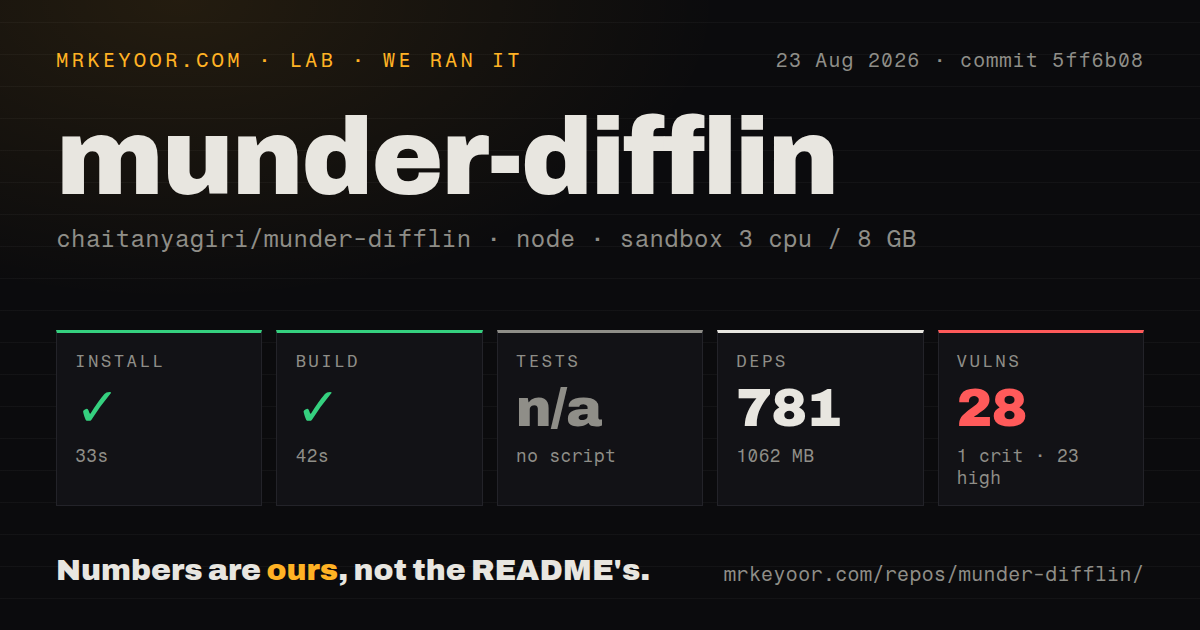
Our run at commit 5ff6b08 installed 781 npm packages in 33 seconds and used 1,062 MB on disk. The build succeeded in 42 seconds. The repository supplied no test script or target, so we skipped tests even though the checkout contained a tests directory. Npm audit reported 28 known vulnerabilities: 1 critical, 23 high, 4 moderate, and 0 low.
The unprivileged Debian container had 3 CPUs, 8 GB of RAM, Node.js 22, and no secrets. The 89.4 MB checkout contained 1,785 files and about 79,240 source lines. Our scan found 6 CI workflow files and no Dockerfile. A passing build is useful, but the missing test target and audit result make the source path a review-and-remediate job before it deserves access to valuable repositories.
Packaged apps still depend on external coding CLIs
Builds exist for macOS, Windows, and x86 Linux. The macOS release is signed and notarized, while Windows is unsigned and can trigger SmartScreen. Linux users must mark the AppImage executable. The app then needs at least 1 supported agent CLI, its subscription or API credentials, and access to a chosen directory. Voice control adds an OpenAI Realtime key; local engines can use Ollama, LM Studio, or vLLM.
Source setup requires Node.js 18+, npm, and a C/C++ toolchain because node-pty has a native addon. Windows users with code and CLI state inside WSL2 should read issue 146 first: it describes unresolved boundaries around paths, commands, settings, and hive sockets. The app executes real local processes, so a disposable repository and narrow credentials are sensible for initial testing.
Version 0.4.5 repaired three trusted paths
GitHub showed 4,821 stars, 129 combined issues and pull requests, and a last push on August 26, 2026. Release v0.4.5 shipped on August 22 with 23 community pull requests. Its notes say lifetime cost was previously under-reported after app restarts, semantic memory returned invalid vectors on Apple Silicon, and agents could leave mail in an inbox without waking the recipient. Those fixes improve core paths while confirming how young those paths are.
The security policy still supports only main and calls the app an early prototype. Code uses the MIT license. Bundled LimeZu pixel art has a separate Complete Version license that permits commercial and non-commercial use but requires credit to remain. That current rule replaces the older non-commercial restriction, so redistributors need attribution rather than asset removal.
Munder Difflin makes several terminals easier to supervise, and its file-based coordination remains inspectable. The 1,062 MB dependency footprint, 28 audit findings, and lack of a test target are reasons to keep that supervision close. Use it on backed-up work while it earns authority through repeated, recoverable runs.