More than 5,300 links solve discovery, not trust
The README claims more than 5,300 skills, and the repository spreads its catalog across 30 files by category. You can browse Git and GitHub, browser automation, documents, smart homes, marketing, security, and many other jobs without relying on registry search. Each row gives a name, destination, and short description. For an OpenClaw user who knows the task but not the package name, that is genuinely useful.
Size also weakens the meaning of "curated." Coding Agents and IDEs alone lists 1,184 entries in the table of contents, while Web and Frontend Development lists 920. Those are catalogs inside a catalog, not a handpicked shortlist. The visible counters disagree too: the introduction says 5,300+, the badge says 5,200, and the current GitHub description says more than 5,400 records. Fast growth can explain the drift, but the headline remains an estimate rather than an inventory you can reconcile.
The filters removed 7,215 registry entries
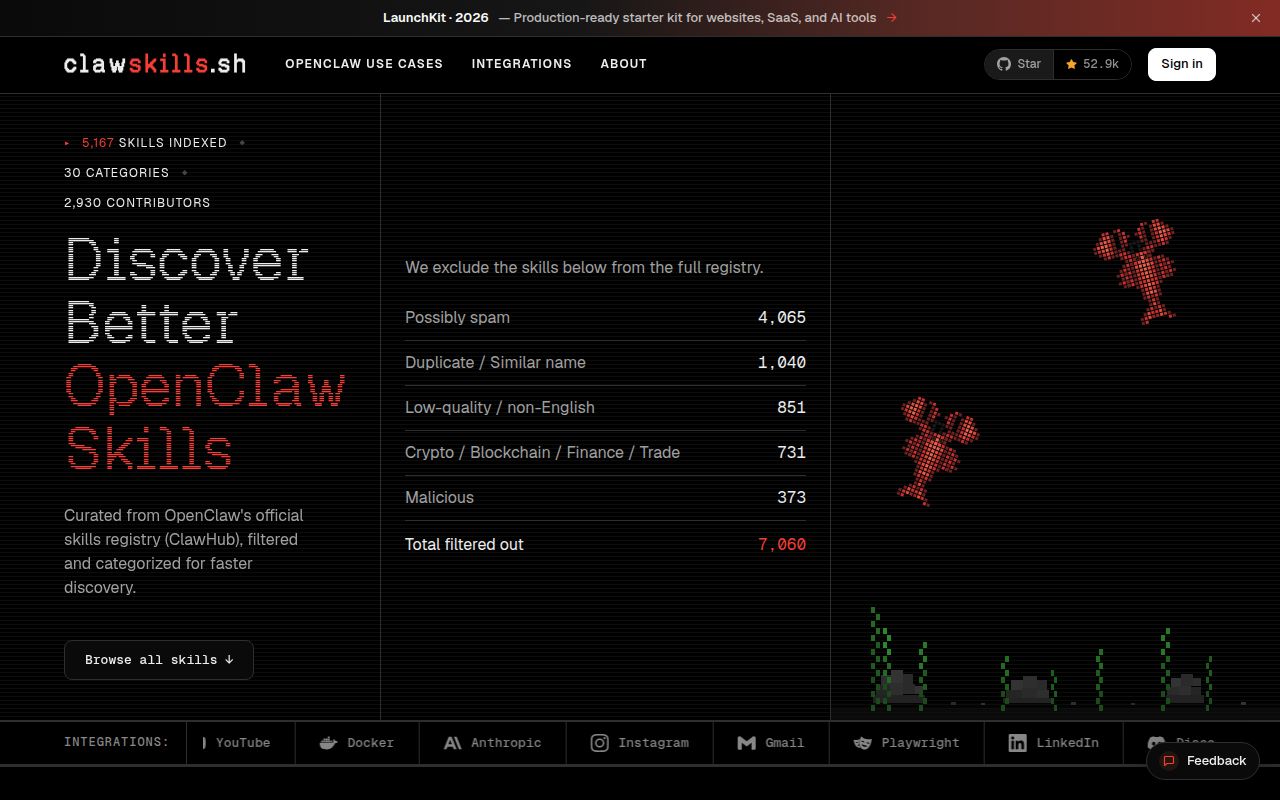
The README's filter table accounts for 7,215 records omitted from the official registry. It lists 4,065 possible spam entries, 1,040 duplicates or near-duplicates, 851 low-quality or non-English descriptions, 886 crypto or finance entries, and 373 entries identified as malicious by published security research. The list therefore does more than mirror ClawHub, especially if you want to avoid obvious junk and repeated names.
CONTRIBUTING.md adds another gate. A submitted skill must already exist on ClawHub, have passing registry tests, carry a clean security status, include a SKILL.md, and show real community use. Descriptions are capped at 10 words. External repositories and gists are rejected. These rules make contributions easier to review, but the repository does not publish a per-entry review record, the date of its last check, or a pinned source revision beside each link.
What happened when we ran it
We did not run commit bcbe1f5 because the repository has no supported language ecosystem and no Dockerfile. Its tree has 35 files, including Markdown, a local Claude setting, and 1 GitHub Actions workflow, rather than an application or package for the sandbox to install. There are no lab timings, dependency counts, test results, or vulnerability-audit numbers for this repo. Inventing them would turn a clear content-only result into a fake software benchmark.
The install commands in the README apply to linked skills, not to this repository. OpenClaw can install a skill by slug, while npx clawhub install handles a registry-managed folder. Manual users copy a folder into ~/.openclaw/skills/ or a workspace skills/ directory, with the workspace copy taking priority. That priority matters during review: the skill your agent loads may not be the global copy you previously inspected.
Curated does not mean audited
The security notice uses the right words: skills in the list are curated, not audited. It warns that a maintainer can update, modify, or replace a skill after the link is accepted. It also names prompt injection, tool poisoning, hidden malware payloads, and unsafe data handling as risks. The recommended check is to inspect the current source and the VirusTotal report on the ClawHub page before use. A clean catalog entry is only the start of that work.
The distinction matters because skills can connect services, read files, run commands, and handle credentials. A 10-word description cannot show shell scripts, requested scopes, outbound hosts, or how secrets are stored. Review the exact revision you plan to install, then test it with the smallest permissions and a disposable account where possible. Recheck after updates. If your organization needs an allowlist, record hashes and approval dates outside this repository instead of pointing at the list.
Sponsored blocks sit above the 30 categories
The README places 5 sponsored product groups before or among the directory sections: crawling, search, security auditing, social publishing, and starter kits. The blocks are visually distinct and several links carry campaign parameters, so the commercial relationship is not hard to spot. Still, readers should not mistake placement for the same submission process used by the 5,300-plus skill links. The page mixes a community index with paid discovery, and procurement should evaluate those two lanes separately.
One benefit of the plain Markdown format is that there is little machinery to fail. The tree includes 30 category files and no generated app that must stay online. The downside is duplication and drift between the main README, category files, ClawHub, and the separate clawskills.sh listings. Open issue 576, for example, asks for a stale image-hosting page on clawskills.sh to be refreshed. Link maintenance is the product here.
September 28 activity shows active list maintenance
GitHub showed 52,854 stars, a September 28, 2026 push, and 2 open issues and pull requests when checked. The split was 1 issue and 1 pull request. Four additions were merged on September 28, including skills for short-video creation, social uploads, an agent community, and email. The releases endpoint returned no latest release, which is unsurprising for a link collection updated through pull requests.
This is a good first tab when you know you need an OpenClaw skill and want names to investigate. It is a poor final approval step. The repository's own warnings support that judgment, and its scale makes individual inspection unavoidable. Take the link, open the current source, map every permission and external service, then decide. The list has done its job once it gets you to that review, not once an install command succeeds.