Start with an official model you can actually use
Pick a model in official/ before you clone TensorFlow Model Garden. The repository collects TensorFlow implementations for jobs such as image classification and language understanding, but its folders carry different support promises. The root README assigns the official collection to TensorFlow maintainers and research implementations to their researchers. If you need a training recipe your team can own, that distinction should decide which directory you follow.
The size reinforces the need to choose narrowly: our checkout contained 4,061 files and roughly 663,959 lines of source in 107.8 MB. You get considerable material to study, including the separate Orbit library for custom training loops. You also inherit a lot of code unrelated to your immediate task. An engineer adapting a documented classifier has a clearer starting point than someone browsing the entire tree for a generic AI feature.
The official libraries include reusable layers and checkpoints
The official model catalog names ResNet, EfficientNet, and Vision Transformer for classification, along with RetinaNet and Mask R-CNN for detection or segmentation. That gives a TensorFlow team recognizable starting architectures and links to their implementations. A segmentation model assigns categories to image regions, while a detector identifies objects. Choose the output your application needs before comparing model names.
For language work, the NLP guide separates tokenization and input preparation from reusable layers, encoder networks, and trainable models. You can adapt those components rather than copy a whole paper implementation. Our 141-package installation reflects the cost of adopting the broader environment. That is defensible for someone extending a TensorFlow training stack, but hard to justify solely to inspect a pretrained encoder's output.
What happened when we ran it
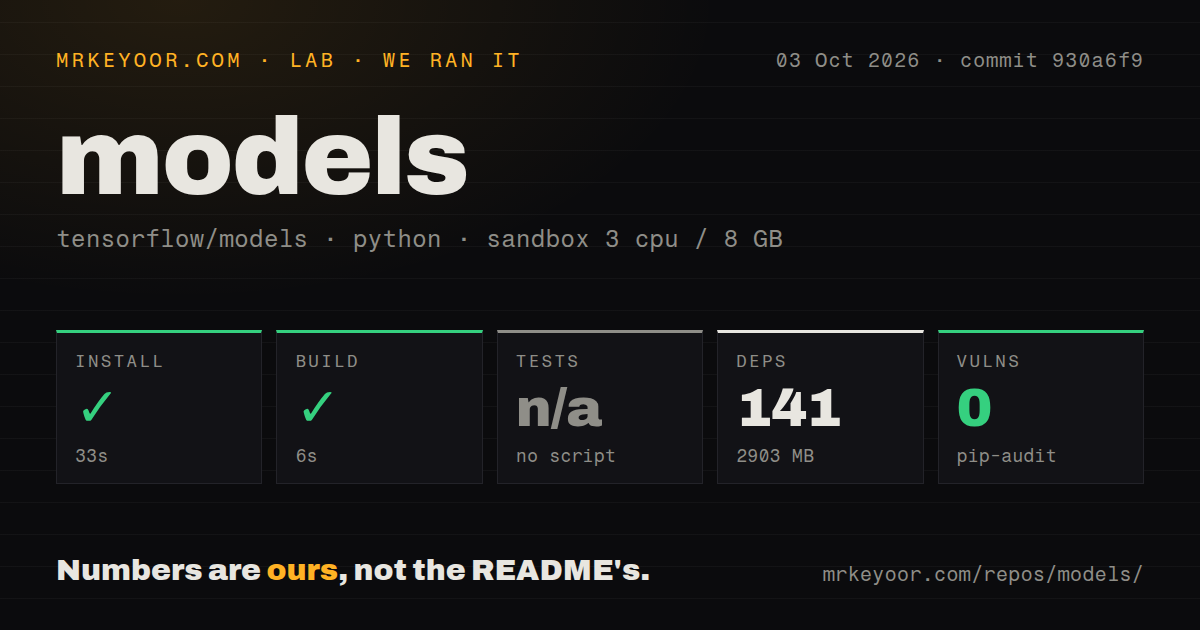
Our run installed commit 930a6f9 in 33 seconds and built it in 6 seconds on October 3, 2026. Installation added 141 packages and occupied 2,903 MB on disk. We ran the project in official/ using the ghcr.io/astral-sh/uv:python3.12-bookworm image, with 3 CPUs and 8 GB of RAM. The container was unprivileged and held no secrets. Both measured steps succeeded.
Pip-audit reported 0 known vulnerabilities. The lab skipped tests because it found no tests script or target, and its scan reported 2 CI workflow files, no Dockerfile, and no tests directory. Those discovery results do not establish that the repository contains no test files elsewhere. They establish that this run produced no test result. Nothing in these measurements demonstrates training throughput, checkpoint accuracy, or successful deployment of a particular model.
Stable packages and master require different version choices
Release v2.20.0 targets TensorFlow 2.20.0, according to its release notes. The official README says stable Model Garden versions match their target TensorFlow releases. It also distinguishes the stable package from nightly code. Pin that relationship when adopting an example: a tutorial on the master branch can depend on changes absent from the stable package you selected.
The successful 6-second build doesn't settle those compatibility choices for another environment. The root instructions give a package route and a source route that adds the repository to PYTHONPATH, then reads official/requirements.txt. NLP users receive an additional TensorFlow Text instruction. Meanwhile, the official guide still contains older Python guidance. Treat that prose as a reason to check your chosen release's requirements, rather than a promise that every listed interpreter supports current code.
Dataset terms can rule out a commercial deployment
The vision guide explicitly warns that some linked datasets restrict commercial use. It licenses checkpoints under Apache 2.0 while directing readers to the separate dataset terms. A permissive code license therefore doesn't answer every question about the example you want to ship. For a commercial image product, trace the chosen checkpoint and training data before building your application around them.
Our 2,903 MB environment also leaves the operational job unfinished. Model-specific documentation links configurations and checkpoint downloads, while training needs data paths and an appropriate compute setup. There is no shared hosted-service credential required by the root quick start. Private data storage or cloud training introduces its own access configuration. Choose the actual model, retrieve its documented assets, and verify an output on your data before estimating production hardware.
MoViNet has an unresolved checkpoint report
Open MoViNet issue 13566 reports that the published Kinetics-400 and Kinetics-600 checkpoint files were identical. The reporter links official/projects/movinet, supplies file comparisons, and describes a class-count mismatch when loading the purported Kinetics-400 weights. This concerns a current official project, not an unrelated historical detector. It is a user report, and the lab measurements do not verify the allegation.
A 33-second successful install would not catch a mislabeled checkpoint. If MoViNet is your reason for choosing Model Garden, compare the exact download against the expected classifier shape before committing to it. The report remained open after a September 24 update. Someone who needs an unattended checkpoint-to-production path has a concrete reason to choose another implementation, or to budget an independent asset check before adoption.
Recent activity makes the old release date less concerning
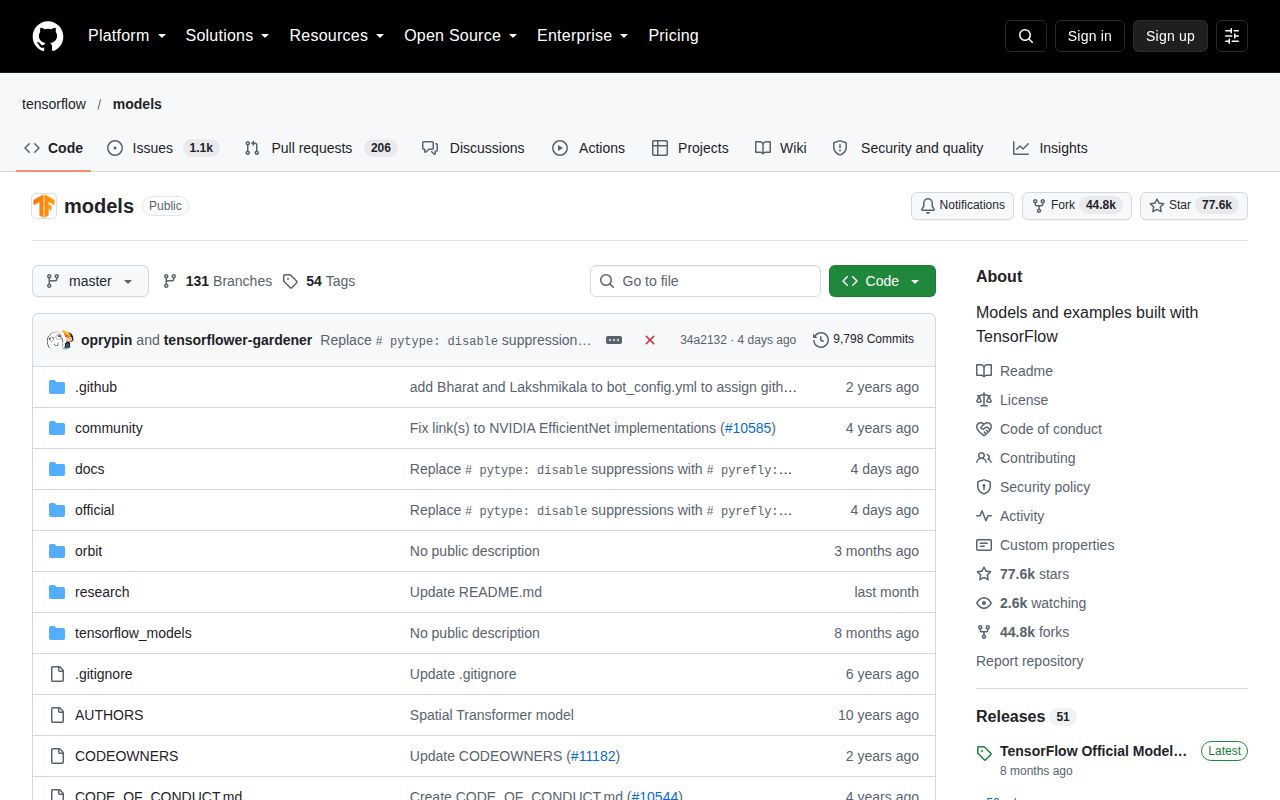
GitHub reports a last push on October 7, 2026, with 1,271 open issues and PRs combined. Recent activity includes an October pull request repairing legacy documentation links and another proposing an Orbit loop fix. The latest release dates to February, but those newer repository events show continuing work. They also show why maintenance activity and a guarantee that every example works are different claims.
Choose Model Garden when an official TensorFlow implementation matches your task and you can maintain its data and version choices. For a PyTorch vision stack, TorchVision is a closer fit. For a language-model project already using Hugging Face, Transformers avoids adopting this TensorFlow environment. The 141 packages we measured are worth accepting for a recipe you'll extend. Choose that recipe and its checkpoint before accepting the whole repository.