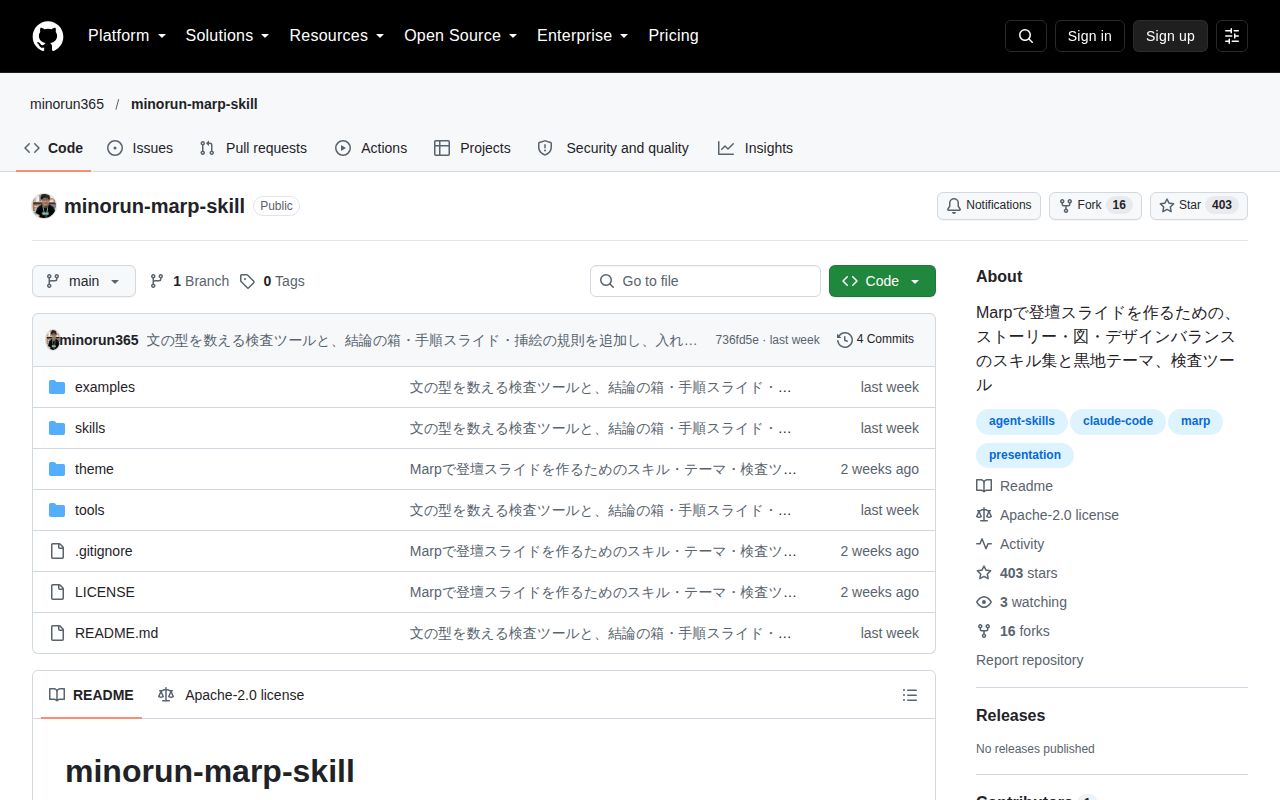
Three skills separate story, figures, and dark-theme design
minorun-marp-skill gives Claude Code three instruction sets instead of one large presentation prompt. slide-story covers openings, section transitions, pacing, headline voice, and endings. slide-figures deals with diagram density, SVG construction, minimum text sizes, and illustrations. slide-design-dark defines the black theme's spacing, colors, tables, code blocks, and export checks. The README and all three skills are Japanese; no English documentation appears in the repository tree.
The story skill has a useful bias: start with the event's published promise and the speaker's real material, then settle the talk's structure before styling slides. It discourages agenda-first decks, repeated three-card layouts, and summaries that reveal every answer too early. Those are opinions, not universal presentation laws. They make sense for a spoken conference session where suspense and the speaker's experience matter more than a handout's completeness.
Six scripts check rendered output and repeated writing patterns
The tools directory contains six checkers. Three read exported PDFs for dark-theme margins, gaps between figures and text, and undersized or cramped text. One opens SVG files in headless Chrome and measures whether text stays inside boxes with at least 14 pixels of space. Another compares reused slides, while check-ai-smell.py scans changed slides for repeated sentence shapes and stock phrasing. Each failed check exits with a nonzero status.
Rendered inspection is the right level for several of these problems. A source file cannot tell you the final width of text in a chosen font, and PDF coordinates reveal whether a box sits against the bottom edge. The dark-margin checker rasterizes pages near a 1280 by 720 reference size and defaults to 60-pixel bottom and right margins. These thresholds encode one author's preferred theme, so a different aspect ratio or visual system may need adjusted limits.
What happened when we ran it
We did not run commit 736fd5e because the lab found no supported ecosystem for this Python-classified repository, and it has no Dockerfile. No sandbox image was selected. There are therefore no measured install, build, test, package-count, disk-use, or vulnerability results for this review. Treat every setup claim below as documentation we inspected, not behavior our lab confirmed.
The repository does provide a finished sample deck and a deliberately broken example meant to trigger its inspection rules. Those are useful reading material, but they do not replace an executed result on our side. We cannot say whether all six scripts agree with the sample, whether their external commands resolve on Debian, or how long a full PDF and SVG pass takes. The absence of measurements is the finding here.
The workflow spans six external tools before a deck is checked
The documented environment includes Marp CLI, Google Chrome, poppler, MuPDF tools, Python 3, and Pillow. Claude Code copies the three skill directories into its user skills folder, while each slide project receives the theme and tools. The sample illustrations are fetched separately because their copyright sits outside the repository's Apache-2.0 license. Zen Maru Gothic is preferred, with a macOS fallback mentioned for machines that lack it.
The JavaScript SVG checker adds a fragile connection between runtimes. It looks for puppeteer-core inside the globally installed Marp CLI and launches a platform-specific Chrome path. Custom layouts need MARP_NODE_MODULES and CHROME_PATH. The PDF scripts also call command-line programs supplied by poppler or MuPDF. None of that is unreasonable for presentation production, but it is more than copying a skill file and opening Claude Code.
Japanese rules make the skill precise and hard to transplant
The documentation uses examples, sentence endings, punctuation habits, and font choices tied to Japanese talks. check-ai-smell.py looks for Japanese constructions, repeated conditional forms, dramatic phrasing, and heading punctuation. That specificity is a strength for its intended author. An English deck may receive little value from those language checks even when the margin and SVG tools remain useful.
Adaptation also means deciding which editorial rules belong to your speaker. The story skill advises against an opening agenda and a final summary, prefers questions as section dividers, and suggests progressive disclosure across several slides. A training course, investor update, or reference deck may need the opposite. Treat the repository as a documented house style with tools, not as a neutral theory of presentations.
Four commits and zero issues leave support unproven
GitHub showed 403 stars and 0 open issues or pull requests on October 7, 2026. The repository was created on September 20, last pushed on September 28, and had 4 commits in the API history we inspected. There is no tagged release. Those dates show recent authorship, while the empty issue history gives no evidence yet about response time or compatibility fixes across operating systems.
Apache-2.0 covers the repository, except for third-party illustrations shown in the sample preview. The combination of three detailed skills, six focused checkers, a sample deck, and an intentionally broken deck makes this more substantial than a prompt pasted into a README. Its limits are just as concrete: Japanese-only guidance, one visual theme, several system dependencies, no release history, and no lab execution. Use the parts that match your speaking style rather than installing the whole method by default.