Reading a file trains the model rather than indexing a document
Point mini-AGI at a notes directory and you're choosing material for training. The model reads bytes, adjusts its weights, and can retain those changes when you use --save. That makes it interesting for someone studying how a language model acquires new knowledge without a separate fine-tuning stage. It also changes what you should expect from the output. Learning from a document does not give you a cited answer or a reliable lookup of its contents.
The repository is compact enough to inspect: our checkout contained 58 files and roughly 13,549 source lines. Its unusual machinery moves pieces of the model between disk, system memory, and the GPU, then grows or prunes capacity as training proceeds. You can follow that design in the paging and training modules. The useful reason to try mini-AGI is to investigate those mechanisms yourself. The README explicitly describes the current model as toy-level.
What happened when we ran it
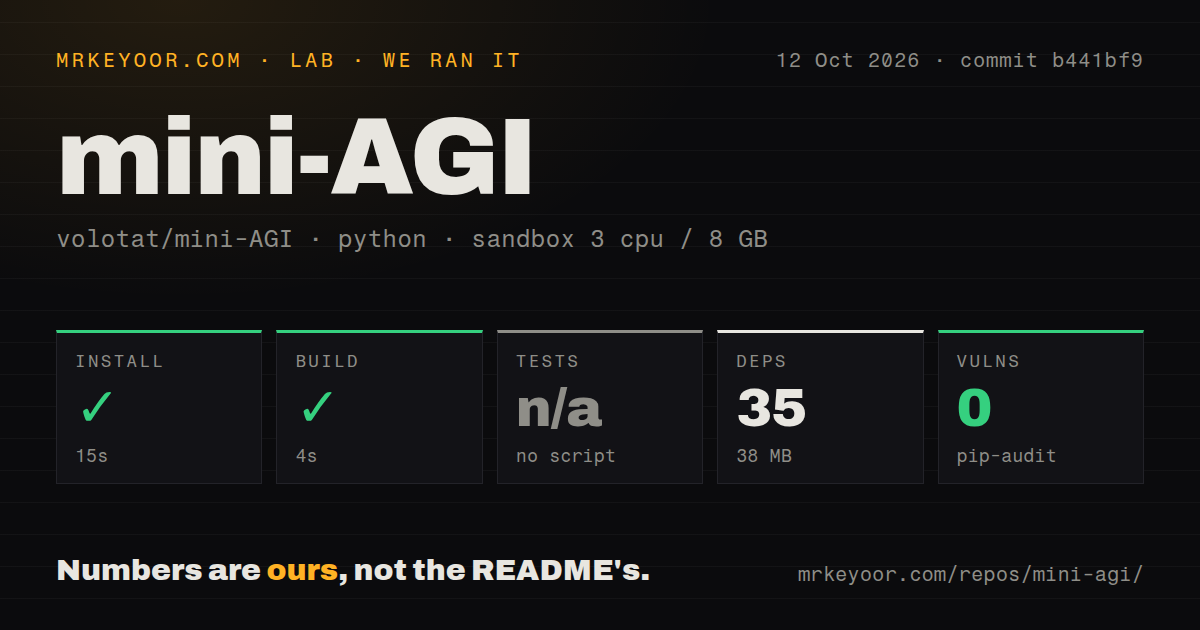
Our run installed mini-AGI commit b441bf9 in 15 seconds, adding 35 packages and occupying 38 MB on disk. The build succeeded in 4 seconds. We ran it on October 12, 2026, in an unprivileged Debian container with 3 CPUs, 8 GB of RAM, no secrets, and the Python 3.12 uv image. Pip-audit reported 0 known vulnerabilities. The supplied results show a successful repository setup, without a failed step to explain.
Tests were skipped because there was no test script or target. Our scan also found 0 CI workflow files, no Dockerfile, and no tests directory. The checkout occupied 20.1 MB before installation. A successful build is useful evidence, but this run supplies no automated regression result and no measured training or generation performance. In particular, the container's 8 GB of system RAM is not evidence that the model ran on a GPU with that much video memory.
Useful training needs data and hardware beyond the package setup
The running instructions require Python and a PyTorch build appropriate for your hardware. NVIDIA uses CUDA, AMD needs ROCm, and CPU execution is documented too. Corpora can come from the bundled builders or your own files. No hosted language-model API credential is required for the documented local path. You still need disk space for data and weights, and a machine you can leave training while inspecting its progress.
The measured 38 MB installation footprint excludes any claim about a trained model's size or a downloaded corpus. The README says final weights are unavailable and points to an undertrained snapshot instead. Starting from scratch is therefore a reasonable reading of the quick start, with a different payoff from downloading an established chat model. If you need useful answers today, the small setup result should not persuade you that training and evaluation will be equally easy.
Serving learns by default, while file reads require an explicit save
The server source at the measured commit exposes --no-learn, which opens weights read-only and prevents writeback. Without that option, the live conversation feeds learning. File ingestion has a different default: the README says a read leaves the weights directory untouched unless you pass --save. Know which mode you're using before comparing replies. Otherwise, a conversation intended to inspect a checkpoint can change the object you're trying to inspect.
The repository's roughly 13,549 source lines include the implementation needed to examine those persistence rules. Keep a separate copy of weights for experiments and record whether learning was enabled. The weights directory contains model state and optimizer history, so preserving only a conversation transcript won't preserve your experiment. The README includes replication scripts and held-out scoring, which are helpful starting points. Our lab results do not independently confirm its claims about retaining earlier knowledge after new training.
The dataset fetcher can erase other projects' cached data
Issue 12 reports deletion of the shared Hugging Face datasets cache after corpus conversion. This matches corpora/fetch.py at b441bf9: unless --keep-cache is set, it recursively removes ~/.cache/huggingface/datasets. That directory can contain datasets from unrelated projects under the same user account. Use an isolated account or container for corpus preparation, or explicitly preserve the cache when invoking the fetcher. This is a concrete workstation hazard rather than a hypothetical training concern.
Pip-audit's 0 known vulnerabilities does not evaluate that cleanup behavior. A dependency advisory scan and a source-level file deletion are different checks. The proposed cache-isolation change remains an open pull request, so don't assume that suggestion is already installed. For a shared research workstation, I'd resolve this behavior before running corpus downloads. You can also skip the bundled corpus build and train on your own files, as the README documents.
Recent activity includes unresolved training and serving reports
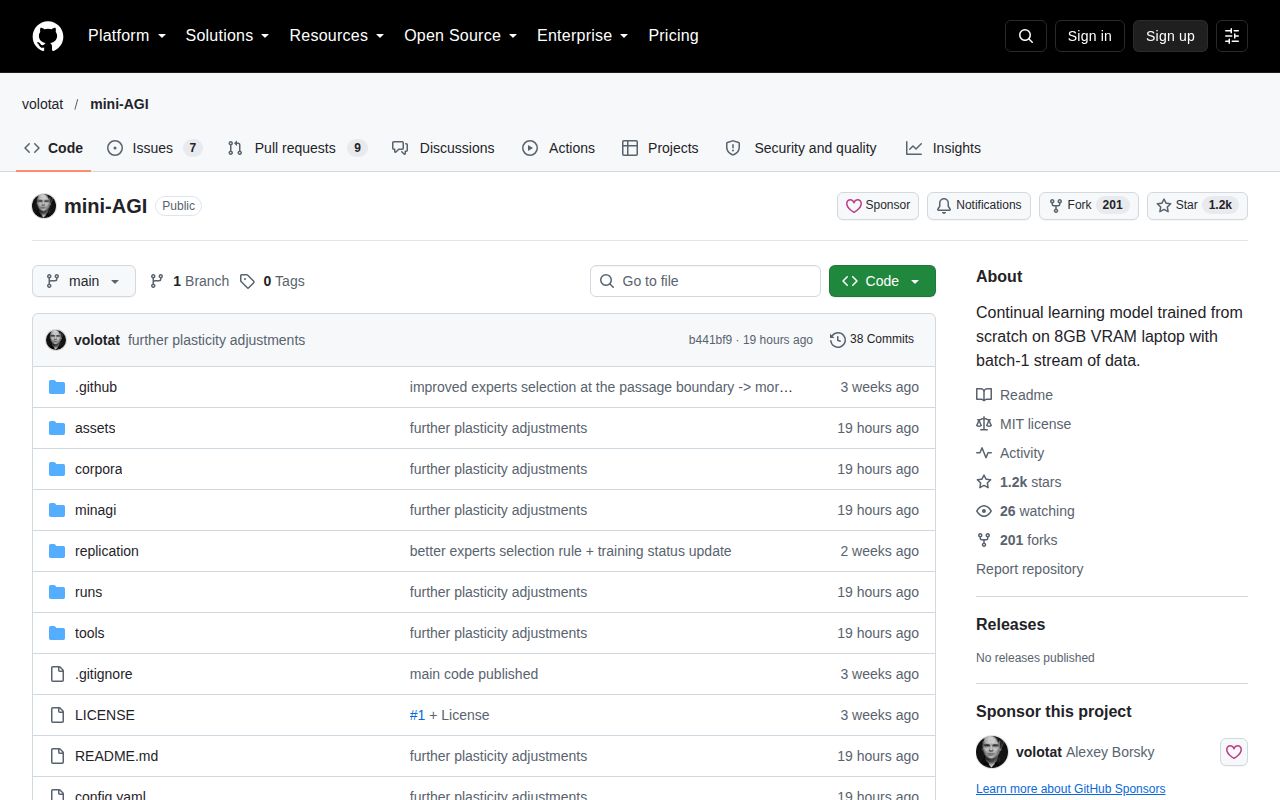
The last push was October 11, 2026. GitHub listed 1,235 stars and 16 open issues and PRs on October 12, and the latest-release endpoint returned no release. Recent reports concern this codebase: issue 17 describes a server startup failure involving the weight-loading path, and issue 18 describes held-out evaluation exceeding the model's context ceiling. The missing release alone says little about health. The recent push and specific open reports show active work with unresolved runtime questions.
For a researcher, the 15-second install makes an isolated trial approachable, provided the lack of a test target is acceptable. Choose nanochat for an experimental training workflow that covers tokenization through evaluation and inference. Choose llama.cpp when your task is running existing model weights locally. With mini-AGI, begin with disposable data and copied weights. Require your own before-and-after retention checks before letting the model learn from the only copy of an important experiment.