The agent follows one surveyed Minecraft 1.16.5 route
Minecraft Agent does something narrower than its name first suggests. Its checked-in configuration fixes the game at Java 1.16.5, Peaceful difficulty, and seed 8398967436125155523. It names the village, three chests, eight preparation beds, Nether waypoints, and the active End portal. The README is candid about this: the route was surveyed in a separate world, and known coordinates are supplied. That makes the project a controlled agent experiment, not a player dropped into an unknown map.
That distinction decides whether the repository is useful to you. A fixed route lets an engineer study planning, action selection, recovery, and evidence without world generation changing every attempt. It also means the result cannot answer how the same controller would search a new seed, locate a stronghold, or improvise when expected resources move. The code solves a bounded benchmark. Treating it as general Minecraft autonomy would give the models credit for information already present in config.json.
JEV selects actions that the controller already permits
Astra sets objectives, item targets, and travel waypoints. JEV receives the current observation plus a list of available actions, then selects one. Mineflayer handles pathfinding and normal game protocol calls. The action set covers tasks such as visiting a waypoint, mining one block, crafting, opening a chest, eating, sleeping, and using a bed attack during dragon combat.
This division is the project's most useful design idea. The model does not generate arbitrary JavaScript or press unrestricted keys. Handwritten code decides what actions exist and executes the chosen one, which keeps the model inside a typed menu. The tradeoff is equally important: much of the practical Minecraft competence lives in those candidate generators, route rules, safety checks, and executors. Open issue 4 asks for ablation runs against simpler selectors. The repository does not currently supply that comparison, so it cannot isolate how much JEV changes the outcome.
What happened when we ran it
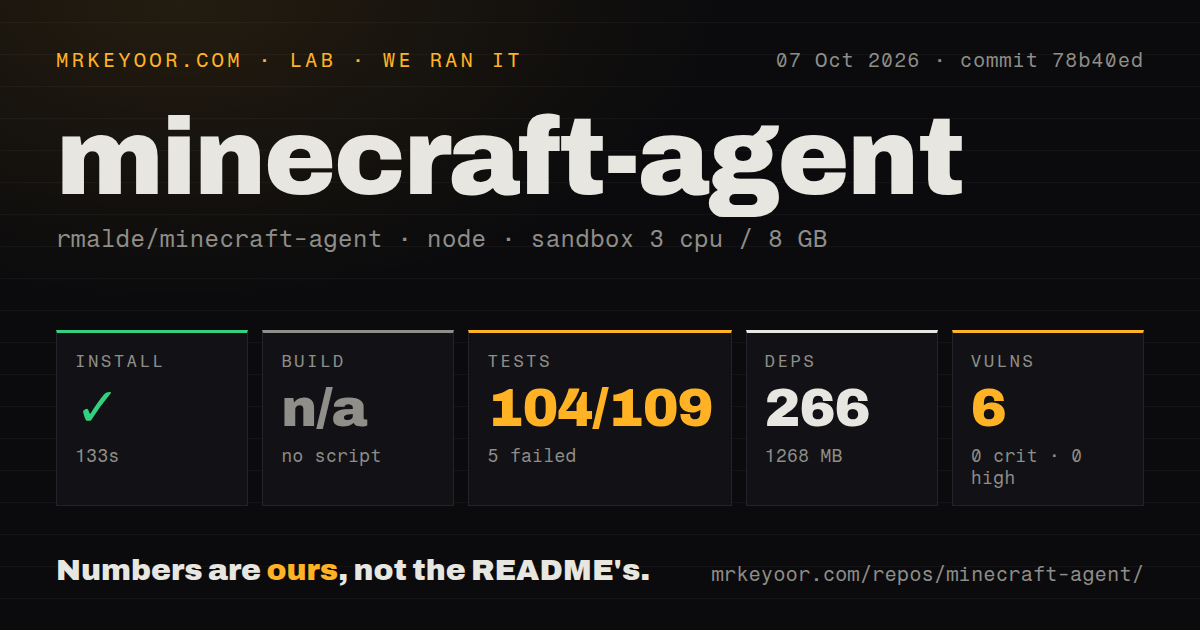
Our sandbox installed commit 78b40ed in 133 seconds. Npm added 266 packages, and the resulting environment occupied 1,268 MB. The repository has no build script, so there was no build step to run. Npm audit reported 6 moderate vulnerabilities and none rated critical or high. For a project with 2,894 lines of source in our scan, the installed footprint is substantial.
The test command exited with failure after 7 seconds. Node's test runner reported 104 passing and 5 failing tests out of 109. The supplied log tail shows tests 98 through 109 passing, including checks around waypoints, breath safety, planner calls, crafting, and completed preparation. It does not show the names or assertion messages for the 5 failures, so assigning them to a dependency, platform, or code defect would be guesswork. The result we can defend is that the full suite was not green.
There is no CI workflow, Dockerfile, or separate tests directory. Tests instead sit beside the modules as .test.mjs files, and the README gives an explicit node --test command for selected areas. A contributor can run them locally, but GitHub does not show an automated check protecting the main branch. The combination of 5 local failures and no visible CI is a reason to inspect every change before relying on a recorded result.
A real run needs Minecraft, three runtimes, and model credit
The 133-second npm install only prepares one layer. A full attempt also needs the official Minecraft Java 1.16.5 server, a compatible Java runtime, Python for the native client, and compiled display and capture support. Model calls need OpenRouter credit. The provided code expects Google application default credentials and Secret Manager access, with the original deployment's project and secret names changed for your account.
Several local services must agree: the main server defaults to port 25576, the status endpoint to 3078, the dragon sensor to 3093, and the model relay to 3099. Fresh evidence also requires a new world name and run directory; changing only the log directory does not reset the world. The README says the native renderer was developed on macOS and that paths need adjustment elsewhere. This is reproducible lab apparatus for a patient owner, not an npm package with a demo command.
The repository explains evidence that it does not ship
The evidence design is more careful than the average game-agent demo. Event logs record requests, model responses, selected actions, results, and completion events. Victory requires dragon-death evidence plus the exit-portal event, with a further world-state and video check. The README separates prepared combat-lab trials from full Survival runs and warns against presenting a paused or repaired recording as uninterrupted.
The catch is access. Recordings, action logs for the named run, saved worlds, downloaded runtimes, and Minecraft binaries are excluded from Git. A clone therefore contains the verifier and documentation, but not the headline run's video or raw evidence. That may be necessary for size and licensing reasons, yet it limits independent review. You can reproduce a new run if you assemble the stack, but you cannot audit the named run from this repository alone.
The September 20 push shows a young project, not a settled release
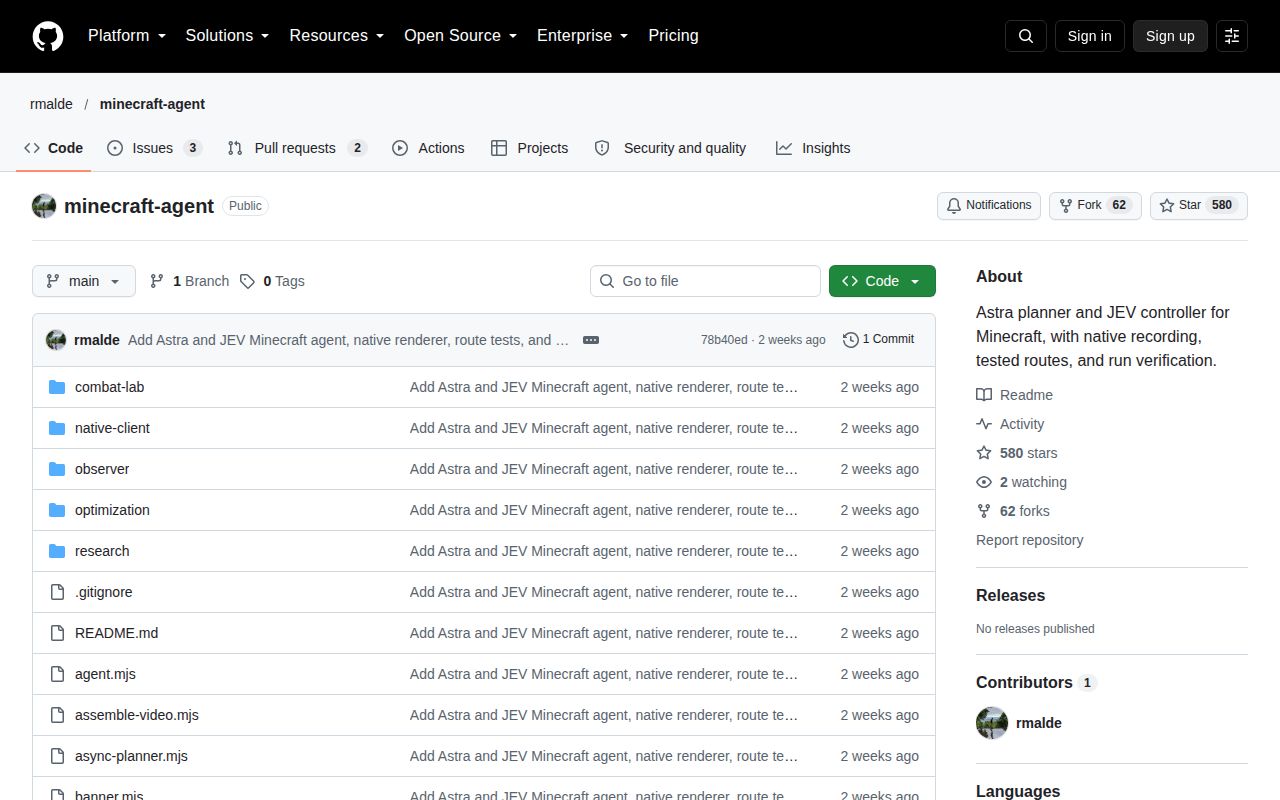
GitHub listed 580 stars, 5 open issues and pull requests, and no release tag on October 7, 2026. The repository was created and last pushed on September 20. The open queue includes criticism of how much work the fixed route and candidate generator do, plus a portability and local-service hardening pull request. Those are central questions for this experiment, not cosmetic backlog.
The README is unusually direct about fixed coordinates, bounded actions, local evidence, and macOS assumptions. That honesty makes the code worth reading. Adoption is a different call: our 109-test run was not clean, direct dependencies use latest, GitHub reports no license, and the full demonstration needs assets the clone does not contain. Use the repository as a case study, then demand a green suite and comparative controller runs before drawing a larger conclusion.