One phone can feed 3 desktop operating systems
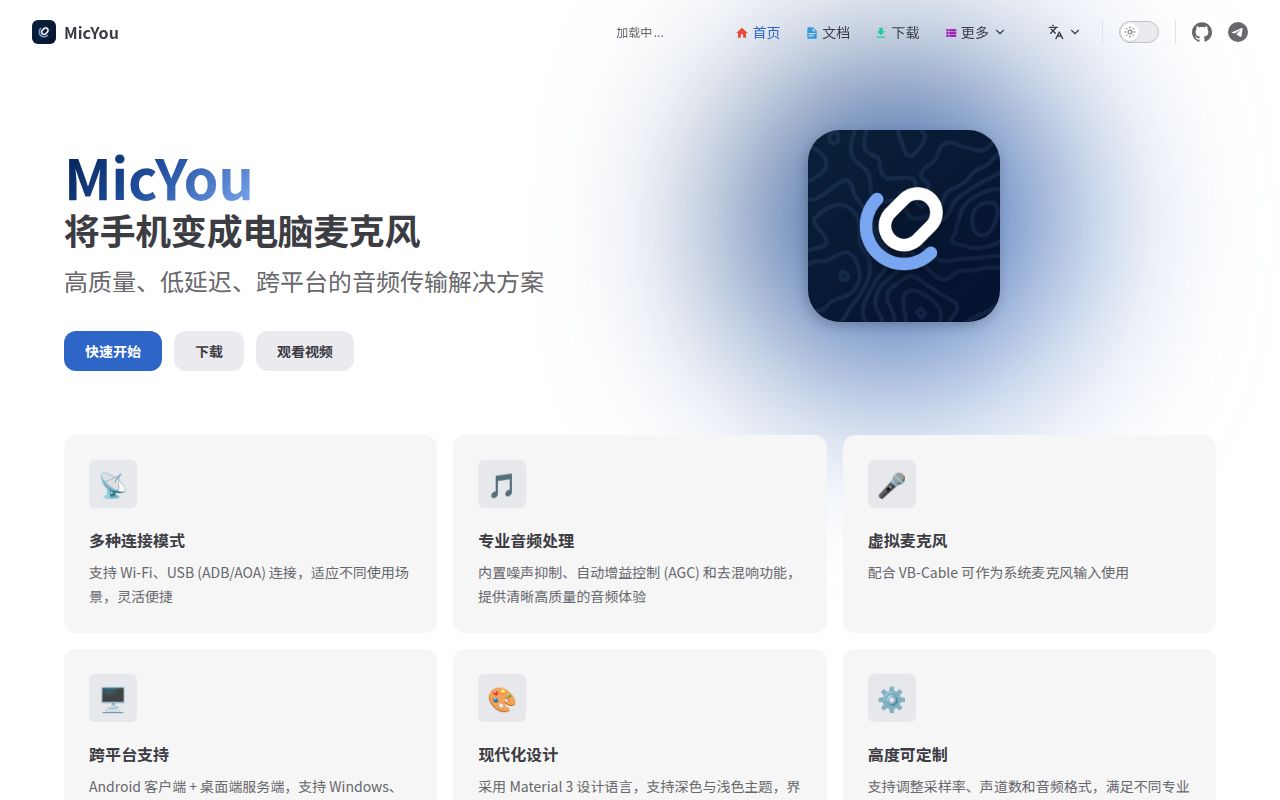
MicYou sends an Android phone's microphone to Windows, Linux, or macOS. Wi-Fi uses the local network, USB uses ADB, and Web mode lets a mobile browser join by QR code. The desktop side comes as a graphical app, command-line server, or interactive terminal dashboard. English is the default README, with Simplified and Traditional Chinese versions. Normal use needs no account or provider key.
MicYou documents AI and traditional noise suppression, acoustic echo cancellation, dereverberation, equalization, amplification, automatic gain control, and voice activity detection. Its status display includes bitrate, latency, jitter, packet loss, and buffer state. Those readings help diagnose a weak link, but they do not guarantee good sound from a particular phone, room, or network. Our sandbox did not measure audio quality or latency.
What happened when we ran it
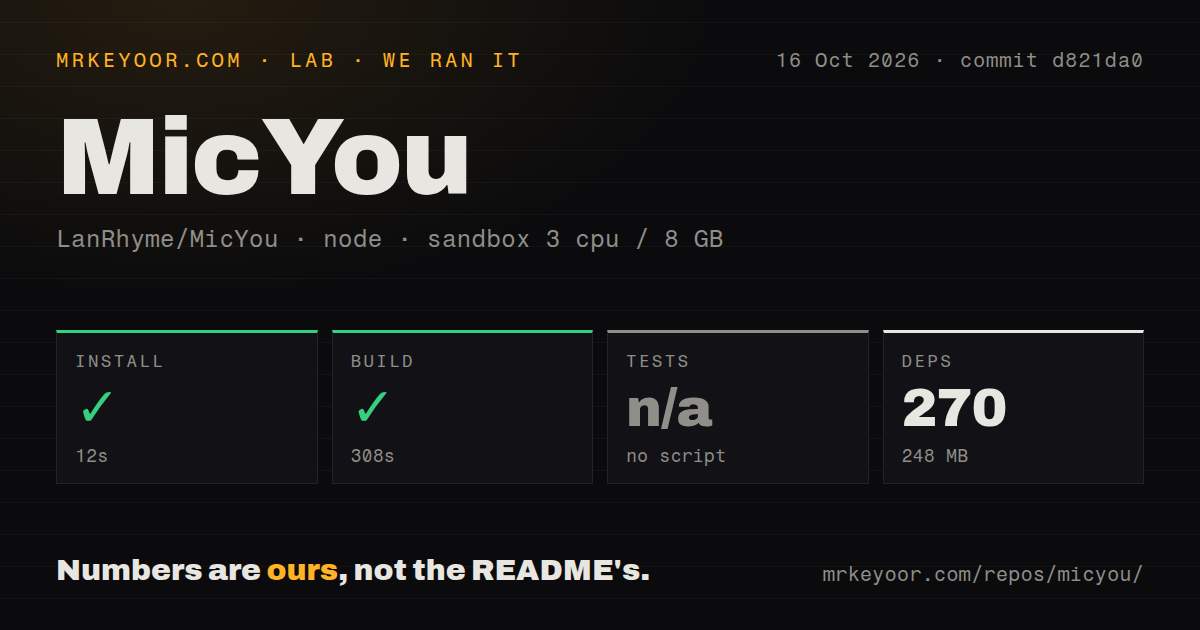
Our run used commit 98e5b93 in an unprivileged container with 3 CPUs and 8 GB of RAM. The Node project lives under tauri-app. Npm installed 346 packages in 18 seconds, using 184 MB, and the build completed in 278 seconds. The full checkout had 447 files, about 50,511 source lines, and occupied 93.4 MB before installation.
The harness found no test script or target, so it skipped tests, and its scan found no tests directory. Npm audit reported 5 known vulnerabilities: 0 critical, 4 high, 0 moderate, and 1 low. The repository contains 6 CI workflow files and no Dockerfile. Our result confirms the Node install and build, not Android capture, Rust packaging, live audio, or virtual-device behavior.
Every desktop needs its own virtual-audio route
Another program needs an operating-system audio device to see MicYou's stream as microphone input. The README points Windows users to VB-CABLE, Linux users to PipeWire, and macOS users to BlackHole. You then select that virtual microphone in a call, game, or recorder. This extra hop is the setup step most likely to surprise someone expecting the downloaded app to appear as a microphone immediately.
Issue 322 shows why routing needs a real check. The Windows reporter sent MicYou output to physical speakers instead of CABLE Input, feeding the sound back into the nearby phone and producing severe echo. Correct VB-CABLE selection fixed the setup. The issue asks MicYou to warn before falling back to a speaker. Until a release confirms that safeguard, start with speaker volume low and verify the complete route before joining a call.
Wi-Fi discovery can succeed while port 8554 times out
Version 2.0.1 supports Wi-Fi, USB, and Web connections. Wi-Fi depends on local addressing, firewall rules, and whether both devices can reach the service port. Issue 312 records an Android 13 and Windows 10 setup where discovery found the desktop at port 8554 but repeated TCP attempts timed out. One report does not establish a general defect, but it supplies a useful failure signature.
USB removes the wireless path but adds Android debugging, a data cable, and ADB. Web mode avoids the APK, though it still needs the desktop server and browser access. A restricted office network may make USB easier, while a borrowed phone favors Web mode. Test reconnection as well as first connection because a backup microphone must recover after a cable or network interruption.
CLI and TUI users do not get the GUI plugin lifecycle
MicYou v2 combines a plugin system with Rust, Tauri 2, Vue 3, and Kotlin. Open issue 308 says the CLI and TUI initialize the plugin host but never trigger discovery and loading because that lifecycle remains inside graphical Tauri setup. The issue was updated on September 3, 2026 and remained open, with labels showing work toward a merge. Treat the 3 interfaces as different product paths until a release includes and verifies the change.
Licensing adds a firm boundary for extensions. Core modifications remain under GPLv3. Independently made non-commercial plugins may use another license through the MicYou Plugin Exception, but commercial distribution or monetization requires prior written authorization or a separate commercial license. A company planning a paid DSP plugin should settle that permission before writing against the C ABI or WASM interfaces.
v2.0.1 ships broadly with little callable test coverage
Release v2.0.1 arrived on August 12, 2026 with packaging and mode-switching fixes. Assets include an Android APK, Windows installer, Linux AppImage, DEB and RPM packages, and an arm64 macOS disk image. There is no iOS app asset, although browser mode offers another mobile route. GitHub recorded the last push on September 3, the same day several open items were updated.
The repository showed 21 combined open issues and pull requests: 20 issues and 1 pull request. That is activity, not a confirmed-defect count. Our stronger concern is the 4 high-severity npm advisories and absent test target at commit 98e5b93. MicYou spans phones, networks, desktop systems, audio backends, 3 interfaces, and plugins. Those boundaries need repeatable behavioral checks.
Try MicYou as a backup before trusting it as the main mic
The 18-second install and successful 278-second build make MicYou easy enough to trial. Missing tests, 5 audit findings, virtual routing, and current connection reports keep it out of the set-and-forget category. Install the release, route it into a virtual device, record a sample, and reconnect once. Only then make it the input for an important meeting or stream.