Direct USB control works across 3 desktop operating systems
wifit3 takes a route most wireless-auditing apps avoid: it ships Python ports of wireless drivers and talks to USB adapters through bulk and control transfers. That lets the same Textual interface run on 3 operating systems, Linux, Windows, and macOS, without depending on monitor-mode support in each one. If cross-platform use is the requirement, this is the project's strongest argument. If you already have a stable Linux kit built around aircrack-ng, the extra driver layer is less persuasive.
The feature set covers reconnaissance, WPA and WPA2 handshakes, PMKID collection, an Evil Twin WPA3 downgrade, WPS recovery, and WEP attacks on 2.4 GHz and 5 GHz hardware. Captures can be exported as PCAP or hc22000 files. Multiple adapters may scan together while a chosen card handles injection. These are active wireless operations, including client deauthentication, so the sensible boundary is equipment you own or have written authorization to test.
The README requires 1 of 18 listed chipset families
At least 1 supported USB adapter is mandatory. The README names 18 chipset rows across Atheros, MediaTek, Realtek, and Ralink devices, with capabilities varying by band and driver. That list deserves more attention than the quick uv sync instructions. An unlisted internal card does not become compatible because Python installation succeeded, and a listed family name does not remove the need to check the exact device revision.
One open report makes that caution concrete. Issue 60 says an ALFA AWUS036AXML on Linux with wifit3 v0.3.2 displayed no networks during a scan. That report does not establish a general defect or describe the current v0.3.3 release, but it concerns a model shown in the supported table. Test discovery, receive, injection, and capture on your own adapter before arriving at a client site.
What happened when we ran it
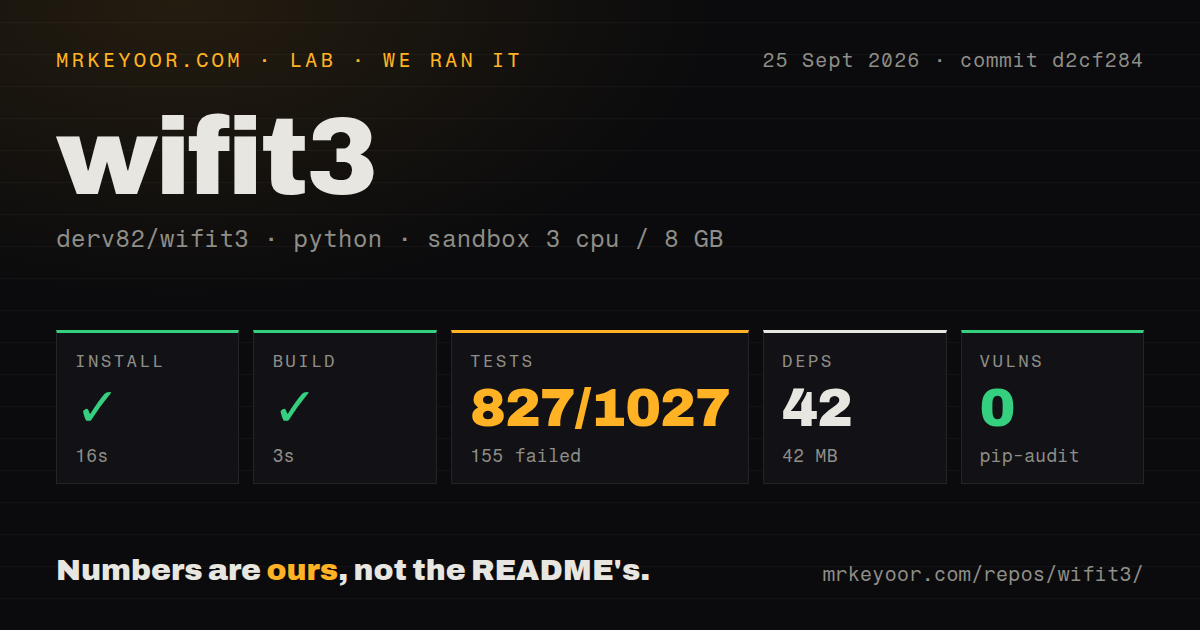
We cloned commit d2cf284 and installed it in our sandbox in 16 seconds. It added 42 packages and occupied 42 MB, then the build completed in 3 seconds. The checkout itself contained 1,339 files, about 270,962 lines of source, and 3 CI workflow files. Pip-audit reported 0 known vulnerabilities in the installed Python dependencies.
The test step failed with exit code 1 after 11 seconds. Pytest counted 827 passed, 155 failed, and 45 collection or setup errors out of 1,027. It also reported 15 deselected tests, 11 expected failures, and 64 warnings. The tail repeatedly says that async test functions are not natively supported, including cases for RTL8188EUS, RTL8812AU, and RTL8814AU drivers. That message is the evidence; the log tail does not prove why the required support was absent.
A large passing majority is useful, but 200 failures or errors keep this from being a clean checkout result. Hardware behavior was outside the sandbox too: the unprivileged container had no supported adapter or secrets. Our run proves that installation and packaging work in a fresh Debian environment. It does not prove radio reception, packet injection, or capture reliability on any of the 18 listed chipset families.
Prebuilt files still require 1 system-level driver change
Prebuilt executables cover 3 platforms. Linux users mark one file executable, Windows users run an x64 executable, and macOS users remove the download quarantine before starting the universal binary. Source users need uv, followed by uv sync and uv run wifit3. Building a standalone binary uses PyInstaller. No hosted account or API credential appears in the basic path.
The one-time device step has system consequences. On Linux, wifit3 asks for elevation and writes udev permissions plus blocklists under /etc/modprobe.d/. Windows installs WinUSB for the device after a UAC prompt. macOS asks the user to allow access. The app includes an uninstall action that removes its Linux rules or Windows binding, after which the adapter must be unplugged and reconnected. Keep a separate network path available while doing this.
v0.3.3 is active beta software
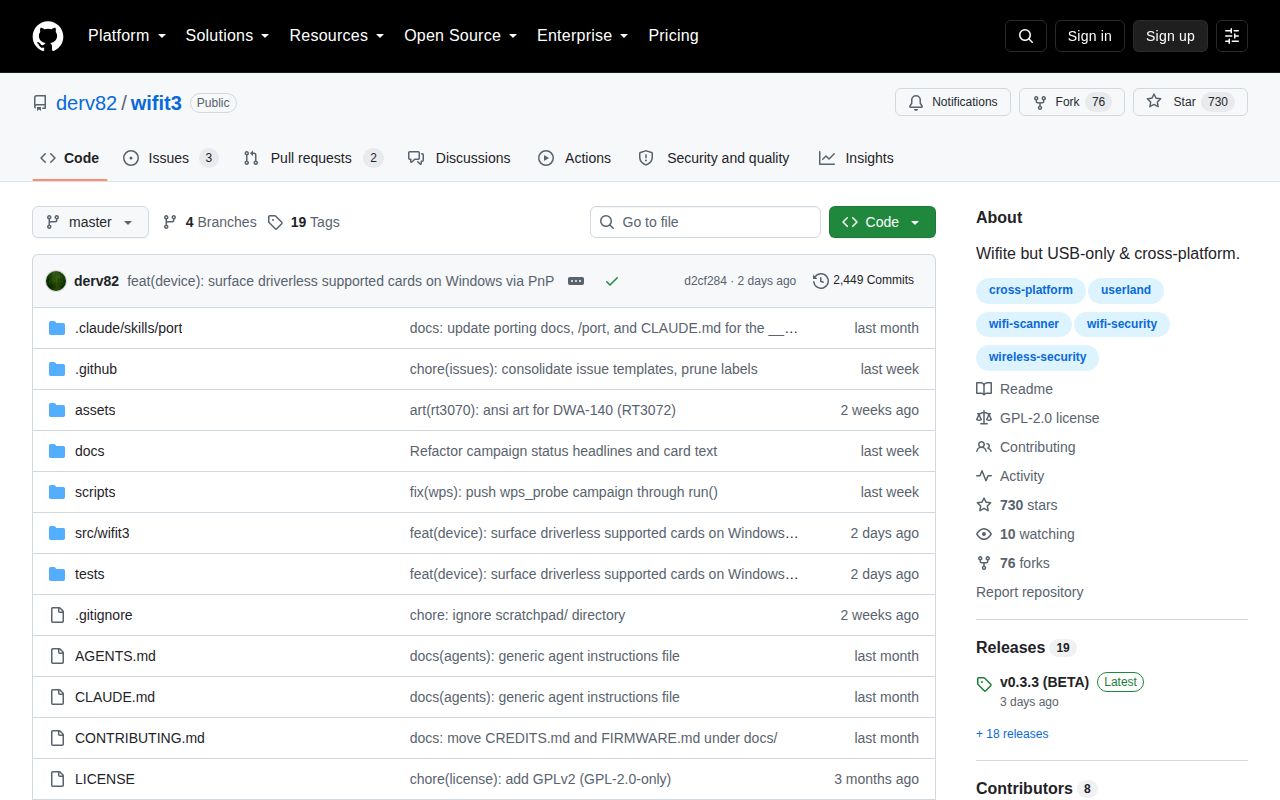
GitHub recorded 728 stars, 5 combined open issues and pull requests, and a last push on September 23, 2026. Release v0.3.3 arrived one day earlier and is explicitly labeled beta. It added a vault for reviewing stored captures and launching Hashcat, along with WPS campaign and USB-library changes. Two current pull requests add another Realtek path and include detailed hardware verification claims, which indicates ongoing driver work rather than a frozen repository.
Activity does not cancel the failed suite or the device-specific risk. wifit3 is worth a controlled lab trial for someone who needs one USB-focused interface across 3 desktop operating systems. Bring a supported adapter, preserve a way back to the native driver, and run a small authorized target through scanning and capture before trusting it on an engagement. The 16-second install is the easy part; adapter behavior is the acceptance test.