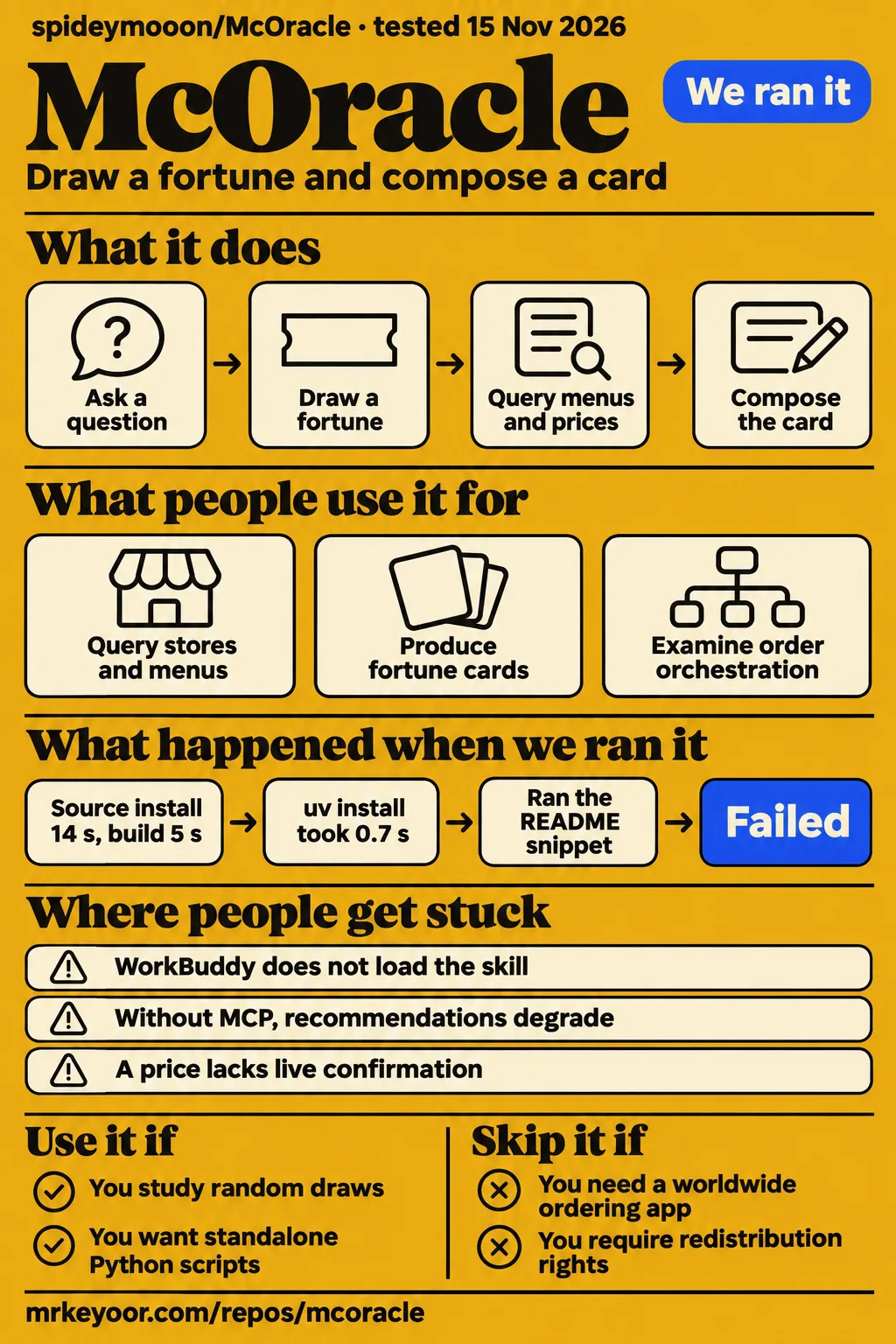
McOracle installed in 14 seconds and built in 5 seconds in our sandbox, but pytest collected no tests. Use it to study a Chinese-language fortune skill that keeps random entertainment separate from restaurant data. Skip it if you need a demonstrated complete payment and order-status workflow or an ordinary worldwide McDonald's ordering app. The useful design question is how a playful answer becomes a meal suggestion without turning an invented price into a commercial fact.
McOracle assigns those jobs to different components. A Python script draws a fortune from an original library, the restaurant connection supplies menu and price information, and Pillow helps compose the card. The README describes an additional confirmation step before order creation. That division gives developers a concrete system to examine: a stable draw, a recommendation grounded in restaurant responses, a rendered artifact and a separately authorized transaction. McOracle README
What people use McOracle for
The project author reports restaurant queries, 1200×1600 PNG cards and an order returned in pending-payment status. Those examples cover three different reasons to explore McOracle: learning the restaurant connection, producing this particular visual experience or examining order orchestration. The documentation also reports running local checks for the oracle, card renderer and order-state logic. Keeping the author as the subject makes the origin of these results clear without interrupting every example with the same disclaimer.
| Who used it | What they did | Reported outcome |
|---|---|---|
| The project author | Queried McDonald's China stores, menus, meal details and prices | Reports restaurant queries including discounts and collection methods. Author documentation |
| The project author | Composed fortune cards with the programmed template and official product images | Reports actual 1200×1600 PNG output. Author documentation |
| The project author | Called the real order-creation interface | Reports an order returned in pending-payment status. Author documentation |
| The project author | Ran oracle, card and order-safety checks | Reports 24 / 24 passing checks; oracle and order-safety checks use mocks, while card checks produce local PNGs. McOracle test documentation |
The README describes a library of 104 Chinese fortunes and a draw locked to the current round. The explanation, card and recommendation refer to that same result until the user asks for another draw. For an assistant developer, this is a useful state-management example: formatting another response should not silently change the underlying fortune. The documented commands distinguish asking a question, inspecting the current draw and requesting a redraw. Oracle architecture and commands
The recommendation rules map fortune tags to food directions, then combine those directions with the available menu and budget. A user who asks only for a fortune stops before the restaurant lookup and location request. That makes the draw script a practical first entry point. Someone interested in restaurant orchestration can instead follow how the recommendation acquires a real item, store and price before those details reach the card or order summary. McOracle project flow
What happened when we ran it
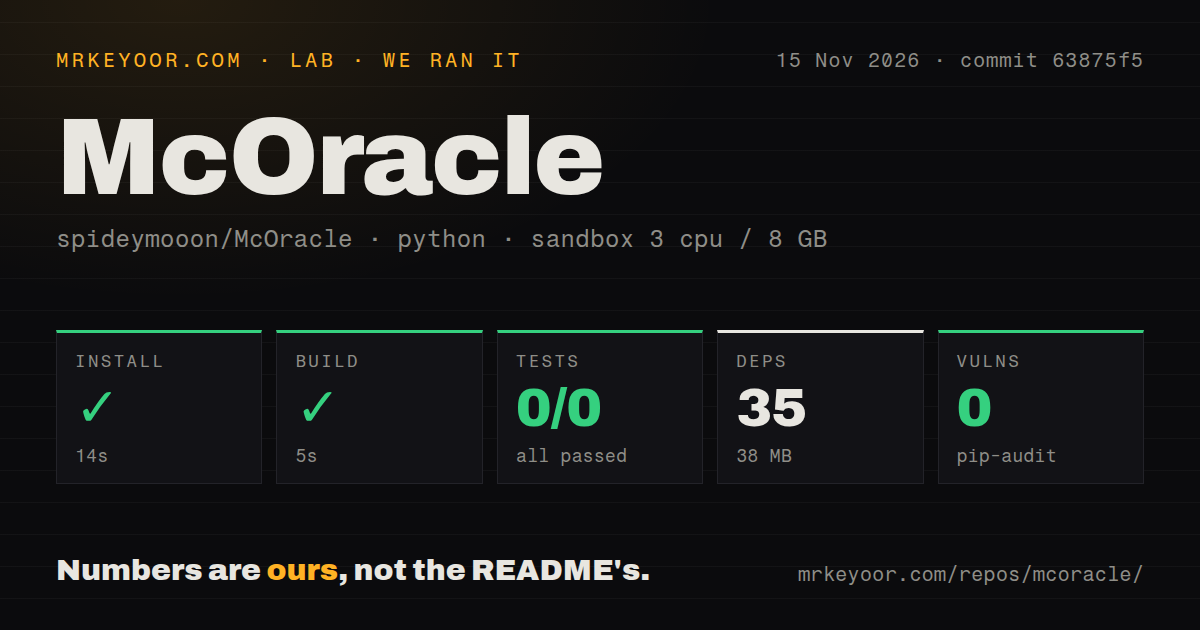
Our run installed McOracle in 14 seconds and built it in 5 seconds at commit 63875f5 on 2026-11-15. Pytest exited 5 after 6 seconds and collected zero tests. The supplied log says 'no tests ran in 0.01s'. These are repository-harness results, recorded separately from the quickstart-lib procedure below. Reading the two procedures side by side preserves both the successful setup steps and the failed attempt to find a runnable snippet.
| Harness step or signal | Our recorded result |
|---|---|
| Install | Succeeded in 14 seconds; 35 dependencies recorded; 38 MB on disk |
| Build | Succeeded in 5 seconds |
| Tests | Failed with exit 5 in 6 seconds; pytest recorded 0 passed and 0 failed out of 0 |
| Test log | no tests ran in 0.01s |
| Dependency audit | pip-audit reported 0 known vulnerabilities |
| Repository scan | 0 CI workflow files, no Dockerfile, a tests directory present |
The harness recorded 3 CPUs, 8 GB RAM and the configured image label ghcr.io/astral-sh/uv:python3.12-bookworm. Its checkout contained 30 files, approximately 1,362 source lines and 14.1 MB of files. The recorded total duration was 32 seconds. These figures describe the repository procedure and its configured resources. The test outcome is specifically empty collection: the supplied tail contains neither a failed assertion nor an exception identifying a package or environment cause.
The separate quickstart-lib run used commit 63875f571f23 on 2026-11-15 in a fresh unprivileged container configured with 2 CPUs, 4 GB RAM, no published ports and no secrets. It used the same recorded image label and installed Pillow from PyPI. The following rows retain each supplied step, including the failed snippet and final cleanup, so the shorter install result cannot be confused with the harness's 35-dependency installation.
| Quickstart step or finding | Recorded outcome |
|---|---|
| Clone | quickstart-lib recipe completed in 2 seconds. |
| Install | uv pip install Pillow into a fresh venv installed Pillow 13.0.0 in 0.7 seconds; the README command was pip install Pillow. |
| Installed size | 19.8 MB on disk in the venv site-packages. |
| Dependency count | 0 packages besides Pillow installed. |
| Snippet | FAILED; the README has no python code block to run. |
| Finding | no-snippet: the README has no python code block to run. |
| Teardown | ok. |
The supplied README contains shell-tagged examples that invoke Python scripts, including the draw command and a mock order-controller demonstration. That resolves the apparent contradiction at the documentation level: a recipe looking for a Python code block can stop while a human reader still has shell commands to follow. The failure remains part of our recorded result. The README commands are the next reproducible starting point, rather than a reason to rename that failed step as a successful demonstration. Standalone script examples
Where people get stuck: registration, live data and price units
McOracle's documentation ties WorkBuddy registration metadata to the installed WorkBuddy version and provides independently runnable scripts. That gives a developer two routes into the project: load the skill through WorkBuddy or start with the local scripts. For restaurant queries, the README adds a token, connector configuration and an enabled connection. For card rendering on Mac or Linux, it asks for an available Chinese font. These are separate setup tasks with different symptoms. McOracle setup requirements
| Situation | Documented response | What to check first |
|---|---|---|
| WorkBuddy does not load the skill | Supply metadata required by the installed version; scripts can run independently | Local WorkBuddy registration requirements |
| MCP is not configured | Oracle draws and product-free cards remain available; recommendations degrade | Whether the requested experience needs live restaurant data |
| A price lacks live confirmation | Display a price-unchecked label | The restaurant response and its timestamp |
| Order details change after confirmation | Discard the old confirmation and request another | Item, quantity, store, price and collection method |
The documentation says restaurant prices arrive in fen and must be divided by 100 for display. It also distinguishes pickup and drive-through parameters from delivery parameters. Those details belong in the data flow: keep the selected collection method attached to the price calculation and the order summary. A renderer should receive the price's status as well as its amount, so a template example cannot accidentally become a claim about the customer's current meal. Integration and price-unit notes
A sensible reading order follows those component boundaries. Start with the draw script and its saved round state, then inspect card composition and font selection. Add the restaurant connector when the goal becomes live menu recommendations. This sequence comes from the project's documented split between standalone scripts and skill orchestration. It also makes troubleshooting more specific: a script invocation, a font problem and WorkBuddy registration each have their own place to investigate. McOracle architecture and setup
Confirmation is part of the order data
The README says a change to the item, quantity, store, price or collection method invalidates the previous order confirmation. Approval therefore belongs to a particular order summary. The documented conversation moves from preparing an order to showing its details, receiving explicit confirmation, checking the price again and creating the order. For developers adapting the flow, preserving those states matters as much as preserving a product identifier or quantity. Order-safety rules
The project distinguishes order creation from payment and asks the assistant to return a real order number and official payment entry point. Its mock controller is presented as pure logic, while the restaurant connector performs commercial operations. Tokens belong in environment variables or connector configuration under the README's rules. Contributors are also asked to exclude tokens, order numbers and personal information from issues and pull requests. These are documented operating rules for readers to examine when adapting the skill. Order flow and contributor instructions
Chinese text and McDonald's China define the audience
The supplied README and fortune-library documentation are Chinese. The documented library has 104 entries across 8 categories, and the conversational triggers are Chinese phrases such as requests for a fortune or another draw. Card text is composed with Pillow, and the setup instructions ask Mac and Linux users to provide a Chinese font. This makes language and font availability part of the first-use decision for an English-reading developer. McOracle language and rendering documentation
The official McDonald's China MCP guide describes a service for mainland China, excluding Hong Kong, Macao and Taiwan. It provides the restaurant interface McOracle connects to and links an English guide. McOracle itself is described as a developer contest entry rather than an official McDonald's product. Keep those identities clear: the official restaurant service supplies the connection, while the developer's skill supplies the fortune experience and its orchestration. Official MCP service guide, McOracle project declaration
Stars show repository attention
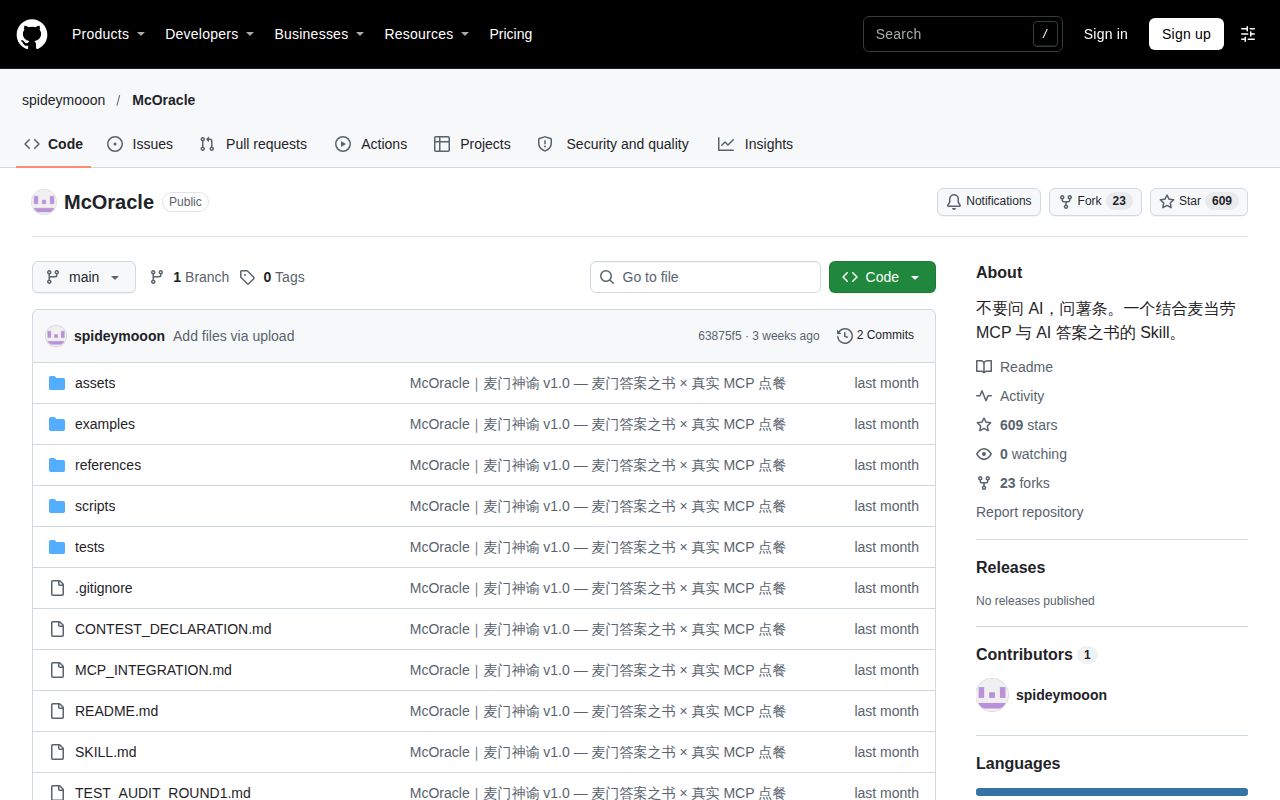
Trendshift records 481 additional stars, 24 additional forks and zero merged pull requests over its stated October 12 to November 15, 2026 period. These figures describe attention and repository activity. GitHub metadata separately records 609 stars, zero open issues and PRs, and a last push on October 25, 2026 when observed on November 15. The two snapshots answer different questions: total attention at a point in time and changes during a stated interval. Trendshift activity record, Supplied GitHub metadata
A post by vintcessun on X describes Python library draws, MCP menu data, programmed cards and explicit order confirmation. That is a useful description of the project's intended division of work. Entity names also matter here: MiCAOracle, MacroOracle and a Musicboard account named mcoracle concern different entities. The review's subject is spideymooon/McOracle, the Chinese fortune skill, and its component choices follow that specific purpose. vintcessun's McOracle post, McOracle repository
McOracle vs the official MCP connection and Pillow
The official McDonald's China MCP service supplies restaurant tools, while Pillow supplies Python image processing. McOracle combines those kinds of building blocks with its own fortune library, recommendation rules and conversation instructions. The choice is therefore about which application behavior you want to adopt and which you want to write. A developer interested in restaurant access can begin with the official interface; a developer interested in a different card design can begin with the image library.
| Choice | What its documentation supplies | Pick it when |
|---|---|---|
| McOracle | A fortune library, recommendation rules, card scripts and order-safety instructions | You want this particular Chinese-language entertainment experience |
| McDonald's China MCP service | An official MCP data interface for mainland China | You want to write your own restaurant assistant around the official connection |
| Pillow | Python image processing capabilities | You want to build your own card renderer and surrounding behavior |
The official service guide documents a remotely hosted MCP endpoint, Streamable HTTP and token-based authorization. Starting there means designing the surrounding conversation and confirmation behavior yourself. Pillow's documentation describes image-processing capabilities for a Python interpreter; using it directly means creating your own layout and application logic. These are concrete differences in responsibility, which make the table useful even for a developer who intends to borrow only one part of McOracle's design. Official restaurant interface, Pillow overview
What the other reviews get wrong
ToolPotion lists AI-generated responses and categorizes McOracle as cloud deployment on the web platform. McOracle's README instead describes a randomly selected fortune from an original library, a skill copied into local WorkBuddy directories and independently runnable Python scripts. An assistant's interpretation of a draw is distinct from selecting that draw. Likewise, a connection to a remote restaurant service is distinct from operating the surrounding skill as a hosted website. ToolPotion listing, McOracle architecture and installation
Those distinctions change the setup a reader should expect. The local skill directory, Python commands, Chinese fonts and connector configuration are part of the documented experience. A repeated fortune can be a valid library result, while a repeated example price has a different meaning because restaurant data changes. Reading the source documentation gives a more specific basis for choosing the project than a generic listing's deployment and feature labels. McOracle README
FAQ
McOracle's README requires explicit confirmation before order creation and leaves payment to the user on the official page. Its FAQ also addresses price differences, use without MCP, image-generation keys, entertainment boundaries and card typography. The six questions below come from that supplied documentation. Their answers describe the project's stated behavior and give first-time readers a direct route to the relevant setup or operating rule. McOracle FAQ
Will McOracle place an order or charge me automatically?
The README requires explicit order confirmation and says McOracle does not pay automatically. Asking to look at food, receive a recommendation or prepare an order does not count as confirmation. After order creation, the user pays on the official page. The order-safety rules also require a new summary and confirmation when relevant details change, keeping consent attached to the selected meal and collection method. Order-confirmation FAQ
Why might McOracle's prices differ from the McDonald's app?
The FAQ directs readers to the selected store's live query and says the card and conversation display a confirmation time. Its answer treats that response as the price reference rather than providing a diagnosis for every possible app mismatch. Under the documented rule, a price lacking live confirmation receives the price-unchecked label. The README's sample meal and amount illustrate a conversation; the selected store's response supplies the customer's price. Price FAQ
Can I use McOracle without configuring MCP?
Yes: the documentation says oracle draws and product-free fortune cards work without MCP. Product recommendations degrade and use the price-unchecked label. This local path suits someone interested in the fortune experience or card composition. The restaurant connection becomes the next setup step when the goal includes live menus and prices, rather than a requirement for reading or drawing from the fortune library. Use-without-MCP FAQ
Does McOracle need an image-generation API key?
No image-generation API key is required for standard card output, according to the README. The normal card uses programmed layout with product imagery or the documented fallback artwork. An optional background-preview mode is described separately for visual experiments. The distinction helps readers choose the intended workflow: the ordinary card path starts with the supplied template and rendering script, without selecting an image-generation provider. Card-generation FAQ
Does McOracle predict the future?
No: the README describes the fortunes as entertainment and inspiration rather than a basis for real-world decisions. It says major subjects such as resignation, investment, health and law receive a reminder to exercise independent judgment. The random draw is the premise of the experience, and the library gives that draw its wording. The meal suggestion is a separate recommendation step grounded in restaurant data. Fortune-purpose FAQ
Will Chinese text become garbled or overflow on McOracle's cards?
The README describes automatic wrapping and font-size reduction through Pillow, plus a font containing the yuan glyph for prices. It asks Mac and Linux users to ensure a Chinese font is present and describes candidate-font selection by the script. Those instructions provide specific rendering checks for a new machine: start with available fonts, then inspect the resulting text and price display in the generated artifact. Typography FAQ
What we have not tested yet
Our supplied runs contain no completed restaurant query, generated card, paid order or order-status retrieval. The harness recorded repository setup and empty pytest collection; the separate quickstart stopped at its snippet step. The cause of empty collection remains unresolved, and the configured image label does not establish actual runtime or operating-system versions. The author's reported 24 / 24 checks are separate from our pytest result. No corrected or additional example was executed for this revision.
The author's documentation reports an order returned in pending-payment status, with payment and subsequent status retrieval outside the completed demonstration. It also lists delivery, coupon collection and redemption, and the visual appearance of fallback concept illustrations among its unfinished checks. Our evidence contains no comparative performance measurements, migration outcomes or independent customer results. Stars, forks and descriptive social posts therefore supply attention and presentation evidence rather than transaction reliability or user satisfaction. Author capability statement
The supplied README and fortune-library documentation are Chinese; English setup documentation was not verified. The supplied metadata does not establish a latest release. GitHub's license field is empty, and the README's learning-and-demonstration statement does not establish redistribution rights. Our records also leave token handling, privacy behavior, confirmation bypasses, concurrent users, sustained volume and service rate-limit behavior untested. The clean dependency audit addresses known package advisories in the recorded scan, rather than those application behaviors.
The supplied pack contains no relevant independent GitHub issue investigation or McOracle video walkthrough, and it provides no basis for judging support-resolution speed. Rendered review assets and other site-level presentation elements are also outside this text correction. The next useful evidence would be a retained live menu response, a card generated on the intended machine and a separately authorized transaction followed through payment and status retrieval. Developers can use the existing material to study the architecture while keeping those remaining questions explicit.