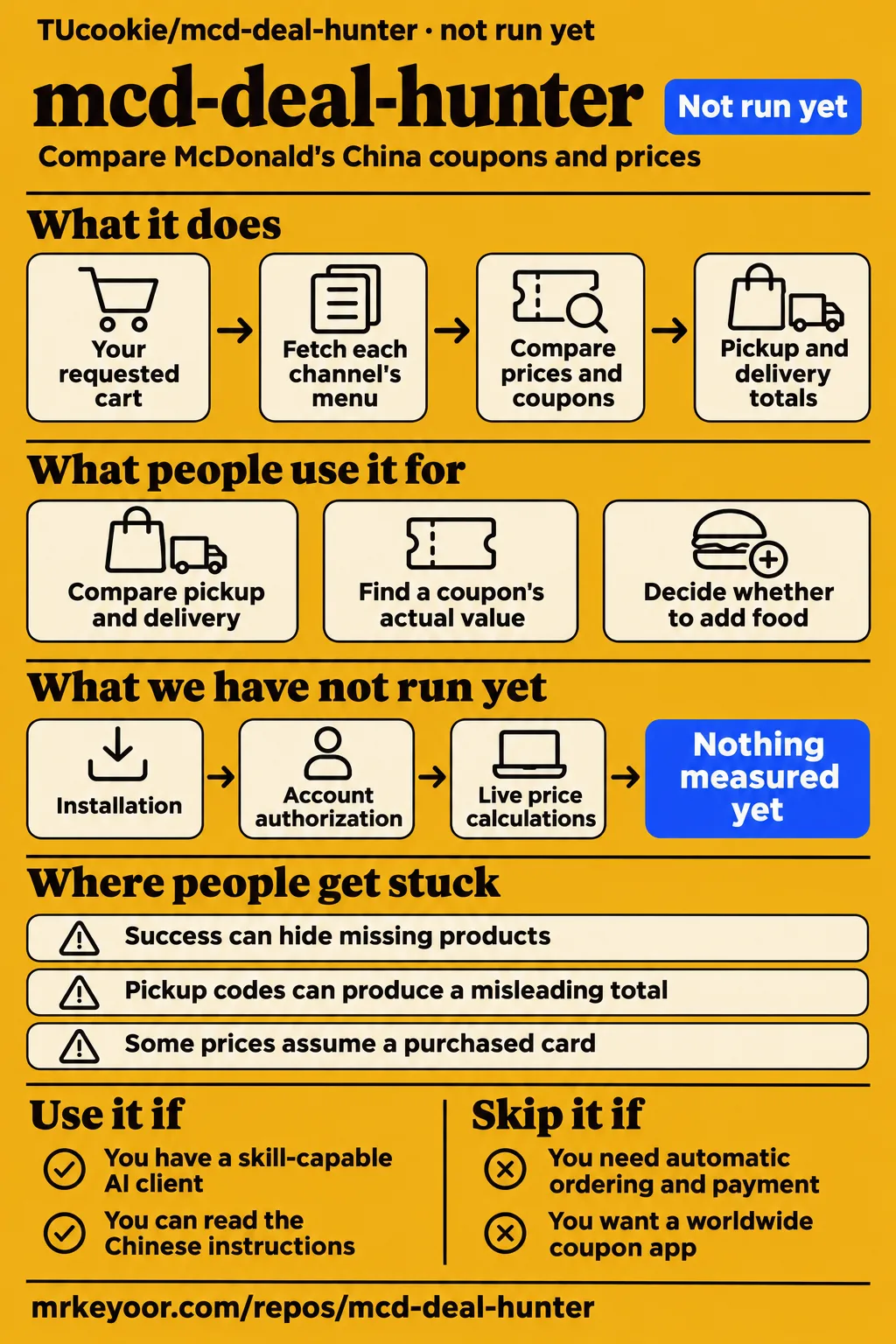
TUcookie/mcd-deal-hunter is an AI-client skill for comparing McDonald's China orders. Use it if you already work with a skill-capable client and want to examine its pricing method. Skip it if you want a worldwide coupon app or an agent to place and pay for lunch. The README leaves ordering and payment to you. Our sandbox attempt at commit 65ab82f ended before execution. Project README
The useful idea is comparing the same food at the same restaurant, using each channel's own menu and coupons. That gives this project a more specific purpose than its name suggests. Its integration notes identify a consequential failure: a price response can report success after dropping requested items. The decision aid here is the relationship between the requested cart, returned products and final amount, rather than the apparent success of a tool call.
What people use mcd-deal-hunter for
The README documents coupon comparisons, pickup-versus-delivery calculations and questions about adding food to reach a discount. These tasks share one purchasing decision: what will this particular meal cost through the available options? GitNova's project summary describes the same uses and labels its summary AI-generated. The primary documents explain the comparison steps and the checks that accompany them.
| Who describes the use | Task | Documented result or method |
|---|---|---|
| TUcookie, in the README | Decide between pickup and delivery | A same-store example separates item prices from delivery and packaging charges. Project README |
| TUcookie, in the integration notes | Find a coupon's actual value | Request a price with the coupon and a price without it, then compare. MCP integration notes |
| TUcookie, in the skill instructions | Decide whether to add an item | Recalculate the expanded cart and recommend it only when the payable total falls. Commit-pinned skill instructions |
The README's two-item chicken-burger example reports a payable price of 20.48 yuan and says the bundle is available only through a coupon. It therefore declines to invent a saving against an unavailable purchase. That distinction helps a reader choosing a meal: a real alternative matters more than a crossed-out reference price. The example also gives an October 30 coupon expiry without a year, so its role here is explaining the method rather than advertising an available offer. Project README
What happened when we ran it
Our sandbox did not run mcd-deal-hunter at commit 65ab82f on 2026-11-17: the harness detected no supported ecosystem, recorded language as null and found no Dockerfile. The recorded configuration was 3 CPUs and 8 GB RAM, with image listed as n/a. Our run produced a harness outcome, rather than an installation, build or pricing result.
| Lab record | What it establishes |
|---|---|
| Checkout | commit 65ab82f, dated sandbox attempt on 2026-11-17 |
| Execution | Not run: no supported ecosystem; language recorded as null |
| Container route | No Dockerfile recorded |
| Configuration | 3 CPUs, 8 GB RAM, image n/a |
| Install, build and tests | No execution results supplied |
The separate hands-on safety record failed because none of compose.yaml, compose.yml, docker-compose.yaml or docker-compose.yml existed. It calls this an unsafe repo, but explicitly gives a missing Compose file as the reason. That is a failed harness prerequisite, rather than a demonstrated security defect in the skill. Keeping the reason beside the label prevents a reader from treating the word unsafe as an account-security assessment.
Another record describes deployment with the repository's own Docker Compose on 2026-11-17, with every port bound to 127.0.0.1. That description conflicts with the missing-Compose result. The teardown record says cleanup was successful. Both records belong in the account of the attempt, but the supplied harness outcome is still not run; the deployment description cannot supply the missing execution result.
The README's setup is a skill directory loaded by an existing AI client, rather than a standalone application launched through Compose. That documented shape explains the difference between the intended setup and the harness prerequisite. The failed step establishes what stopped this attempt. It does not show a failure of the McDonald's pricing service, an incorrect coupon calculation or a broken client installation. README installation instructions
Where people get stuck: success can hide a missing burger
TUcookie's integration notes report that calculate-price can return success while silently dropping unrecognized product codes. In the author's example, four requested products disappear and the returned price contains only a 6 yuan delivery charge. An assistant that reads only the success flag could present that fee as the meal price. The prescribed response is to compare every returned product and quantity with the requested cart. MCP integration notes
A nonempty product list is insufficient because one surviving item can hide another missing item. The commit-pinned skill instructions also describe three delivery failure forms: some products disappear, the entire product list disappears while a delivery charge remains, or the call returns error 60006. Separately, an empty favorite-store lookup can return 600050; the instructions then direct the agent to use searchType=2 and request a city and keyword. These are author-reported behaviors. Commit-pinned skill instructions
| Author-reported problem | Consequence | Documented response |
|---|---|---|
| Product codes differ by channel | Reusing a pickup code can produce a misleading delivery total | Fetch the menu separately for each channel and match items by name |
| Coupon titles are campaign names | Reading the title as a discount gives the wrong basis for comparison | Compare calculated totals with and without the coupon |
| Some currentPrice values assume a purchased card | A comparison can count an entitlement the user lacks | Exclude card-dependent prices by default and explain the exclusion |
| Pickup-method codes vary by store | A hard-coded method can be invalid for the chosen store | Read the returned method rather than assuming a constant |
These problems and responses come from TUcookie's integration notes, rather than GitHub support reports. They explain why copying only the final price table would lose important parts of the method. The requested cart, channel-specific product matching and returned quantities all contribute to the result. A shorter prompt that drops those checks would no longer preserve the documented comparison procedure. MCP integration notes
The delivery example explains the bill
The README's same-store example totals 36.50 yuan for pickup and 48.40 yuan for delivery. It reports an 11.90 yuan difference, or 33%, comprising 4.00 yuan in higher item prices and 7.90 yuan in delivery and packaging charges. The delivery side lists 40.50 yuan for food, 6.00 yuan for delivery and 1.90 yuan for packaging. Those figures belong to the author's example. Project README
The practical question is whether delivery is worth the full difference for that meal. Looking only at the delivery fee misses both packaging and higher item prices. Adding food spreads a fixed charge over a larger basket while also buying more food. The skill therefore tells the agent to price the expanded cart and compare payable totals, recommending an addition only when that total falls. Commit-pinned skill instructions
The channel comparison also requires the same restaurant. The integration notes explicitly require the pickup quote to use the restaurant selected for delivery, so a difference between stores does not become a supposed channel difference. They also report zero available delivery coupons and one pickup coupon in the author's example. Keeping restaurant, meal contents and quantities aligned makes the resulting table useful for the actual purchasing choice. MCP integration notes
Account access includes coupon claiming
The documented workflow claims coupons and retrieves delivery addresses even though the README excludes ordering and payment. The integration notes describe auto-bind-coupons as a write operation and delivery-query-addresses as the step for obtaining an addressId before finding a delivery restaurant. An advisory answer therefore follows account-connected operations, rather than anonymous arithmetic on a public menu. MCP integration notes
The commit-pinned instructions prohibit create-order, mall-create-order, draw-lottery and party-order-create. They also warn that create-order is not idempotent and prohibit retrying an order after a timeout. Those are written rules for the agent, which a technical reader can inspect alongside the client's available tools and permissions. The README separately identifies the project as an independently developed competition entry rather than an official McDonald's product. Commit-pinned skill instructions, project README
China MCP access defines the setup
The integration notes identify the McDonald's China MCP Server at mcp.mcd.cn, using Streamable HTTP and an Authorization bearer token. The README tells users to sign in with a phone number at the McDonald's MCP platform and apply for their own token. It then supplies a DSH profile patch and a skills directory containing SKILL.md and references. These instructions describe the project's intended client setup. MCP integration notes, README setup instructions
The supplied README, integration notes and skill instructions present their walkthroughs in Chinese. An English-speaking developer adapting them needs to preserve technical identifiers as well as translate the explanations. Channel-specific item matching and the interpretation of returned prices are part of the procedure, not incidental wording. In particular, changing a product-code rule into a convenient naming assumption would discard the author's warning that the two channels use different codes. Commit-pinned skill instructions
mcd-deal-hunter vs DealHunter and Deal Hunter
The two similarly named retail projects describe different purchases from TUcookie's McDonald's China workflow. AKhileshPothuri's README describes benefit stacking for retail shopping; sujithsuresh's README describes comparison across three India retail platforms. Merchant coverage and the type of purchase therefore distinguish these projects before any question of savings performance. Their own documentation also gives practical reasons to inspect the data behind a recommendation. Holiday-shopping README, India retail README
| Project | Documented job | Pick it when |
|---|---|---|
| TUcookie/mcd-deal-hunter | Compare McDonald's China coupons and ordering channels | Your decision concerns a meal through that documented service |
| AKhileshPothuri/Deal-Hunter | Combine retail prices, cashback, shopping portals and coupons | You want to examine retail benefit stacking; its README says the demo uses mock data |
| sujithsuresh-803/deal-hunter | Compare Amazon.in, Flipkart and the HP India store, including coupons and cards | You want its India retail workflow and can maintain the scraping and starter offer data |
AKhileshPothuri's README says the demo uses mock data. It lists real price data, coupon scraping and other integrations among its coming work. Sujithsuresh's README warns that scraping is fragile, that requests sometimes encounter CAPTCHAs and that its card and coupon data is a starter set. These documented conditions belong beside the selection advice because they affect what a displayed recommendation means. Holiday-shopping README, India retail README
The pack's eBay Deal Hunter description concerns used homelab and enterprise hardware, making it another separate entity. Its stated tools search eBay and retrieve item details, while the user buys manually. That source helps disambiguate the name; it supplies no corroboration for TUcookie's restaurant pricing. Choose the project whose documented merchants and purchasing task match the decision you actually need to make. eBay Deal Hunter description
Questions people ask
Use the selected store and channel's coupon results: the integration notes identify query-store-coupons as the source of coupons available for that store and order type. The consumer questions below come from the supplied EatHealthy365 article, while the repository's documents explain its own calculation procedure. Keeping those sources named lets readers distinguish general app advice from instructions for this account-connected China MCP skill. MCP integration notes, consumer deal questions
Why don't I have the same McDonald's app deals as my friends?
Silas attributes different offers to location, order history and app use. For this repository, TUcookie directs the agent to retrieve coupons for the selected store and ordering channel. A friend's offer list therefore differs from the input the skill asks the service to return. The useful next step is to obtain the applicable coupon results for the actual order, then use those results in the documented price comparison. Consumer deal questions, MCP integration notes
Can I use a McDonald's daily deal more than once in a day?
Silas says most deals are intended for one use per account and tells readers to open the offer's terms. In TUcookie's workflow, the coupon lookup includes validity information and the calculation uses coupons returned for the selected store and order type. Read the terms attached to the specific offer before treating it as available for another purchase; the consumer article's general advice is not a substitute for those terms. Consumer deal questions, MCP integration notes
What is the difference between McDonald's Deals and Rewards?
Silas describes Deals as coupons and Rewards as items earned through accumulated purchase points. That answers the terminology question in the consumer article. TUcookie's documented workflow instead focuses on store-specific coupons, menu items and calculated cart prices. For evaluating this repository, those are the concrete operations to inspect when deciding whether its procedure matches the kind of offer you want to compare. Consumer deal questions, MCP integration notes
What should I do if my McDonald's deal code isn't working at the restaurant?
Silas recommends showing the offer in the app to the cashier at a participating restaurant. In the repository's workflow, TUcookie tells the agent to say plainly when a coupon cannot be used at the selected store and to offer a baseline purchase instead of inventing a discount. Both responses keep the decision attached to an actual offer or available purchase rather than an assumed saving. Consumer deal questions, commit-pinned skill instructions
What we have not tested yet
Installation, account authorization and live price calculations remain untested by our lab. The supplied records also leave English responses, account eligibility, access outside the documented China context, token handling and enforcement of the written ordering prohibition unresolved. The sandbox configuration is not a minimum hardware requirement or measured resource use, and its image label does not identify runtime or operating-system versions. The author's reported API failures have no reproduction in our run.
The author's price examples need comparison with a current, complete cart before supporting a savings recommendation. That requires the same restaurant, matching items and quantities, channel-specific menu codes and an official payable total without completing a purchase. The skill itself limits its reported price observations to one store and several products. The supplied evidence supports neither universal delivery premiums nor universal redemption rules, points redemption, offer stacking or access to another person's offers. Comparative savings, concurrency, reliability and account-support outcomes also lack measurements.
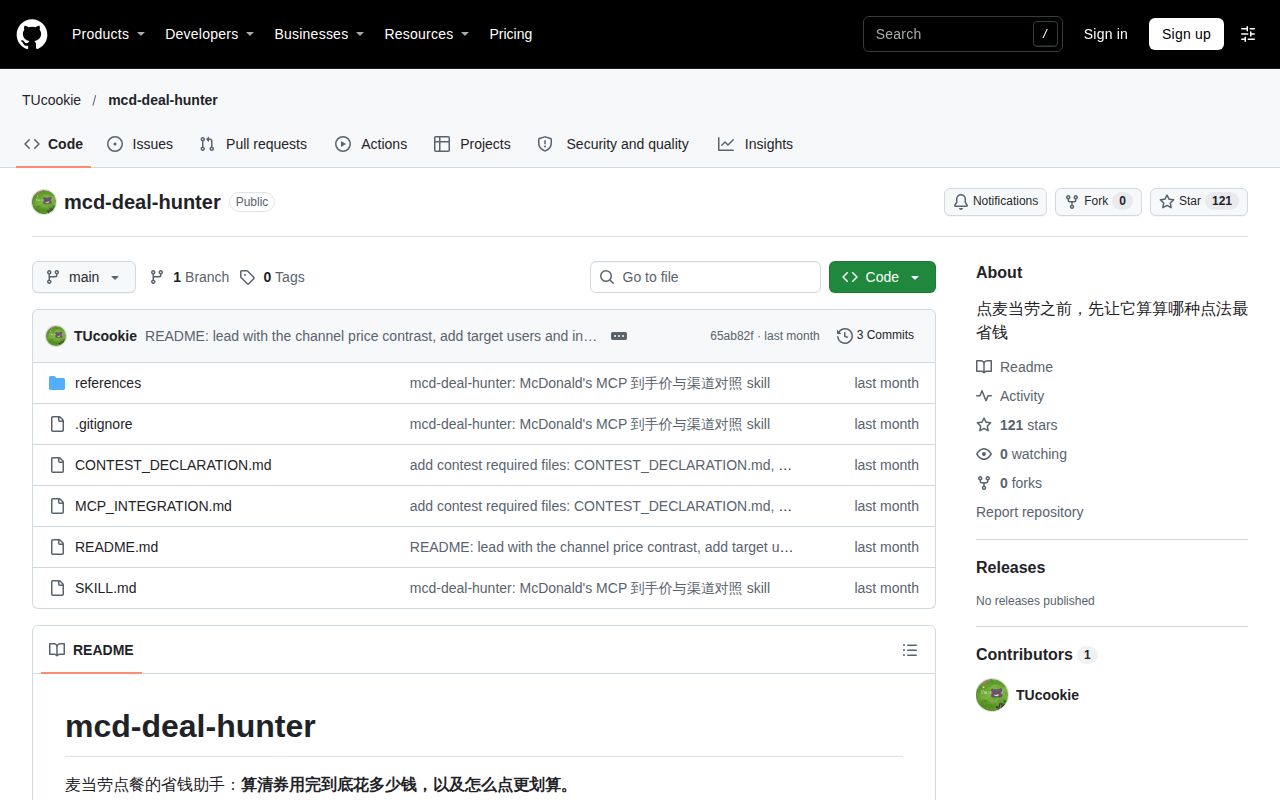
The supplied GitHub metadata observed on 2026-11-17 records 121 stars, zero open issues and pull requests, and a last push of 2026-10-24T04:46:08Z. Its latest-release value is null, which does not prove that no release exists. Current release history and support outcomes remain unverified. These dated facts do not supply a maintenance rating, a license recommendation or a runtime-security assessment. Rendered layout, accessibility and recommendation modules also fall outside this supplied-text assessment.