Magnitude combines a local model runner with an agent
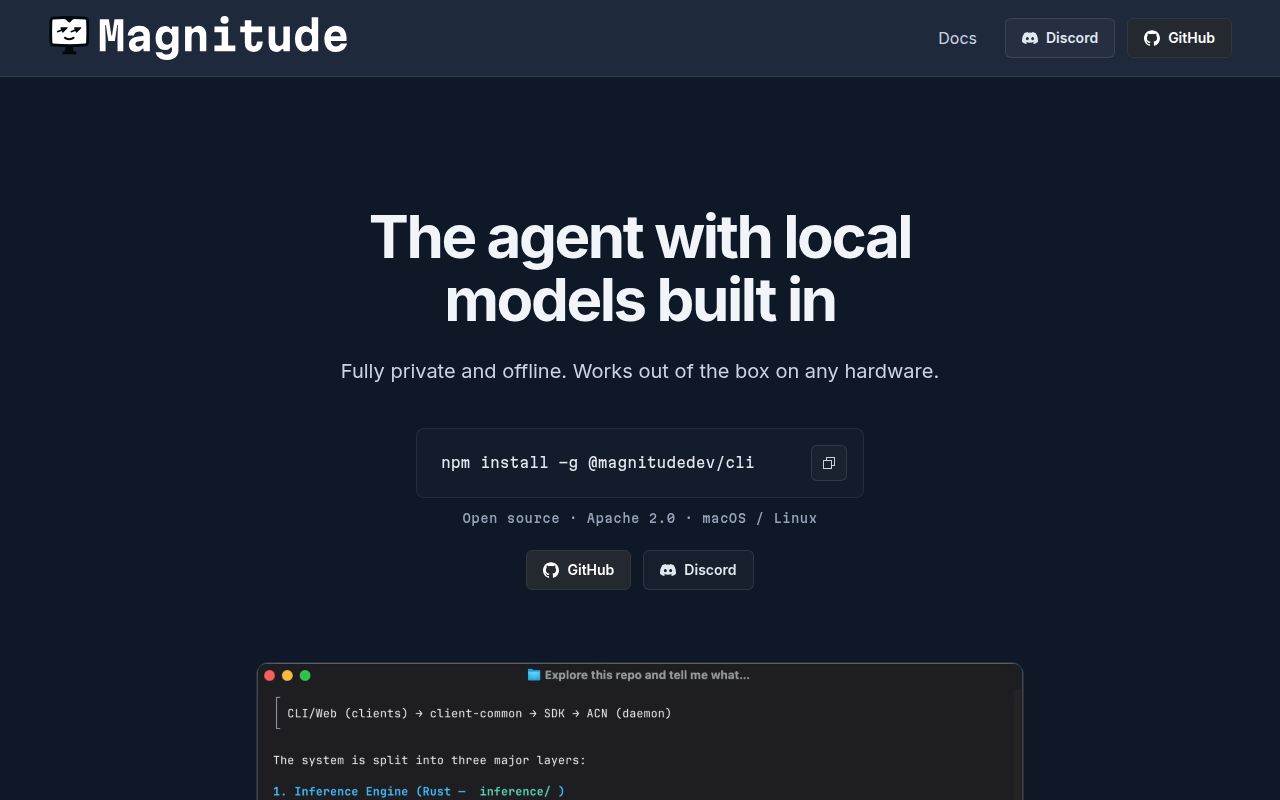
Magnitude is a terminal agent that profiles the host, recommends a GGUF model, downloads it, runs its own inference service, and gives that model file, shell, and skill tools. It aims to remove the decisions between downloading a model and getting useful project work from it. Prompts, files, inference, and saved conversations can remain on the machine after installation.
That is different from Ollama, which primarily serves models for other applications. Magnitude owns model selection, loading, context setup, conversation state, tools, and the interface. It also accepts compatible GGUF files from Hugging Face and OpenAI-compatible endpoints, so users can step outside the catalog without abandoning the CLI.
The integrated route is valuable for a first local-agent experiment. It does not erase hardware limits. A model chosen for 8 GB of memory will differ sharply from one that fits a large unified-memory workstation, especially across multi-step coding tasks.
What happened when we ran it
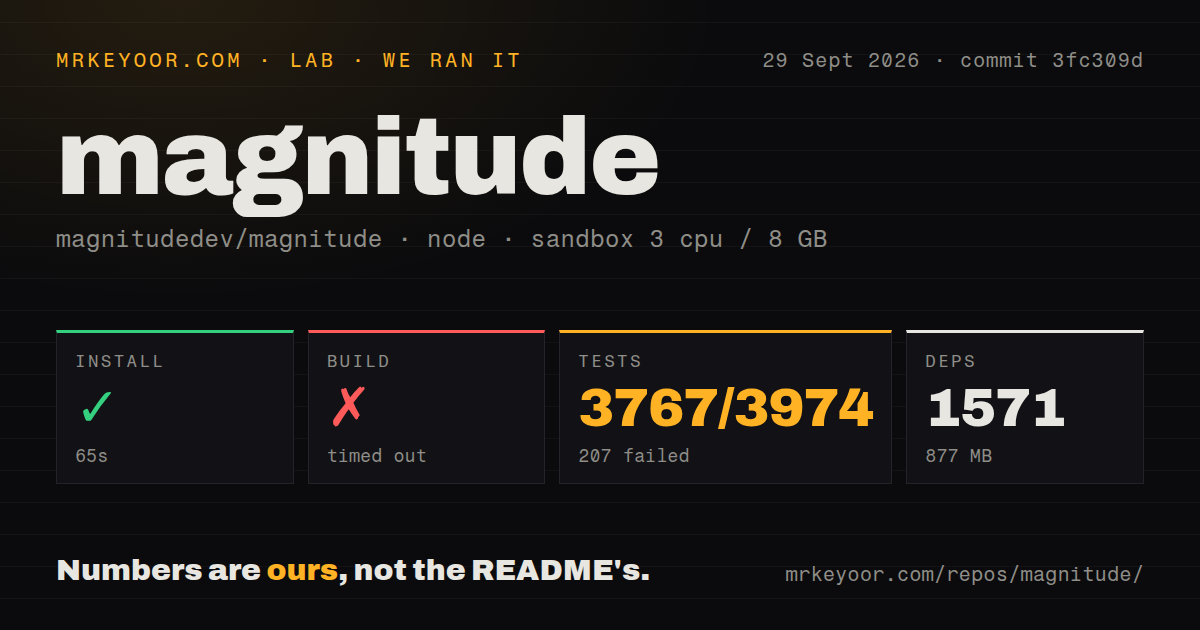
Our sandbox installed 1,511 Bun packages in 40 seconds and occupied 858 MB. The build failed with exit code 1 after 5 seconds. The final lines identify @magnitudedev/inference#build as the failed task, report 0 successful tasks out of 3, and show Bun 1.4.0 exiting the script. The supplied tail does not establish the underlying cause, so that is the narrow finding.
Tests did not finish within the 900-second cap. The last output still showed passing cases in command routing, documentation, a stacked-bar component, and block rendering before the timeout. A timeout is not a failed assertion, but it means our run cannot claim a completed passing suite.
The run used commit 934a3a4 in an unprivileged container with 3 CPUs, 8 GB of RAM, the project's Node.js 22 lab image, and no secrets. The 192.3 MB checkout contained 5,477 files and about 1,115,092 source lines. Our scan found a workspace monorepo, 6 CI workflows, no Dockerfile, and no tests directory.
The published CLI is easier than the monorepo
The user path is three commands: install @magnitudedev/cli globally, enter a project directory, and run magnitude. First launch then profiles the hardware, downloads a native inference component and selected model, verifies them, and loads the model into memory. That means the command is small while the actual installation still includes a large model and native runtime.
There is no fixed hardware minimum in the README. More memory unlocks larger model recommendations, and smaller machines receive smaller choices. Windows users need WSL; native Windows is not supported. Issue 36 remains open with a /bin/sh.exe failure outside that documented path.
Optional web search uses Exa and requires a key, so a session with that capability is not fully offline. Custom GGUF models and external OpenAI-compatible servers are supported, but users then own model format, chat-template, reasoning, and endpoint compatibility that the catalog is designed to avoid.
Hardware detection can undercount unified memory
The hardware-aware catalog is Magnitude's best feature because local model fit is easy to misjudge. Its documentation explains model storage, partial download resume, disposable caches, and the operating-system reserve that separates a model that never fits from one blocked by other applications.
Issue 44 shows the limit of automated profiling. On a 128 GB Strix Halo system, the reporter says Magnitude saw roughly 33 GB of non-VRAM memory but missed a 96 GB pool assigned to graphics. That would recommend a much smaller model than the machine can run. Owners of less common unified-memory systems should compare Magnitude's detected total with operating-system and GPU tools before downloading its choice.
Command warnings do not enforce isolation
Magnitude can inspect and edit project files, execute commands, and use skills for browsers, spreadsheets, presentations, documents, and PDFs. More capabilities make a local model useful, while also increasing the damage from a mistaken command. Local inference keeps data off a model provider; it does not sandbox what the agent does on the host.
Issue 43 makes that distinction directly. It proposes a read-only investigation environment separated from explicit host access because command blocklists can be bypassed through scripts, interpreters, processes, Docker, devices, or networking. The issue describes a proposal rather than shipped behavior. Until isolation exists, use a disposable worktree or container, keep valuable changes committed, and withhold unrelated credentials.
Reasoning-only turns can wedge an Ollama session
Issue 42 documents a CLI 0.0.5 compatibility failure with an Ollama OpenAI-compatible endpoint. A reasoning-only assistant turn can be stored with null content; Ollama rejects that shape, and every later message replays the same bad history. The issue remained open after the 0.0.7 release, whose notes cover auto-update, daemon coordination, and one catalog change.
GitHub showed 1,510 stars, 12 combined issues and pull requests, and a last push on August 26, 2026. Release @magnitudedev/cli@0.0.7 shipped on August 22. That is active maintenance, but the 0.0.x version, open isolation proposal, 5-second build failure, and unfinished 900-second test run describe an early product.
Magnitude is still worth trying on a Mac or Linux project where privacy and offline inference matter. Its setup idea is good. The measured monorepo result says buyers should use a pinned CLI on disposable work, verify hardware detection, and watch every requested action rather than treating the local label as a safety guarantee.