The standard human interface to OpenWrt
LuCI gives OpenWrt a browser-based control panel. On a normal installation it covers network interfaces, wireless settings, firewall rules, software packages, system status, logs, and administration. Optional packages add pages for services such as ad blocking, dynamic DNS, VPN software, file sharing, monitoring, and captive portals. The repository organizes those pieces as modules, applications, protocols, themes, plugins, and libraries rather than one large web program.
That packaging model fits a router distribution. A small device can carry the base interface and only the pages its installed services need. A firmware builder can select LuCI components in the same system used for other OpenWrt packages. When a package is installed, its files land in the router's web root, ucode library path, configuration tree, and rpcd ACL directories as needed. Removing an add-on does not require rebuilding a giant frontend bundle.
For a person managing one router, the attraction is simple: many tasks that would require remembering UCI sections and command syntax become forms with validation and status views. LuCI remains close enough to OpenWrt's configuration model that experienced operators can still inspect or automate the underlying files.
It is an OpenWrt feed, not a Node application
The root package.json can mislead a web developer. Its scripts generate JavaScript documentation, and its dependencies cover JSDoc and ESLint. The working product comes from the OpenWrt package system. The README tells builders to update the luci feed and install its package definitions through the source tree's scripts/feeds commands.
Client pages use LuCI's own JavaScript APIs. Server operations use ucode and rpcd, while UCI holds service configuration. An application package also carries the access rules that let a logged-in session call specific RPC functions. A page, its backend daemon, the expected UCI config name, and its ACL file have to agree. This coupling is reasonable on a router, but it means copying a view into a generic web server will not produce a useful app.
The branch policy reinforces that relationship. Branches named for an OpenWrt release are created during stabilization and receive security or bug fixes. New packages and major upgrades belong on the main development line. Extension maintainers need to decide which firmware series they support and avoid assuming current master code will drop into an older router image.
What happened when we ran it
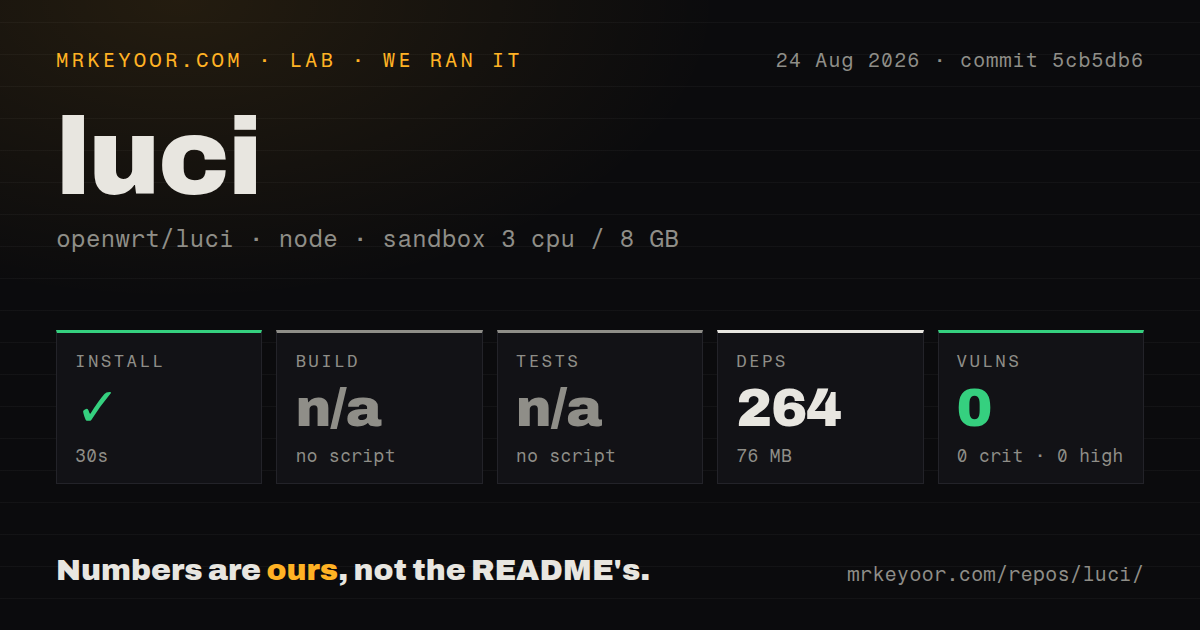
Our lab cloned commit 5cb5db6 into an unprivileged container with 3 CPUs, 8 GB of RAM, Node 22, and no secrets. The repository contained 5,543 files, about 172,992 lines of source, and used 114.5 MB after checkout. npm install completed in 30 seconds, adding 264 packages and 76 MB. npm audit reported zero known vulnerabilities across every severity level.
There was no npm build script or target, so the harness skipped building. There was also no npm test script or target, so it skipped tests. The checkout had five CI workflow files, no Dockerfile, and no tests directory. Those results describe the root Node toolchain only. They do not prove that LuCI packages compile inside OpenWrt or that a router page works with rpcd, UCI, and its corresponding service.
This distinction changes how to read the clean audit. It is useful evidence about the installed documentation and lint packages. It says nothing about the router firmware's full package set, because our npm step did not install or exercise that system. A meaningful product check needs an OpenWrt build and a supported device or virtual target.
Extension breadth creates uneven edges
LuCI's central modules are only part of the repository. The applications directory contained 102 named packages when we inspected it, covering services with different maintainers and backend contracts. That range is valuable, but quality can vary at the edges. One current CoovaChilli report gives a precise example: the page and ACL request a UCI configuration called coovachilli, while the installed backend provides chilli. The result is an RPC resource-not-found error until both references match.
A separate report dating to 2017 says associated stations can disappear from LuCI's status display when 802.1X assigns them to dynamic VLAN child interfaces. Command-line tools still see the clients under interfaces such as wlan0.20, but the page may not aggregate them under the parent radio. The issue was still receiving updates in August 2026. Network administrators using less common arrangements should compare important status screens with the underlying commands before relying on the UI.
Authentication plugins have a current boundary too. An August 2026 request explains that plugin hooks run after password verification and can approve or reject that login, but cannot establish a user's identity on their own. Teams wanting OIDC or passkeys as the primary sign-in method currently need out-of-tree work that recreates sensitive session and ACL behavior. That is a poor place to improvise.
Maintenance and the decision
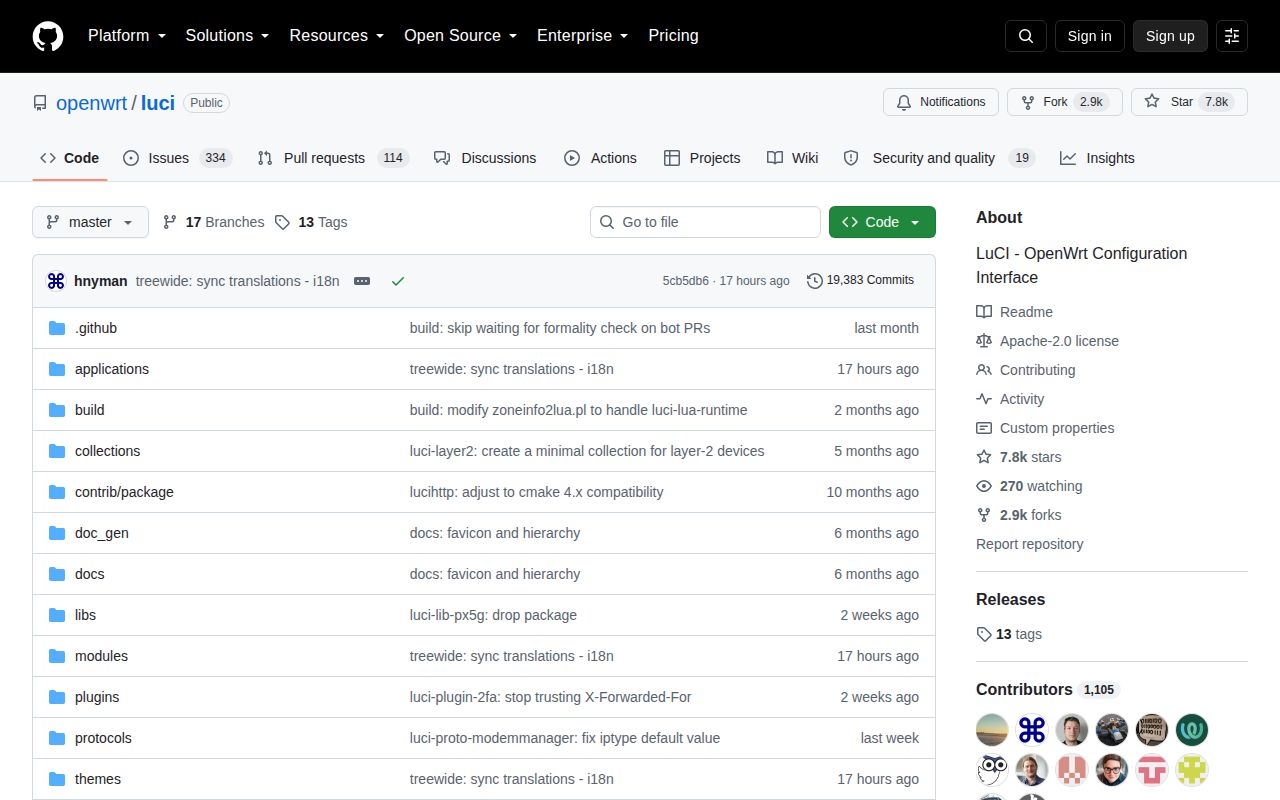
The repository was pushed on August 23, 2026, and an authentication design request was opened and discussed that day. GitHub showed 448 open issues and pull requests together. The queue is substantial, which fits a mature interface spanning core modules and many add-ons. Recent code movement plus current issue updates are better health signals here than a latest GitHub release, because that endpoint returned no release and the project tracks OpenWrt release branches.
Documentation is split across the short README, a development wiki, generated client API pages, contribution rules, and code inside each package. That is enough for an experienced OpenWrt developer, though newcomers must assemble the architecture from several places. The signed-off commit requirement and branch rules are stated clearly. Translations go through Weblate instead of direct edits to language files.
LuCI is the sensible default for interactive OpenWrt administration. Keep shell access available, especially when diagnosing an add-on page or an unusual wireless setup. Developers should test the complete package against the intended firmware branch, since a successful npm install checks only a small support layer around the actual interface.