
One 22B model family generates video and synchronized audio
LTX-2 is a codebase for running and training Lightricks' audio-video models. The recommended LTX-2.5 path uses a 22B transformer, a tuned Gemma 4 12B text encoder, separate video and audio VAEs, and an optional spatial upscaler. The headline difference from many open video generators is synchronized sound: a prompt can describe visible action, speech, and audible events for one generation process. That makes the project interesting for shots where dubbing audio onto a silent clip would create extra alignment work.
The repository has more than one pipeline because production video is not one setting. A distilled path favors fewer inference steps. DFR adds generated keyframes and a spatial detailing pass. Other modules cover keyframe interpolation, audio-conditioned video, retaking a time region, HDR output, and rephrased dubbing that preserves lip movement. This breadth is useful in a studio experiment, but it also means a team must choose a pipeline and pin its exact component set before results are repeatable.
The quick start requires roughly 66 GiB of model files
Installing the Python repository is the small part. The README's first Hugging Face command downloads the distilled transformer, text encoder, both VAEs, and a spatial upscaler, roughly 66 GiB in total. Access can return 401 or 403 until the user accepts the model terms and supplies a read token with gated-repository permission. Optional DFR detailing, temporal upscaling, alternate decoders, and development weights add more files with their own compatibility rules.
LTX-2.5 components cannot be mixed casually with the older LTX-2.3 set. The README says the checkpoint layouts differ, and a LoRA only works with the model it was trained against. Even within 2.5, the full transformer belongs to guided two-stage pipelines, while the distilled transformer powers the fast path and DFR. A deployment manifest should record every file name and hash. "LTX-2.5" alone is not enough to reproduce a run.
What happened when we ran it
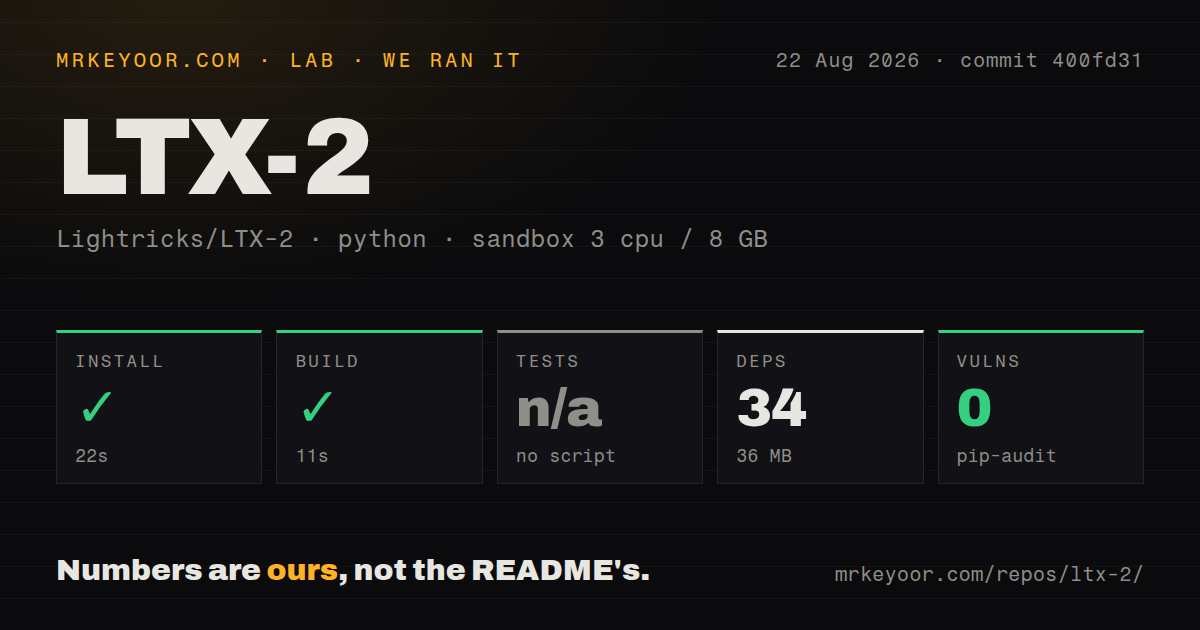
Our sandbox cloned commit 400fd31 and installed 34 Python packages in 22 seconds. The installed environment used 36 MB, and the repository checkout was 3.7 MB with 408 files and about 64,034 lines of source. The build completed successfully in 11 seconds. Pip-audit found 0 known vulnerabilities in the packages installed by that controlled setup.
There was no test script or target, so we skipped tests. Our scan also found 0 CI workflow files, no Dockerfile, and no tests directory. Those facts apply to the checked-out commit and the commands our lab could discover. They do not measure generation quality, GPU compatibility, inference speed, audio synchronization, or whether any 66 GiB model bundle loads correctly. We did not download the weights or render a clip in this run.
The distinction matters because a passing 11-second build checks package construction, not the expensive path buyers care about. Before adoption, run a fixed prompt set through the chosen pipeline, decode every output with an independent media tool, record GPU peak memory, and compare upgrades with the same seeds and component files. None of those results can be inferred from our build.
CUDA backends and offload choices determine the usable path
The fastest documented DiffVAE decoder path uses natten on Linux with CUDA. Windows and macOS skip that extra and fall back to Triton or eager attention. Hopper and Blackwell systems have separate FlashAttention or quantization advice. DFR's default output is 1024 by 1536 at 24 fps, while the documented UHD command uses 3840 by 2176 because 2160 does not fit the model's size grid. These details make the README much more useful than a generic "CUDA required" note.
Memory pressure still shapes architecture. The CLI supports FP8 casting and CPU or disk offload. Issue #232 describes a 96 GB GPU running out of memory when a new prompt caused the Gemma encoder to join resident transformers; the reporter wanted component-specific offload rather than one global choice. That is one serving setup, not a universal requirement. It shows why a successful single prompt does not prove a warm multi-user service will handle a cache miss.
Specific decoder reports justify output checks
Issue #288 reports that image-to-video generation at 1216 by 832 repeatedly hit an illegal CUDA memory access on an RTX Pro 6000 Blackwell, while text-to-video at that size and image conditioning at smaller heights worked for the reporter. Issue #277 documents gray tails linked to automatic DiffVAE tiling near a flattened-element boundary on an A100. Version 1.3.0 says automatic tiling fixes several memory cases, but adopters should verify their exact resolution, clip length, decoder, and GPU.
These are not reasons to dismiss the model. Video systems combine large tensors, hardware-specific kernels, media encoding, and several stages where a valid file can still contain a bad frame. A useful acceptance suite should inspect every frame for flat-color regions, decode the entire file with ffmpeg, confirm audio duration, and rerun troublesome aspect ratios. Visual review remains necessary because a technically readable MP4 can still be unusable.
Version 1.3.0 moves quickly and changes interfaces
GitHub recorded a push on August 26, 2026, 9,258 stars, and 37 open issues and pull requests. Release v1.3.0 arrived the same day. Its notes add multi-GPU DFR and 4K finishing options, while changing DFR arguments and replacing tuple returns with a named output object. That is healthy engineering activity, but it also creates migration work for scripts written against earlier releases. Pinning is mandatory for a production render queue.
LTX-2 is worth the operational cost when synchronized audio and picture are central to the product and the team already understands GPU inference. Our 22-second install makes code inspection easy, not deployment cheap. The missing test target and current hardware-specific reports mean each buyer needs a private qualification run using the exact weights, dimensions, and accelerator that will serve real jobs.