Clang users can start with a release package
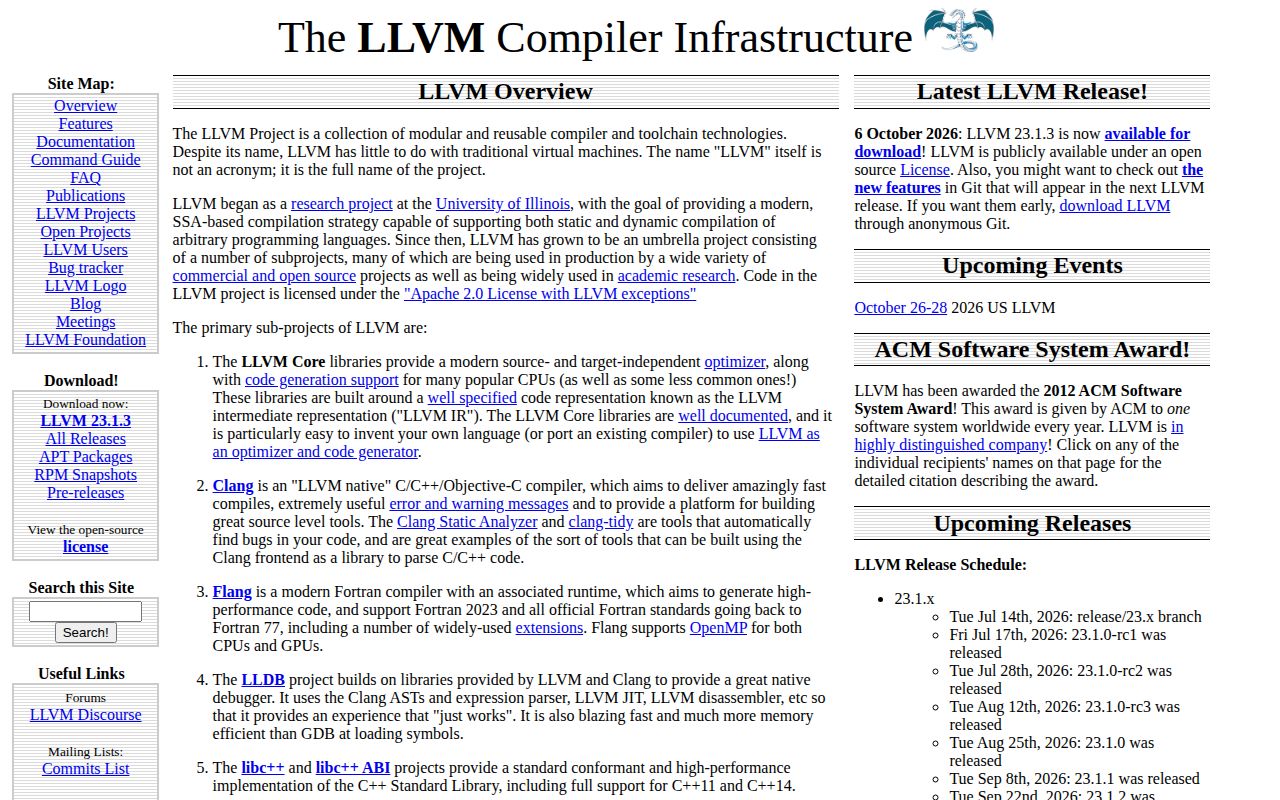
Downloading the full LLVM source tree is an expensive way to get a C++ compiler you don't intend to change. The LLVM 23.1.3 release supplies packages for Linux, macOS Apple Silicon, and Windows. Start there if your job is compiling an application. This repository earns its keep when you need to work inside the compiler or reuse its libraries.
Our checkout occupied 2,372 MB and contained 186,140 files, with roughly 17,537,902 lines of source. That footprint buys access to the compiler's internals and neighboring projects. It also makes the decision concrete: a team changing an optimization needs those files; a developer trying Clang on an existing application usually needs a packaged toolchain. Choose the entry point before you clone.
What happened when we ran it
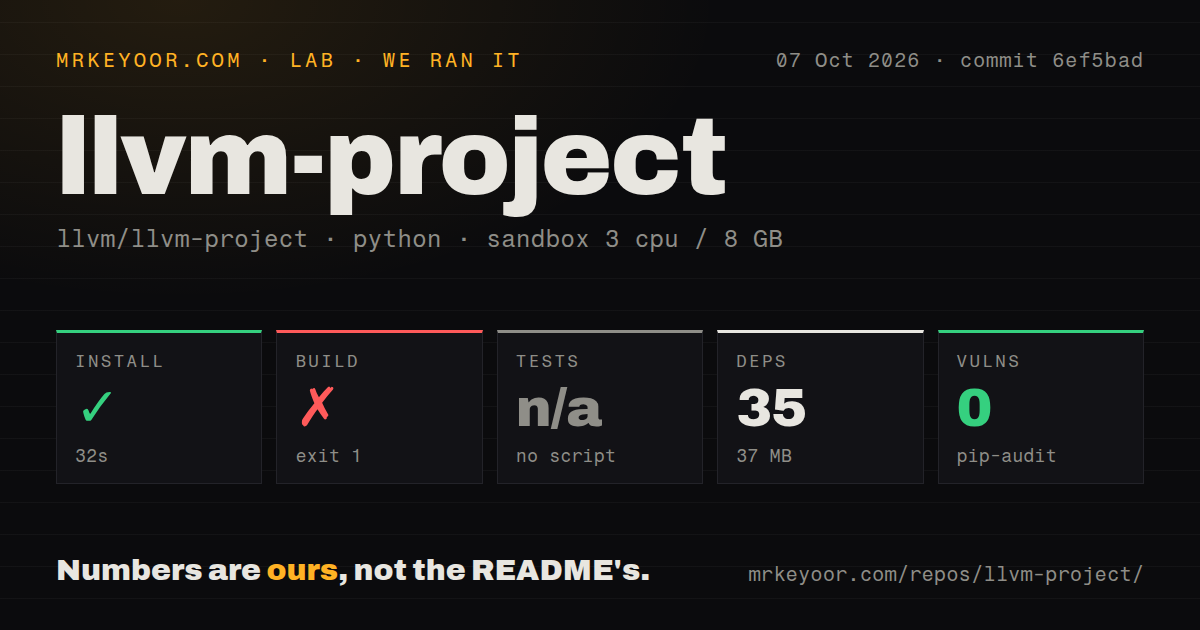
Our run installed 35 Python packages in 32 seconds, using 37 MB on disk, then failed its build step after 10 seconds with exit code 1. We cloned commit 6ef5bad on October 7, 2026, in a fresh Debian container with 3 CPUs and 8 GB of RAM. The image was ghcr.io/astral-sh/uv:python3.12-bookworm, running without elevated privileges or secrets.
The log tail shows Python syntax warnings. In llvm/utils/update_test_prefix.py, Python flags invalid escape sequences in regular expressions. In mlir/test/Integration/Dialect/SparseTensor/python/test_output.py, it flags comparisons using is with integer literals. The Python 3.12 environment reported those warnings, but the supplied tail contains no explanation of the fatal exit. Blaming a missing package, memory pressure, or those warnings would require evidence we don't have.
Tests were skipped because the harness found no test script or target. Pip-audit reported 0 known vulnerabilities in the installed Python environment. Neither result establishes compiler correctness, and that audit does not cover every native component in this checkout. We have a successful dependency step and a failed build step, with no test result to soften or explain the failure.
The scan found 58 CI workflow files, no Dockerfile, and no directory named tests. Those are discovery signals with obvious limits: the supplied warning paths themselves include mlir/test. A directory-name scan cannot establish that LLVM lacks testing infrastructure. The defensible finding is that our automated route did not reach a usable test command in this run.
The Python result leaves the native toolchain unverified
The getting-started guide directs source users through CMake with a host C++ toolchain and a build tool such as Ninja or Make. The top-level README links to that guide instead of promising a short Python setup. Building the compiler is local work, with no hosted inference account or service credential in the documented path. You still need the appropriate system tools.
Our harness labeled the ecosystem Python, and its 35-package installation left 37 MB of dependencies. Those figures describe the route we ran. They don't show that Clang or LLVM's native libraries were produced. Keep the successful install separate from the compiler decision: we cannot use this run to estimate a native build's duration, output size, or readiness for your target machine.
You can select Clang without enabling every neighboring project
The README describes a useful division of work: Clang reads C-family source, while LLVM processes an intermediate representation and emits object files. That intermediate representation is a lower-level form of your program that the optimizer can transform. The repository also contains the LLD linker and libc++ standard library. Compiler developers can change a stage without writing every surrounding component themselves.
With 186,140 files in our clone, selecting a small working area matters. The CMake guide documents separate project and runtime selections, plus target selection and controls for parallel compilation and linking. Write those choices into your configuration before asking colleagues to reproduce it. A checkout that contains Clang, libc++, and other components doesn't mean your chosen configuration enables all of them.
API stability needs an explicit boundary
LLVM's developer policy calls C API stability a best-effort commitment. It distinguishes relatively abstract operations from interfaces that closely follow changing internals. If your product requires an unchanging integration interface, that qualification is a reason to reconsider embedding LLVM. Pinning a release and checking the operations you actually use is a more credible policy than assuming every exported function stays fixed.
Our 3-CPU, 8-GB sandbox supplied no passing build or test evidence for commit 6ef5bad. For an embedding project, I'd require a follow-up using the documented native configuration and representative programs before choosing it. That work should answer your application's question: can the selected libraries generate the required output and survive an upgrade? The Python warnings cannot answer either part.
October activity shows maintenance, not a clean bill of health
The repository's last push was October 10, 2026, and GitHub listed 40,998 stars plus 40,183 open issues and PRs. Recent pull requests addressed optimization behavior, while open issue 230816, updated that day, reports a Clang crash involving parentheses in a matrix-type declaration. The report concerns an upstream assertion build, separately from our sandbox failure. That activity shows ongoing maintenance, though queue size alone cannot tell you how quickly your report will receive attention.
For ordinary C or C++ compilation, GCC is the direct alternative. For embedding machine-code generation in a Rust runtime, consider Cranelift, which lives in Wasmtime and translates its own intermediate representation into executable code. Neither has a comparison result from our sandbox. Take on LLVM's 2,372-MB source checkout when you can name the compiler behavior you need to change; otherwise, start with the release package.