
Four avatar models share one streaming API
LiveTalking can drive ER-NeRF, MuseTalk, Wav2Lip, and Ultralight-Digital-Human avatars from text or uploaded audio. The server can synthesize speech, accept an optional language-model reply, generate lip movement, and send the result through WebRTC, RTMP, or a virtual camera. Its browser pages cover conversation, avatar creation, recording, and administration. The /human and /humanaudio endpoints also let another application control the avatar without using the included page.
That combination is more useful than a single talking-head notebook. Speech can be interrupted, idle video can be choreographed, and each connection receives a session ID. TTS choices include EdgeTTS, GPT-SoVITS, CosyVoice, and Tencent Cloud. The registry mechanism lets developers add avatar, speech, and output handlers. A customer-service product still needs its own knowledge source, access control, consent rules, and monitoring around those components.
A GPU and UDP access are part of the basic setup
The documented quick start installs PyTorch 2.9.1 for CUDA 12.8, downloads a Wav2Lip checkpoint, unpacks an avatar under data/avatars, and starts the service on port 8010. The README recommends an RTX 3060 or better for Wav2Lip256 and an RTX 3080 Ti or better for MuseTalk. The project supplies those GPU recommendations; our hardware run did not test them.
WebRTC also changes the network plan. The README tells operators to expose TCP 8010 and UDP 1-65536. That may be acceptable on an isolated GPU instance, but many production networks will require a narrower media design, TLS termination, and explicit firewall review. RTMP and virtual-camera output have different operating requirements. Pick the transport before buying capacity because the server divides work between CPU video encoding and GPU lip inference.
What happened when we ran it
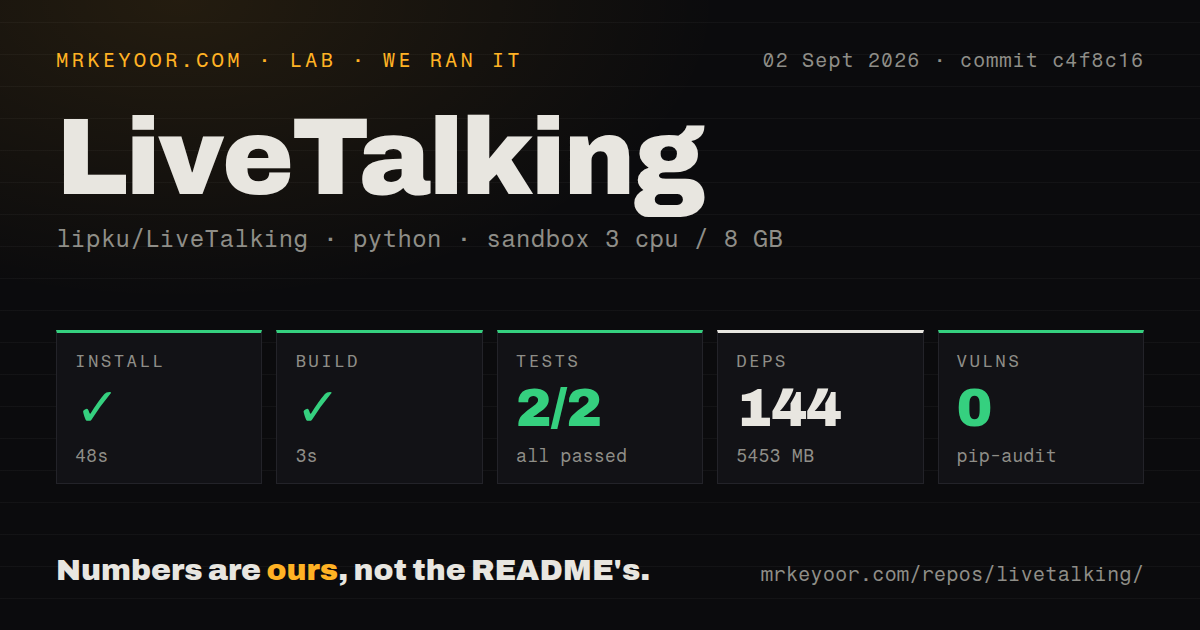
Our sandbox installed commit c4f8c16 in 48 seconds. The process added 144 packages and used 5,453 MB on disk, a large base before downloading the avatar archives and model checkpoints named in the quick start. The build passed in 3 seconds in an unprivileged Debian container with 3 CPUs, 8 GB of RAM, Python 3.12, and no secrets.
Pytest completed in 4 seconds with 2 passed and 0 failed out of 2. Pip-audit reported 0 known vulnerabilities. The checkout itself contained 176 files, roughly 19,415 lines of source, and occupied 6 MB. It had a Dockerfile and tests directory but 0 CI workflow files. We did not run a GPU avatar, open a WebRTC peer, call a speech provider, or assess visual synchronization in that sandbox.
Two tests leave session cleanup largely unguarded
Two passing tests offer little coverage for four avatar engines and three output paths. Open issue 615 reports that closing a WebRTC browser session removes its dictionary entry without stopping render, inference, compositing, and TTS threads. The reporter measured about 3 CPU cores consumed per disconnected session on one MuseTalk deployment. Open pull request 616 proposes calling the existing shutdown chain during removal, but it was still open when checked.
That report lands directly on LiveTalking's multi-user claim. A prospective operator should connect, interrupt speech, refresh, close, and reconnect repeatedly while watching threads, GPU memory, CPU, and session counts. Recording and avatar-creation jobs need similar cleanup checks. The repository's 4-second test run cannot answer those questions, and the issue reporter's hardware result should not be treated as a universal capacity figure.
The Chinese and English setup pages disagree on Ubuntu
The primary README is Chinese and links to a substantial English translation plus an English documentation site. Both editions explain model downloads, web pages, APIs, streaming modes, and GPU expectations. There is one concrete drift point: the Chinese page says the stack was tested on Ubuntu 22.04, while the English page says Ubuntu 24.04. Both name Python 3.12, PyTorch 2.9.1, and CUDA 12.8.
Users should treat the language-specific README as orientation, then pin the actual container, driver, CUDA, and model combination they verify. The repository is Apache-2.0 licensed, while a separate README statement says videos published on Bilibili, WeChat Channels, and Douyin must carry the LiveTalking watermark and logo. A white-label team should resolve that publishing requirement before building templates and customer workflows around the output.
An August 30 push and 236 issues and PRs show current work
GitHub recorded the last push on August 30, 2026 and listed 236 open issues and pull requests. Issue 615 and its proposed fix were active on September 2. Release v2.0.4 arrived on June 20 with YAML configuration support and a documented priority order of command-line arguments, YAML values, then defaults. The combined open count includes pull requests and says more about queue size than defect count.
LiveTalking is worth a controlled trial when real-time avatar streaming is the actual product requirement. The shared API and output choices save integration work, while the 5,453 MB environment, model downloads, GPU floor, broad UDP instruction, and thin suite move risk into operations. Before serving real users, pin one backend, rehearse disconnect cleanup, test the chosen TTS path, and measure the exact avatar resolution on the GPU you will deploy.