11 main crates separate the chain from the application SDK
Linera's README introduces 11 main crates, starting with cryptography and storage views and ending with the client, service, and SDK. The protocol's distinguishing idea is the microchain: an application can spread state over many chains that share validators and security. A chain may have one owner, several owners, or public block proposers. This makes independent activity easier to separate, although developers have to think about where state lives instead of treating the network as one shared database.
Cross-chain work is asynchronous. A message enters the receiving chain's inbox and takes effect when a later block selects it. That model can suit games, marketplaces, or user-owned state where most actions stay local. It changes application reasoning around ordering and liveness, especially when a receiving chain is quiet. The scale of the implementation matches that ambition: our checkout had 2,481 files, about 311,927 source lines, and occupied 35.2 MB before its Rust dependencies arrived.
2 Wasm components deploy through a Linera wallet
A Linera application deploys 2 Wasm artifacts, a contract and a service. Developers write them with the Rust SDK, configure a wallet, compile for wasm32-unknown-unknown, then use publish-and-create with initialization data. The wallet decides whether the target is a local network or the current public testnet. Interacting with the deployed application also requires a node service, so the finished shape includes more than an SDK crate embedded in a normal web backend.
The repository includes examples plus storage, faucet, indexer, explorer, bridge, RPC, and service crates. That is useful for protocol work and expensive for a casual evaluation. Our install pulled 967 packages in 72 seconds before Cargo could finish one normal build. A developer interested only in application code can install the published CLI and SDK crates, but anyone changing the protocol enters a large workspace with system tools, service processes, and network fixtures.
What happened when we ran it
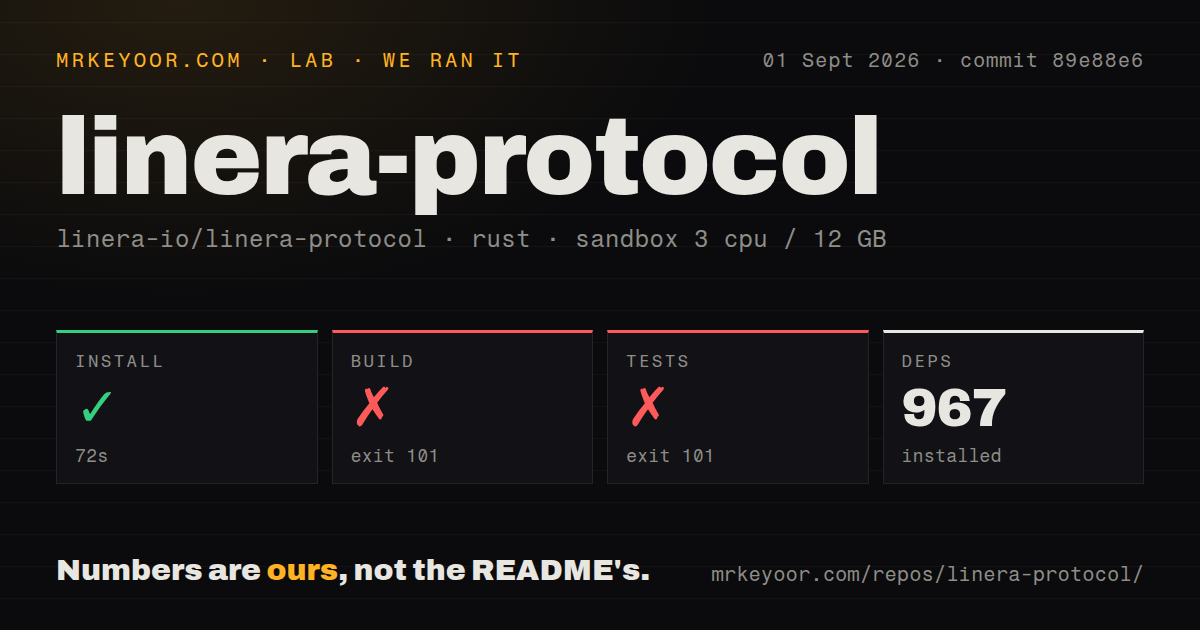
Our sandbox installed 967 packages in 72 seconds, then the build failed with exit 101 after 27 seconds. The measurement setup used commit 89e88e6, 3 CPUs, 12 GB of RAM, a Rust lab image, Debian, an unprivileged container, and no secrets. Cargo reached build scripts for the ordinary Rust dependencies quote and proc-macro2, where linking stopped before the Linera binaries were produced.
The test command failed with exit 101 after 23 seconds at the same stage. In both log tails, clang says invalid linker name in argument '-fuse-ld=lld'; Cargo then reports that quote and proc-macro2 could not compile their build scripts. The checked-in x86_64 Linux Cargo config selects clang and passes that lld argument. The logs do not identify whether a different compiler, linker installation, or project setting is intended, so we cannot narrow the remedy further.
Our scan found 26 CI workflow files and no Dockerfile or tests directory. Rust projects commonly keep unit tests beside source, so the missing directory does not mean the repository has no tests. The failed command means none completed in our sandbox. This distinction matters: 967 packages installed successfully, yet a fresh Rust image still did not satisfy the link configuration. Linera's own INSTALL.md warns about compilation disk space and lists more tools for the full test workflow.
Rust 1.95.0 is only the first prerequisite
commit 89e88e6 pins Rust 1.95.0 with clippy, rustfmt, rust-src, and the wasm32-unknown-unknown target. The Linux guide also requires Protoc and says some distributions may need g++, libclang-dev, and libssl-dev. Testing the repository adds jq, Docker, cargo-rdme, taplo-cli, cargo-all-features, and cargo-machete. Nix is offered as an experimental way to enter a prepared development environment on Linux or macOS.
Platform support is narrower than Cargo alone suggests. Linux x86-64 is the main target, both Intel and Apple Silicon macOS are listed as working, and Windows is untested. INSTALL.md tells Windows users to use WSL. Our 27-second build failure shows why the native toolchain details matter: Cargo downloaded the graph, but the configured C linker still stopped compilation. Budget time for the exact compiler, linker, Protoc, Wasm target, and test utilities before debugging protocol code.
v0.15.21 is a testnet prerelease, not a stable mainnet line
Release v0.15.21 was published on August 14, 2026 and marked as a prerelease. GitHub's latest-release endpoint returned no stable release, while the release list contained recent v0.15.x prereleases. The developer manual directs users to the current testnet. Its roadmap labels stable EVM support, governance, tokenomics, storage durability, security audits, and mainnet as later work, and warns that the roadmap may change. Buyers should treat those entries as aspirations rather than shipped guarantees.
Current issues expose the kinds of liveness work still underway. Issue 6799 says an internal cross-chain delivery can remain pending on an idle sending chain after retries are exhausted, until another write causes the outbox to be processed again. Issue 6741 describes one slow operator task holding other groups for the same application. Neither report says every deployment loses messages or freezes tasks. Together with our failed 23-second test command, they argue for failure injection and application-specific recovery tests before handling valuable state.
32,138 stars come with daily protocol activity
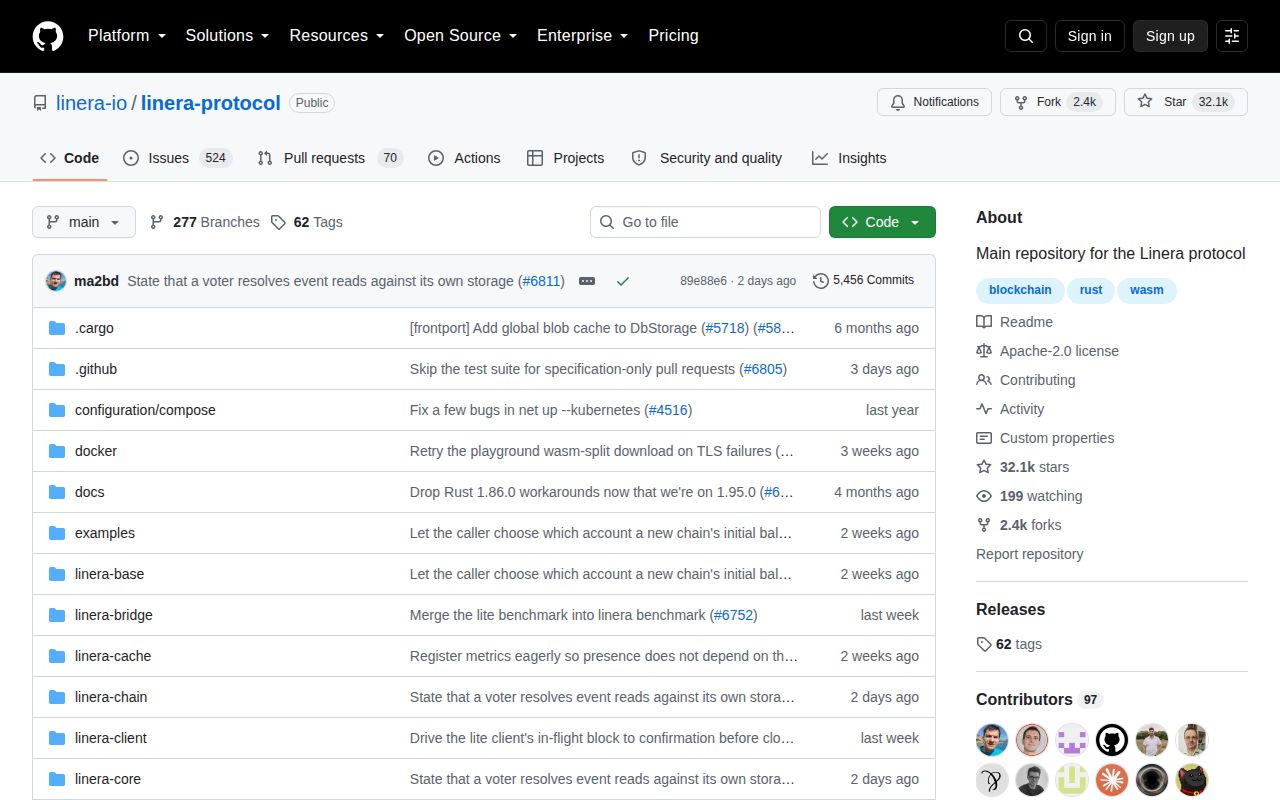
GitHub showed 32,138 stars and a last push on September 1, 2026. Issues and pull requests were also being opened or updated through that date, including work on cross-chain delivery, storage reads, task cancellation, and block export. A prerelease testnet is not a stable production platform, although the roadmap is backed by visible implementation work rather than an idle repository.
The combined queue stood at 594 issues and pull requests, not 594 confirmed bugs. One open item labels an existing-testnet compatibility workflow flaky, and v0.15.21 includes fixes for validator examples, dashboards, cross-chain forwarding, and task handling. Linera is a serious protocol research and testnet option for a Rust team that wants its microchain model. A team choosing infrastructure for production funds should wait for the specific mainnet, audit, release, and recovery guarantees it requires.