The interface joins six sensitive domains in one account
Life IPO combines finance, health, qualifications, contacts, AI decision support, and team execution. The main site uses one user identity and exposes data to specialist workspaces rather than keeping six unrelated accounts. Its README is written in Chinese and labels the product alpha. We found no English guide. That language boundary matters because the configuration and safety notes cover personal records that should not be deployed through machine translation alone.
The scope is unusually broad for a repository created on August 25, 2026. Screenshots cover 14 pages, including budgets, portfolios, medical timelines, knowledge records, contact histories, AI planning, and a team board. The intended flow is clear: collect facts, ask a model for a decision, then turn the result into tasks and review it later. The breadth also multiplies the consequences of a permissions bug or incorrect recommendation.
Six local services make the quick start Windows-specific
The documented launcher requires Windows 10 or 11. It coordinates a Vinext main site on port 3010, contact and knowledge applications on ports 3002 and 3020, a health graph on 8767, an AI planner on 7341, and a team workspace on 7351. Node.js 24 and Python 3.11 or newer are required for the full setup, while the main site alone accepts Node.js 22.13.0 or newer.
Each service brings configuration. The main site needs JWT and AI credential encryption secrets. Health data has separate session and encryption keys, while knowledge and team services require their own application secrets and databases. Cloudflare deployment needs a Sites project and D1 binding. DeepSeek calls need an API key. The README advises HTTPS, rate limiting, encrypted backups, audit logs, and least privilege for public hosting, but those controls are deployment work for the operator.
What happened when we ran it
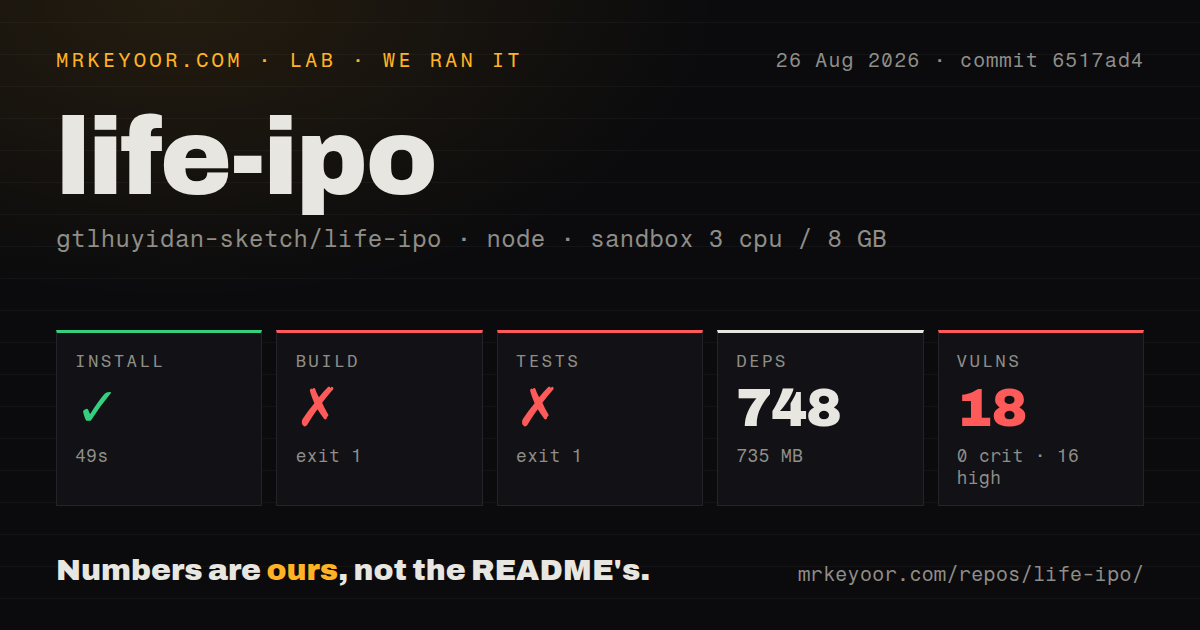
Our sandbox installed 748 npm packages in 49 seconds and consumed 735 MB. The build then exited with code 1 after 8 seconds. The log tail shows an error traveling through Rolldown's binding wrapper while Vite was bundling and loading its configuration for Vinext. It does not expose the originating message in the supplied tail, so we cannot responsibly name a dependency, platform, or configuration as the cause.
Tests exited with code 1 after 9 seconds. The root test script runs npm run build before its Node test file, and the summary says the build failed with one error. No test cases reached a reported pass or fail result in the measurement. Npm audit found 18 known vulnerabilities among the installed packages: 16 high severity and 2 low, with none classified as critical or moderate.
The checkout held 608 files, about 82,304 source lines, and 27 MB before installation. It has a tests directory, but no GitHub CI workflow and no Dockerfile. That leaves the only measured build red and offers no visible repository automation that would rerun it on a clean host. Cross-platform launch, container deployment, versioned database migrations, and optional encrypted backups all remain unchecked roadmap entries.
The alpha label matches the missing ingestion and migration work
Manual entry currently carries much of the data model. Issue #1 says users may abandon the product within three months if financial, health, knowledge, and contact information must all be entered by hand. It suggests image recognition, a browser extension, and app connections as future directions. The README does not present those inputs as shipped features, so buyers should judge the current forms and imports rather than the proposed collection layer.
Database evolution is another open boundary. A unified migration system and versioned schema appear as unfinished roadmap items. With 6 services and several SQLite or D1 stores, schema upgrades and rollbacks are operational necessities, especially once a user has accumulated health records or financial history. An experimenter can discard sample data after a bad migration. A real user needs tested restoration and documented compatibility.
The relationship proposal creates an ethical reason to walk away
Open issue #2 proposes adding astrology, social posts, avatars, and messages to generate personality profiles and relationship advice. The author acknowledges stereotyping while calling it useful. That is not a minor interface preference. It changes what data may be collected about other people and how unverifiable signals could influence decisions about them. Teams with consent, fairness, or employment constraints have a concrete reason to reject this direction.
The README is more careful about the current AI planner. It says model conclusions can be wrong and that medical, investment, insurance, tax, and legal decisions need review by qualified professionals. DeepSeek credentials are described as AES-GCM encrypted and tied to the user identity, while JSON exports omit several secrets and binary images. Those design statements are sensible, but our 9-second test attempt never reached a passing suite that could support them.
No license means this is not adoptable open source yet
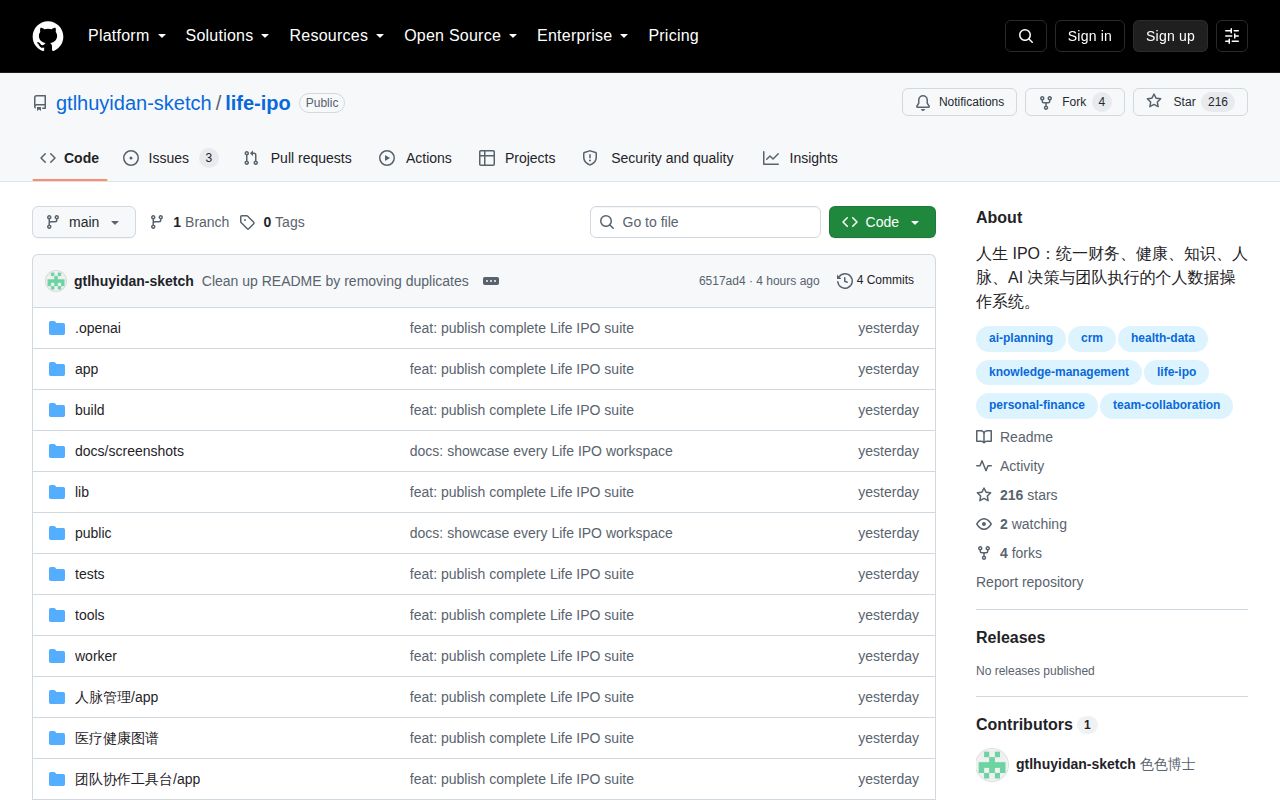
The repository had 216 stars, 3 combined issues and pull requests, and a same-day push on August 26, 2026. There was no latest GitHub release. That activity is too young to establish maintenance habits, upgrade discipline, or response times. The repository's own status label, alpha, is the useful maturity signal.
More decisively, GitHub reports no license and the README says the repository has not selected one. Public source can be read, but that does not automatically grant rights to copy, change, or redistribute it. Actual Budget is a safer focused choice for local-first finances, Firefly III for self-hosted financial records, and Monica for contact history. Life IPO becomes a serious adoption candidate only after licensing, clean builds, dependency remediation, migrations, and a supported deployment path exist.