Librespot turns a host into a Spotify Connect receiver
Librespot is both a Rust library and a runnable headless player. Once authenticated, it can appear as a Spotify Connect device, receive playback from an official client, decode audio, and send sound through a selected backend. The default command is enough to name a speaker and choose a bitrate. Applications can instead use the crates directly for sessions, metadata, playback, discovery, and Connect control.
The repository is compact for that scope: our checkout at commit 1599145 contained 664 files, about 29,962 source lines, and occupied 1.6 MB. Its backend list covers Rodio, ALSA, GStreamer, PortAudio, PulseAudio, JACK, SDL, pipe, and subprocess output. That makes Librespot useful inside network speakers and terminal players, while also creating many combinations of operating system, sound server, TLS provider, and discovery method to support.
Spotify Premium and an unofficial protocol are fixed costs
The README is unambiguous about accounts. Librespot works only with Spotify Premium, and the maintainers say they will not implement the advertising and skip limits needed for free accounts. This is not a local music server either. It still connects to Spotify for authentication, metadata, audio keys, and streams, so an outage or service change can stop a device that otherwise runs entirely on your hardware.
There is also a blunt legal and product warning: the README says using this code to connect to Spotify's API is probably forbidden by Spotify. Librespot replaces a deprecated official library by reproducing client behavior, without an official compatibility promise from Spotify. That may be acceptable for a personal receiver. A commercial appliance or supported installation needs its own policy review and a plan for service changes.
What happened when we ran it
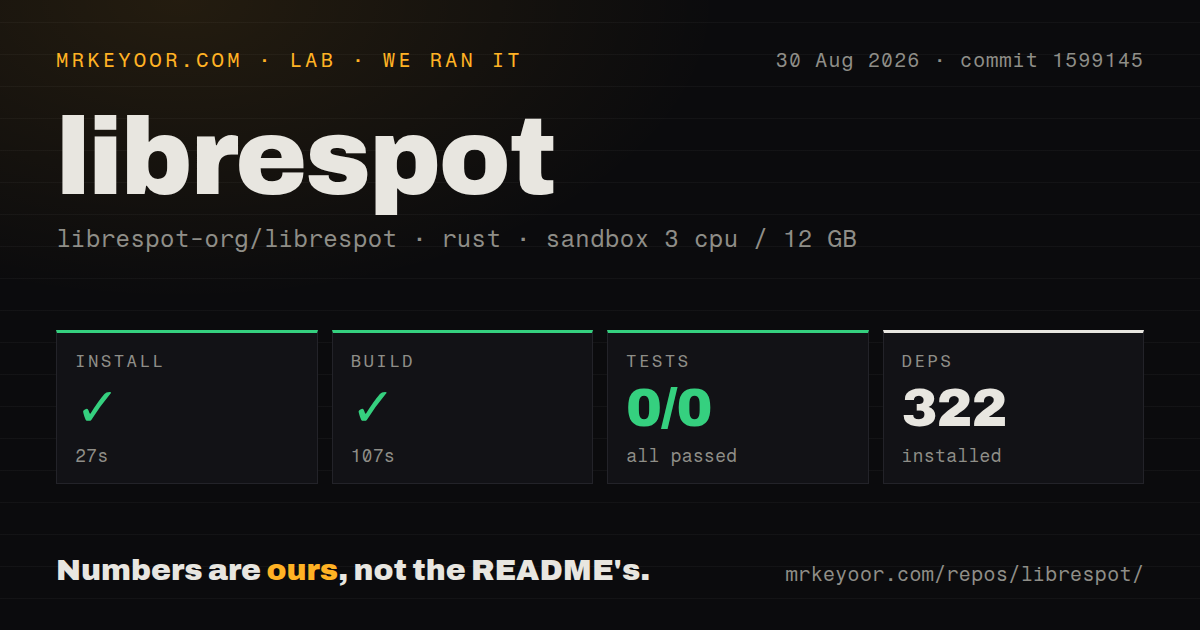
Our sandbox installed 322 Rust packages in 27 seconds. The build succeeded in 107 seconds on 3 CPUs with 12 GB of RAM, using an unprivileged fresh Debian container. The measured repository had 5 CI workflow files, no Dockerfile, and no tests directory. Nothing in the install or compiler output failed.
Cargo test then exited successfully in 21 seconds, but reported 0 passed and 0 failed out of 0. That distinction matters. We confirmed that commit 1599145 resolves dependencies, compiles, and accepts the test command in the lab image. We did not authenticate a Premium account, advertise a Connect device, play audio, or exercise any of the 9 listed output routes. The run supplies no playback-quality or connection-uptime benchmark.
Linux setup depends on the selected audio and TLS backends
The default build uses native TLS, Rodio audio, and libmdns discovery. On Debian or Ubuntu, the README tells users to install build-essential and libasound2-dev. The compilation guide adds libssl-dev and pkg-config for native TLS. ALSA, GStreamer, PulseAudio, JACK, PortAudio, and SDL each bring their own development packages. Mac and Windows need fewer packages for the default Rodio path.
Feature selection deserves attention in embedded or cross-compiled builds. Native TLS and rustls are mutually exclusive, and at least 1 TLS backend is required. Librespot supports system certificate roots or compiled Mozilla roots through different rustls features. Discovery can use libmdns, dns-sd, or Avahi-related paths. A reproducible appliance build should record the exact Cargo features instead of relying on defaults that may not fit its image.
Cached credentials need file permissions, not just a cache flag
A more complete command can set a 320 kbps stream, initial volume, receiver type, normalization, and a cache directory. When caching is enabled, Librespot stores an authentication blob for the Spotify account. The README recommends mode 700 for that directory. Treat it as a credential store in backups, container volumes, and support bundles, rather than ordinary disposable audio cache.
Long-running behavior also depends on Spotify and the host network. Open issue 1419 contains a Raspberry Pi Zero 2 W report where playback stopped after hours following a broken pipe, TLS closure, and audio-key timeout. The report is one environment, not a universal failure. It is enough to justify a restart policy, useful logs, and an endurance test on the exact network and device before placing a receiver somewhere hard to reach.
Current issues expose discovery and login edges
Open issue 1736 reports discovery failing on an IPv4-only TinyCore-based system because IPv6 receiver registration returned an address-family error. Issue 1705 describes LibreWolf sending an empty line before its OAuth callback request; the reporter's local change to skip empty lines restored login, while Firefox worked unchanged. Both cases show how network and browser assumptions can reach an otherwise headless player.
Issue 1737 is more consequential for embedders. Its reporter says code following the repository's play.rs access-token example began returning INVALID_CREDENTIALS after August 10, 2026, apparently after a Spotify service change. The log establishes the failure for that report, not its cause across all users. A product should test its chosen authentication path continuously rather than assume a compiling example remains accepted.
August development matters more than the older release date
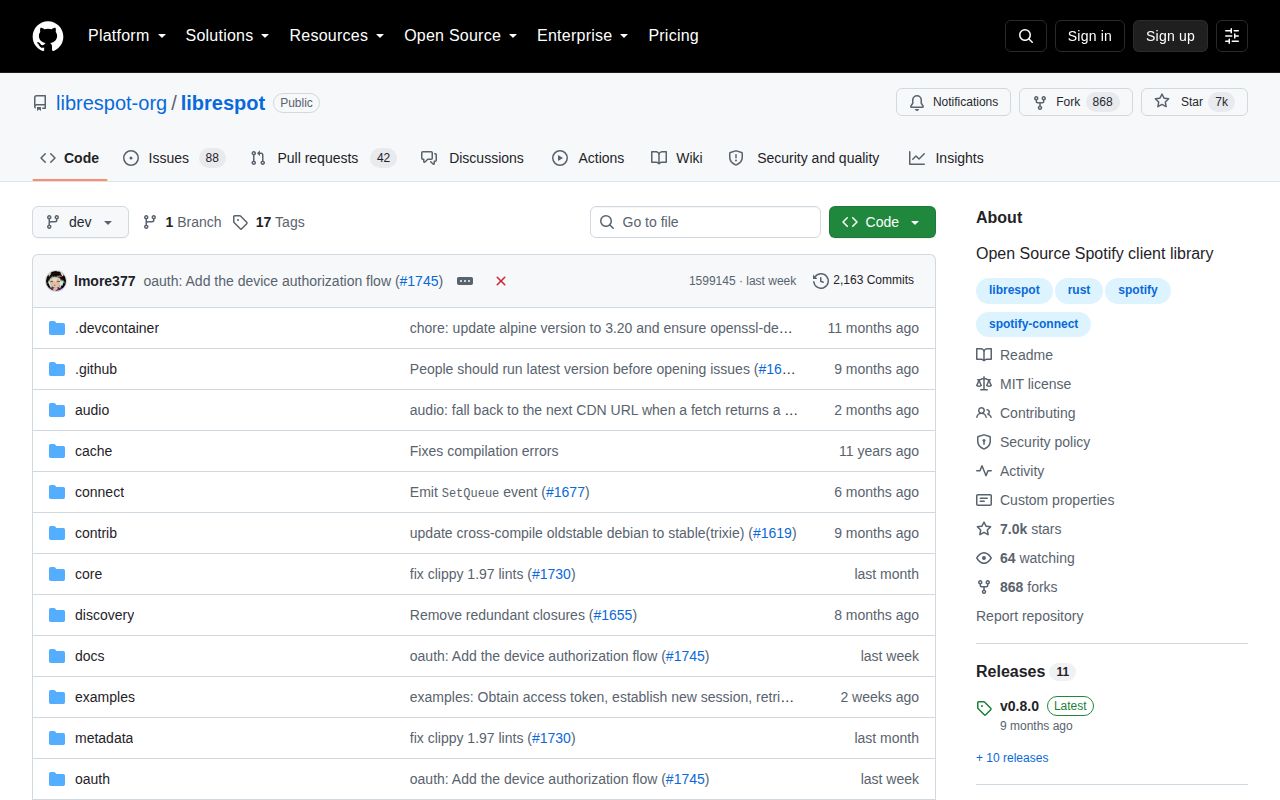
GitHub showed 6,996 stars and 130 combined issues and pull requests when fetched. The last push was August 22, 2026, while the latest tagged release was v0.8.0 from November 10, 2025. That release added device aliases and local-file playback, changed several public types, and included breaking API changes. The newer push and active issue discussion show maintenance beyond the tag date.
Librespot is the sensible foundation when a Rust project genuinely needs Spotify Connect. Our 107-second build was clean, but 0 discovered tests leave account login, discovery, decoding, and audio output outside the lab result. Use a wrapper for a simple household speaker. Embed the crates when you need control and are prepared to track Spotify behavior, pin Cargo features, protect cached credentials, and test the device for hours rather than minutes.