The Digital Detective's Directory
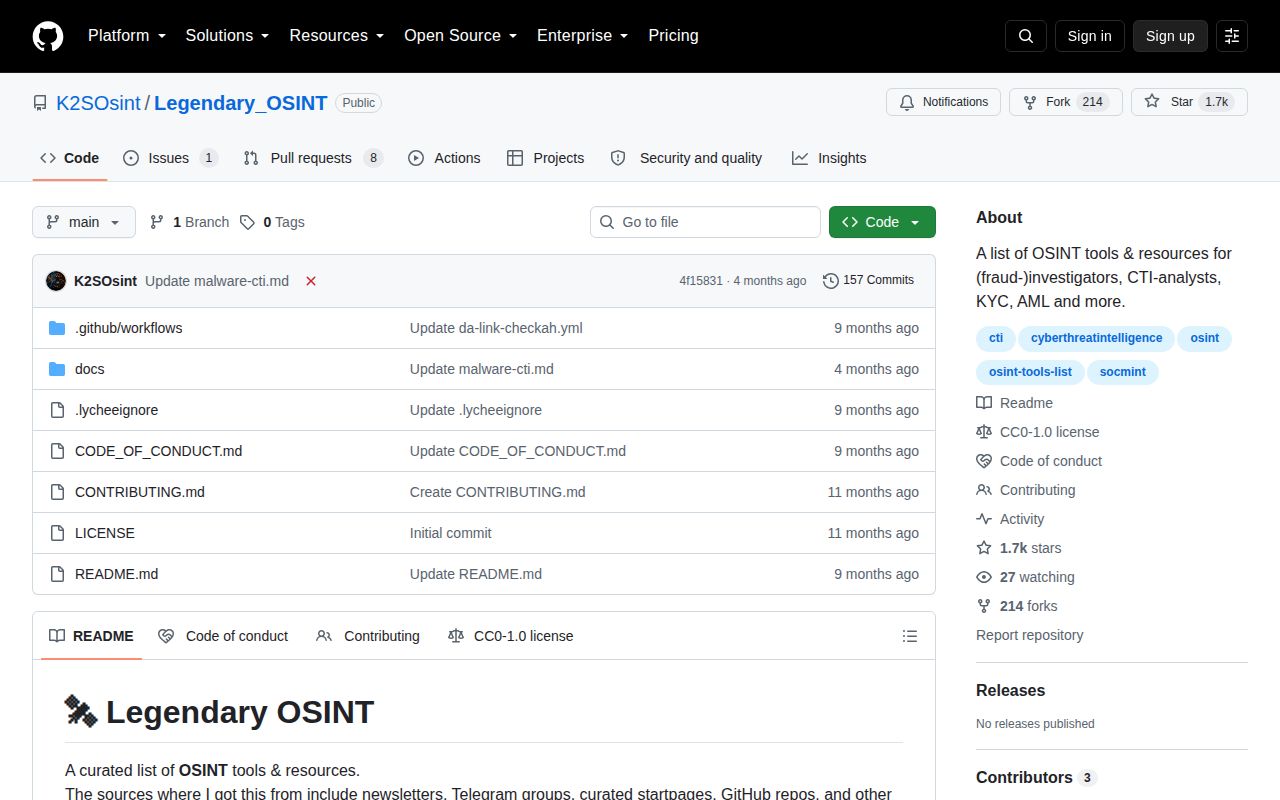
Open-Source Intelligence (OSINT) is the art and science of gathering information from publicly available sources. For investigators, journalists, and security researchers, the field is a goldmine. The challenge, however, isn't a lack of information but an overwhelming abundance of tools designed to find it. Dozens of new utilities, websites, and databases appear monthly, making it nearly impossible for any single practitioner to keep track. This is the problem K2SOsint/Legendary_OSINT aims to solve. It’s not a software application but a curated directory, a digital library of links to OSINT resources, designed to bring order to the chaos.
A Library, Not a Toolkit
The first and most important thing to understand about Legendary_OSINT is that it isn’t a program you install. It is a knowledge base, a collection of Markdown files hosted on GitHub. There is no setup, no configuration, and no command line to master. You simply browse its contents like a website. This approach makes it incredibly accessible. The main README.md file serves as a master table of contents, with a clean, emoji-supported list of 25 distinct categories.
This organizational structure is the project's greatest asset. Instead of a single, massive file that is difficult to navigate, Legendary_OSINT splits its resources into logical documents within a /docs directory. Looking for flight tracking tools? There’s a dedicated aviation.md file. Investigating corporate structures? Head to business-intel.md. This granularity makes finding the right tool for a specific task remarkably efficient. It guides the user's discovery process, preventing the "analysis paralysis" that can come from staring at an undifferentiated list of hundreds of links. The project's author has clearly put thought into the taxonomy, creating a user experience that feels more like a well-organized wiki than a simple list.
Strengths: Clean Curation and Modern Topics
Beyond its structure, Legendary_OSINT shines in its topic selection. It covers the standard OSINT domains like people search, infrastructure analysis, and document searching. However, it also includes categories that reflect the evolving landscape of digital investigation. The inclusion of sections like "AI & OSINT Assistance," "OSINT for Good (NGOs & Initiatives)," and dedicated files for specific transport sectors like aviation, maritime, and railways shows a modern perspective. These aren't always present in older, more established OSINT lists.
Another significant strength is its permissive CC0 1.0 Universal license. This effectively places the content in the public domain, allowing anyone to freely use, modify, and build upon the collection without restriction. For educators creating course materials, developers building OSINT dashboards, or teams maintaining their own internal knowledge bases, this is a massive benefit. The project encourages sharing and building, with the only request being a friendly attribution. This open philosophy is a welcome contribution to the community.
Weaknesses and Rough Edges
Despite its excellent organization, the project shows signs of stagnation. The last contribution was in April 2026, roughly four months ago. While not an eternity, for a project whose value is directly tied to the freshness of its links, this is a concern. The world of OSINT moves quickly; tools go offline, URLs change, and new resources emerge daily. A list that isn't actively maintained risks becoming a graveyard of dead links. With only eight open issues, the repository isn't overwhelmed, but the lack of recent activity in resolving them or adding new community suggestions is a red flag.
Furthermore, the repository lacks a formal release cycle or changelog. This makes it difficult for a returning user to know what has been added or changed since their last visit. You have to rely on inspecting the commit history, which is not user-friendly. Another weakness is the lack of context for most links. The files are primarily just lists of names and hyperlinks. There are no descriptions explaining what each tool does, its primary use case, or its limitations. This forces the user to click through to every link to evaluate its utility, adding a layer of friction to the research process.
The OSINT Landscape and Alternatives
Legendary_OSINT does not exist in a vacuum. The OSINT community has several go-to resources, and it's important to know how this project compares. The most direct competitor is jivoi/awesome-osint, the definitive and most comprehensive "awesome list" on the subject. awesome-osint is far larger and has been maintained for much longer, making it the more exhaustive resource. However, its size can also be a drawback, as its single-page format can be overwhelming to navigate. Legendary_OSINT offers a more curated and structured experience.
For those who prefer a more visual approach, there is the OSINT Framework by lockfale. It presents tools in an interactive, mind-map-style web interface. This is excellent for visual learners and for exploring tool categories in a non-linear fashion. Legendary_OSINT, being a text-based list, is faster to search and scan for users who know what they're looking for.
Legendary_OSINT's niche, then, is as a well-organized, highly digestible starting point. It’s the clean, easy-to-read field guide compared to awesome-osint's encyclopedia. It’s an excellent first stop for newcomers and a valuable quick-reference for experts who appreciate its clear categorization. In a real-world workflow, an analyst might start with Legendary_OSINT to find a tool in a specific category, then cross-reference with awesome-osint for more obscure options if the initial search comes up short.