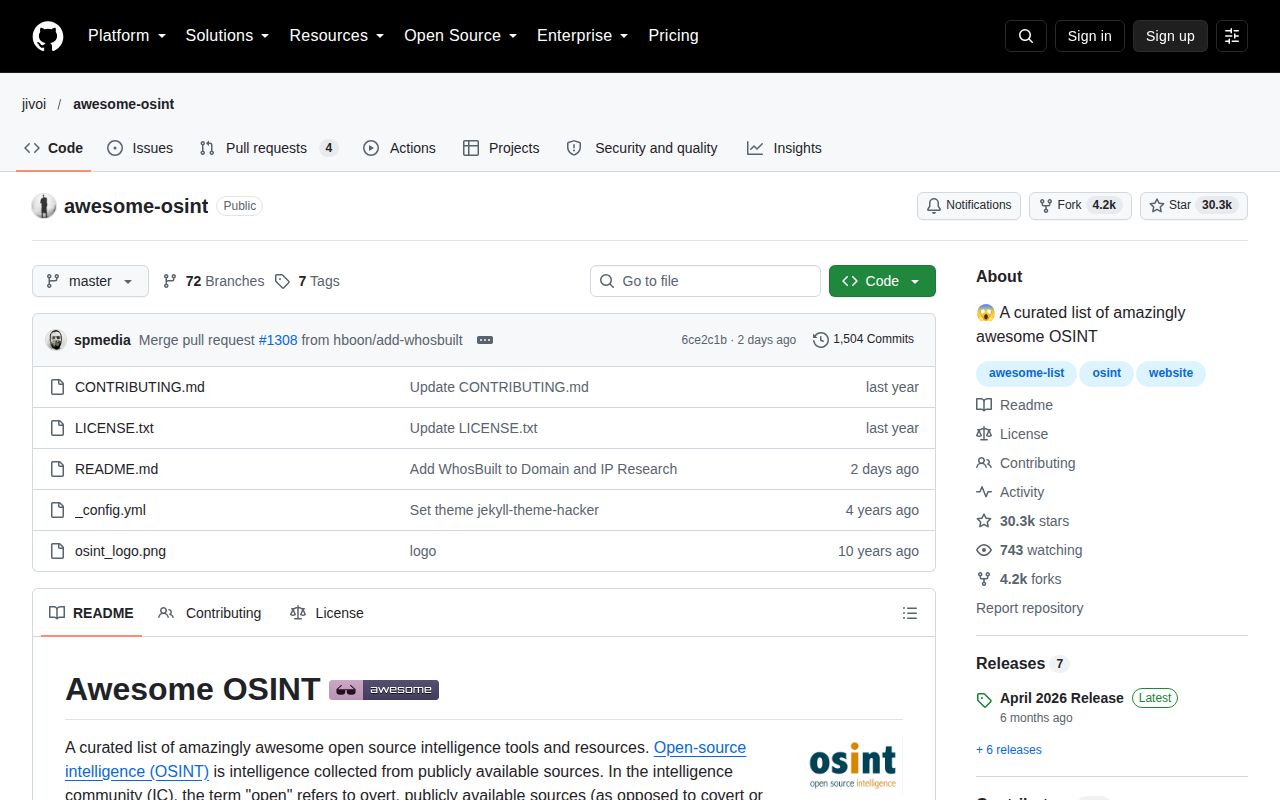
Awesome OSINT helps you choose where to look next. It organizes links to intelligence tools and resources, while leaving the investigation and evaluation of those destinations to the reader.
What the directory helps you find
The README defines OSINT as intelligence collected from publicly available sources and names beginners, advanced researchers, threat hunters and cyber threat-intelligence practitioners as its audience.
Its table of contents covers search engines, social networks, usernames, people, email, phone numbers, companies, domains and IP addresses, images, video, geospatial research and threat intelligence. That organization gives a newcomer vocabulary for a research question and gives an experienced reader categories to check beyond their usual sources.
For example, someone starting with an online identity can locate the username, email and social-media sections. Those headings identify possible research paths; they do not establish that any particular service will return a correct match. Short descriptions help readers select candidates, but capabilities described in those entries remain README claims unless checked against the destination itself.
What our recorded run established
Our stored sandbox run was recorded on 2026-10-16 at 03:35:20.429 UTC against commit 6ce2c1b5ba7817da378818e691d0408899e3a924. The detector found no supported language ecosystem and no Dockerfile. The harness classified the repository as not_runnable.
The raw execution record contains no steps. No installation, dependency download, build, tests, installed-binary check or measured investigation workload was recorded. This was repository detection, not an attempted investigation that failed. It provides no passing-test count, runtime benchmark or evidence about external tools.
The stored summary reports five files, zero counted code lines and a repository size of 0.2 MB. It records a sandbox allocation of three CPUs and 8 GB of memory, with four seconds total harness time. These are repository and harness observations, not performance measurements of OSINT work. The sandbox image is unspecified, so the record does not support identifying it as Debian.
Where the evidence stops
The supplied README extracts show categories, links and descriptions. They do not establish destination availability, output accuracy, account requirements, current pricing or data handling across the collection. Our run did not validate those properties either. A listing should start an evaluation rather than substitute for one.
For recurring work, choose a relevant category, identify candidate resources, then check each destination's own documentation and suitability for your task. Keep the query, date, source URL and supporting evidence in your investigation records. This is a suggested workflow, not a workflow we executed in the sandbox.
The stored harness metadata reports the license value NOASSERTION. That means this metadata does not identify a license; it does not prove that the repository lacks one. Inspect the repository's licensing terms before redistributing its contents.
The supplied release page identifies v1.0.6 as the April 2026 release. A release label does not establish that every linked destination remains available. The supplied evidence also does not establish maintainer response times, a maintenance cadence or investigation success rates.
How to read the scores
These are editorial ratings for evaluating a reference directory, not benchmark results. The rubric is: 1 means insufficient evidence to assess the dimension; 2 means limited supporting evidence; 3 means useful support with substantial gaps; 4 means strong support for the narrow reference task; 5 requires broader verification than this review has. A score of 1 for an unknown dimension does not mean the product performed poorly.
Setup receives 4 because readers can consult the README directly, although external setup is untested. Documentation receives 3 because the categories and descriptions support discovery without establishing destination quality. Community and maturity each receive 2: contribution guidance and an identified release provide limited evidence, but do not establish responsiveness or sustained link validation.
Which directory to choose
OSINT Framework states that it focuses on free resources, while warning that registration or payment may be needed for additional information. Choose it when that access criterion matters most.
OSINT Stuff Tool Collection offers another categorized collection. Its maintainer explicitly keeps obsolete or nonworking entries so readers can use their names and descriptions to find analogues. Choose it for another set of discovery paths, with that retention policy in mind.
Start with Awesome OSINT when its categories fit your question. Before relying on a result, evaluate the selected tool and preserve the evidence separately.