Panels make Git state easier to read before acting
Lazygit opens a repository as linked views of changed files, branches, commits, stashes, and command output. Moving the cursor changes the diff or history shown beside it, so the user gets context without chaining status, diff, log, and branch commands. Space stages a file, hunk, or selected lines. Other keys open menus for rebase, cherry-pick, bisect, reset, worktrees, and custom actions. Help is available inside the interface when a binding is forgotten.
This speed depends on knowing what Git is doing underneath. A menu can make an interactive rebase easier to arrange, but squash, drop, amend, force push, and reset still rewrite or remove history. The README even documents a nuke option that discards everything reported by git status, including dirty submodules. Experienced users gain a quick control surface. Beginners can execute a dangerous command before they understand the repository state that makes it dangerous.
The 5.9 MB checkout built without dependency installation
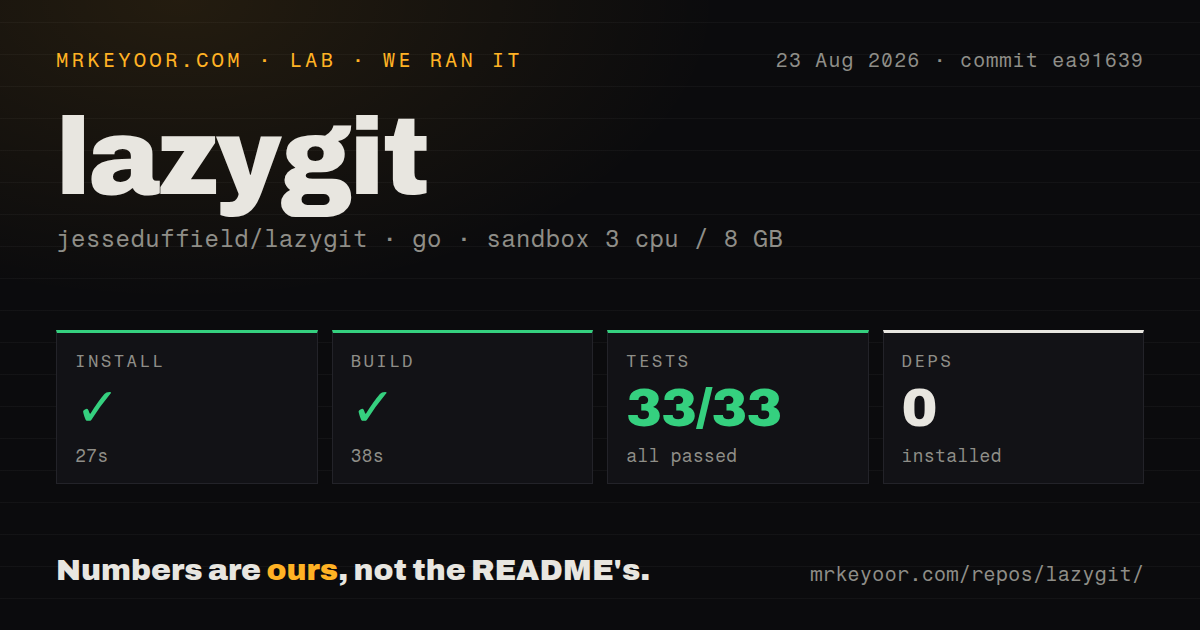
We tested commit ea91639 in a fresh Go 1.24 Debian container. The repository contained 1,213 files, roughly 143,156 source lines, and occupied 5.9 MB. Its install step succeeded in 27 seconds without adding packages, and the build completed in 38 seconds. Six CI workflow files, a Dockerfile, and a tests directory were present. This is a modest source tree compared with many developer tools that bundle a browser runtime.
Most users do not need to compile it. The README lists binary releases and installation through Homebrew, MacPorts, Scoop, Arch packages, Fedora COPR, Debian and Ubuntu routes, Nix, FreeBSD, Termux, Go, Chocolatey, and Winget. Many packages are maintained by third parties, so their release may lag upstream. Downloading the project binary or using a trusted operating-system repository is the easiest way to keep installation responsibility clear.
What happened when we ran it
Our run completed the install step in 27 seconds with 0 packages added. Building lazygit took 38 seconds. The test step then succeeded in 193 seconds, with 33 passed and 0 failed out of 33 detected Go tests. The sandbox had 3 CPUs, 8 GB of RAM, no secrets, and no elevated privileges. Nothing in the supplied run showed a missing compiler dependency, build failure, or test error.
Those figures measure source health, not interactive correctness in every terminal. We did not exercise a real signing key, Git LFS, submodules, a remote host, or a rebase conflict through the UI. Terminal emulators also disagree on color, clipboard behavior, and modifier keys. The passing 33-test result is a strong reason to try this commit, while a disposable repository remains the right place to learn reset, force push, and rebase bindings.
Rebase and worktree tools go well beyond basic staging
Lazygit handles line staging, commit graph browsing, comparisons, cherry-picks, stashes, and branch cleanup, but history editing is where it stands apart from a basic status viewer. Users can reorder commits, squash or fix them up, drop commits, amend an older commit, and build custom patches. Worktree commands create another working directory from a selected branch, which helps when two changes need to remain checked out at once. Undo and redo cover commit and branch actions through Git's reflog.
Undo has a boundary the README states plainly: working-tree changes and stash operations are outside it. That matters because the interface puts reversible history actions near operations that can remove uncommitted work. Version 0.64.1, released August 12, 2026, fixed a race in stashing staged changes, stale pull-request indicators, Git directories outside the working tree, and a hang on quit. Several fixes concern edge conditions around state, which is exactly where a Git client must be judged.
Hooks and managed configuration still need plain Git
Lazygit runs the real Git command beneath its interface, but it does not mirror every command-line path. Issue 4995 reports that prepare-commit-msg is ignored when committing through both the popup and editor mode. A team that inserts ticket identifiers, templates, or policy text with that hook should verify its workflow before adopting the UI. The reporter's fallback is the raw terminal, which remains a sensible escape hatch for any unsupported behavior.
Configuration migration has another specific edge. Issue 4595 shows lazygit trying to rewrite a managed NixOS config on a read-only filesystem, then refusing to open after the write fails. Custom commands deserve review as well because they can invoke arbitrary shell commands with repository context. Personal configuration is convenient; copying a large shared config into every developer machine should receive the same scrutiny as a collection of shell scripts.
GitHub support needs gh, while core Git stays host-neutral
For github.com branches, lazygit can show pull-request state and open the request in a browser. The README says this requires GitHub's gh tool plus gh auth login. GitHub Enterprise needs another host login and a service entry in lazygit's configuration. Core staging, history, branch, rebase, and remote operations still use Git, so the application is not tied to GitHub for its main job.
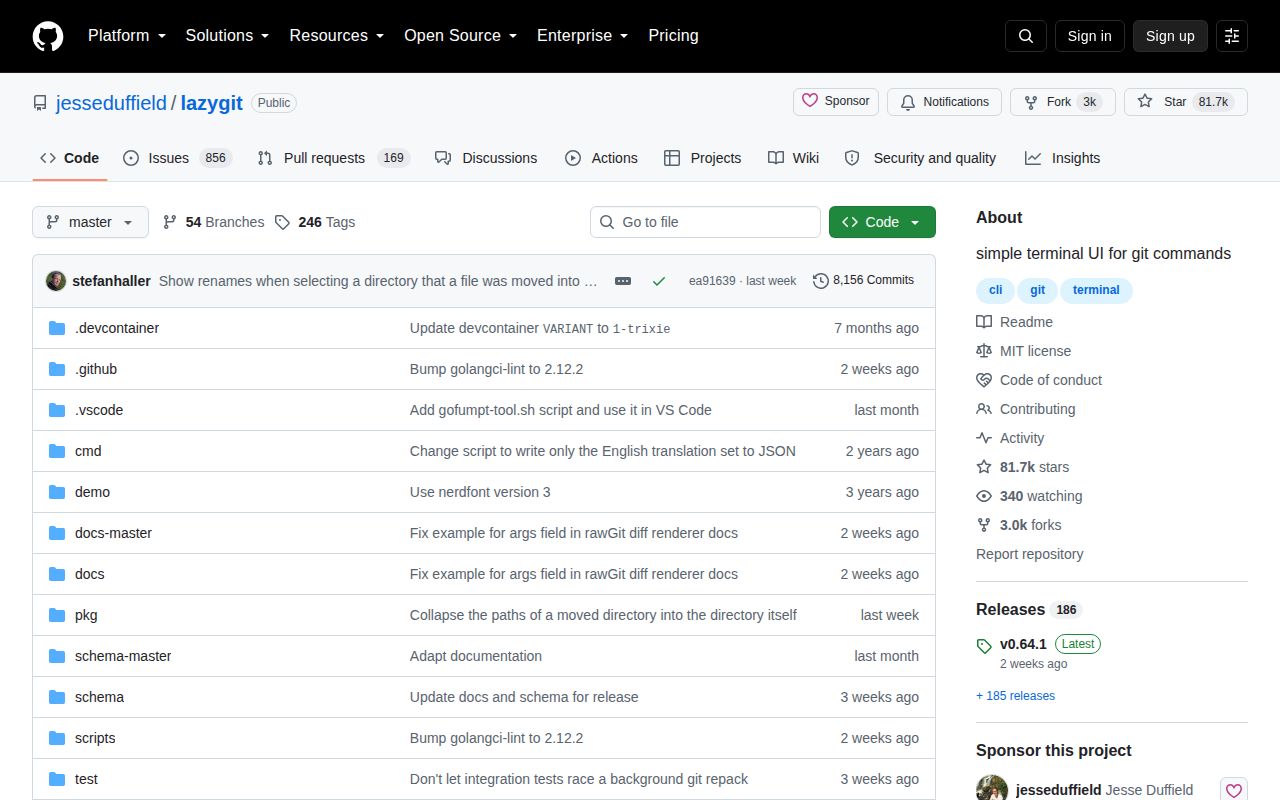
GitHub showed 81,665 stars, 1,025 combined issues and pull requests, and a last push on August 26, 2026. That queue includes years of feature requests as well as current work, so it is not a defect count. The 33 passing tests and v0.64.1 regression fixes point to active maintenance. For developers who already know Git's recovery tools, lazygit removes keystrokes without hiding the repository. For everyone else, learning reflog, status, and safe branching first will pay off.