Three answer types replace generated text
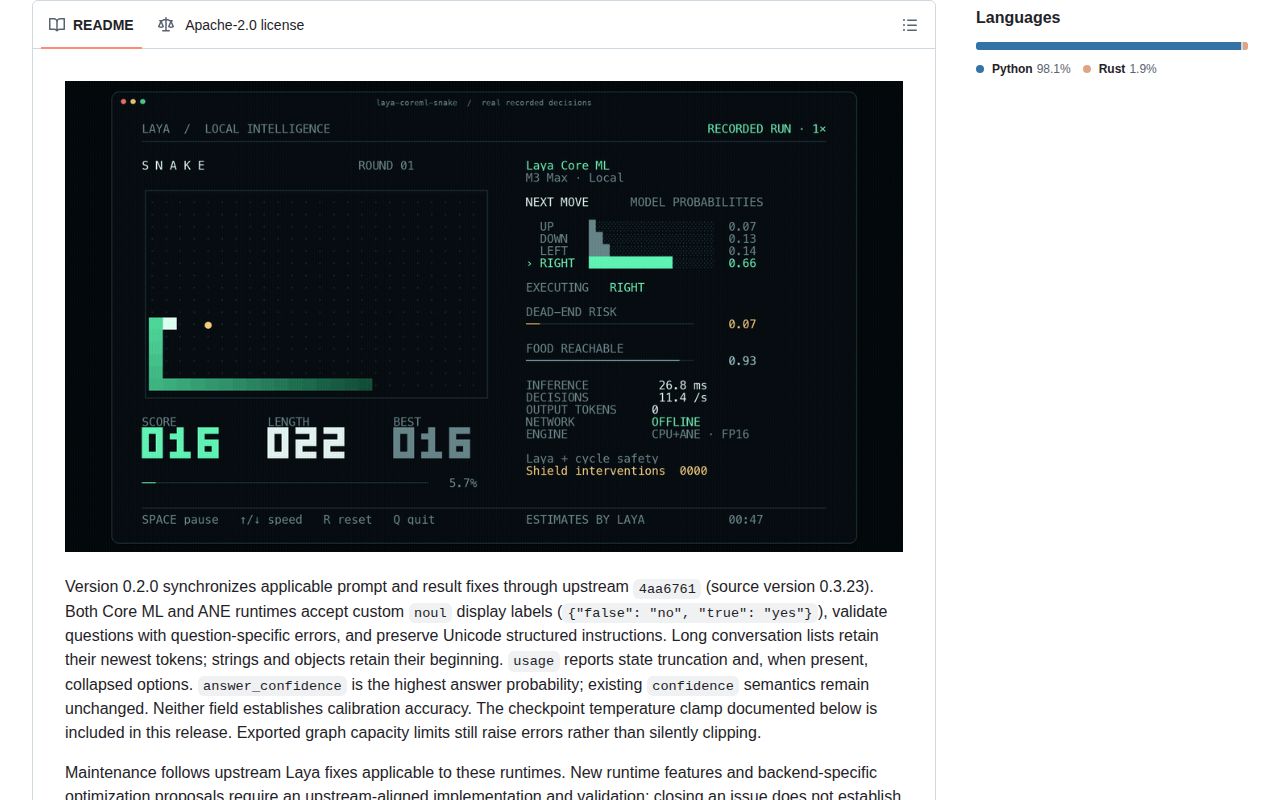
Laya-CoreML takes a piece of state and a set of questions, then returns typed answers. A question can select a choice, produce an ordinal score, or answer yes or no with probabilities. There is no generated sentence to parse and the reported output-token count stays at zero. That makes the library appealing for a narrow step such as routing a support request or deciding whether a stated condition is present.
The design is more constrained than calling a chat model, which is the point. Our checkout had 158 files and about 6,954 lines of source, a small enough codebase to inspect. The runtime package depends on Core ML Tools, NumPy, Tokenizers, Hugging Face Hub, and Safetensors. PyTorch is reserved for the conversion extra, so ordinary inference does not pull in the original training stack.
The result still needs application checks. The documentation says the returned probability estimates can be wrong and describes its fixtures as conversion-fidelity tests, rather than proof that the model makes good decisions on new data. A matching Core ML port tells you that the port preserved the source model's answer. It does not tell you whether that answer is useful for refunds, moderation, or any other production decision.
What happened when we ran it
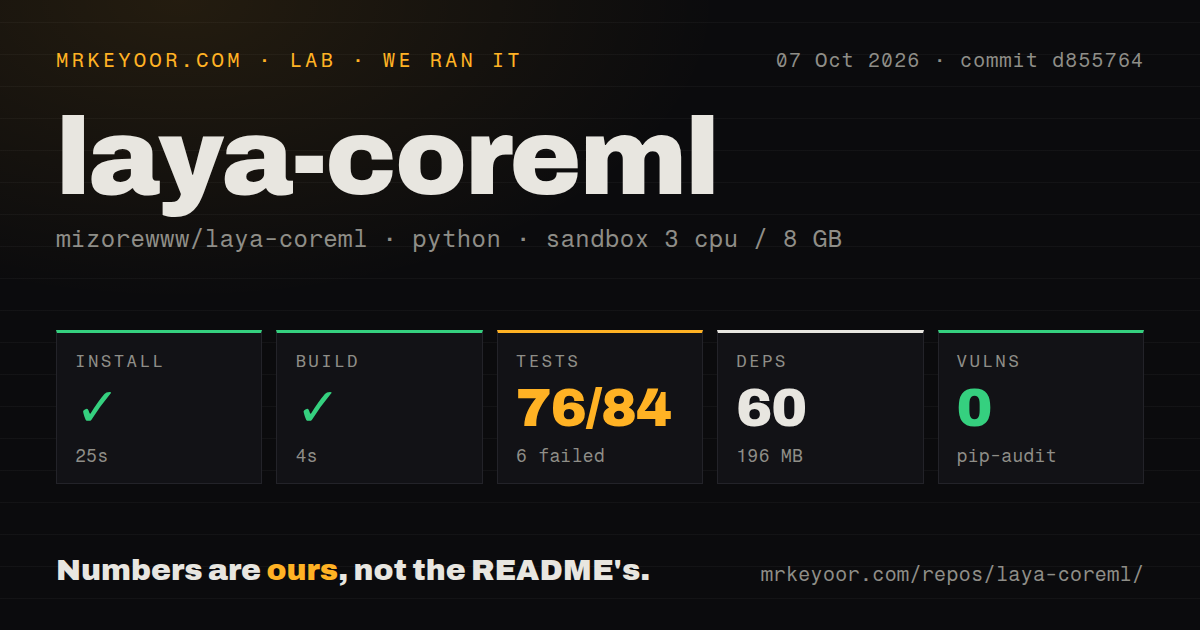
Our sandbox installed commit d855764 in 25 seconds. It pulled 60 packages, occupied 196 MB on disk, and completed the build in another 4 seconds. Pip-audit found 0 known vulnerabilities. The container was an unprivileged Debian environment with 3 CPUs, 8 GB of RAM, Python 3.12, and no secrets. Those results cover installation and packaging, not Core ML inference on Apple hardware.
The test step failed after 13 seconds. Pytest reported 76 passing tests, 6 failures, and 2 collection/setup errors out of 84. All 6 named failures were Snake recording or replay cases, and each ended with ModuleNotFoundError: No module named 'PIL'. Pillow appears in the project's optional demo dependencies, while the core dependency list does not include it. The log establishes that PIL was unavailable during our run; it does not establish why the test environment omitted it.
The 2 errors came from tests/test_ane_layout.py and tests/test_model.py. The supplied log tail does not contain their exception details, so labeling them Core ML platform errors or missing system packages would be guesswork. The useful conclusion is narrower: most of the 84-test suite ran on fresh Debian, but commit d855764 did not give us a clean test result with the environment we used.
Apple Silicon and macOS 15 are hard runtime boundaries
The documented inference path requires Apple Silicon, macOS 15 or newer, and Python 3.11 through 3.13. Exported ML Programs target macOS 15 and iOS 18, though the usage guide says older macOS versions and iPhone or iPad execution have not been tested. A successful 4-second package build in Debian should not be mistaken for proof that a chosen model uses the Neural Engine correctly.
Model files come from Hugging Face or a local directory. After the first download, predictions can stay offline, and local_files_only=True prevents a remote fetch. The loader also handles a documented macOS problem with symbolic links in Hugging Face's shared cache by copying the Core ML package to a regular-file cache and checking its content hash. That second copy costs disk space, even though it avoids another download.
The 96-token ANE limit rules out many prompts
The short Neural Engine bundles accept 96 total input tokens, including the question, options, and state. Requests that exceed the exported capacity raise an error. A general multilingual package raises the ceiling to 1,024 tokens and uses CPU plus GPU instead. These are different deployment choices, so a quick ANE result cannot be stretched into a claim about long-context work.
There are 6 published checkpoint choices in the usage table, covering English, multilingual, typed-decision, Snake, and two short ANE variants. The project records weight hashes, source revisions, shapes, precision, tool versions, and file hashes for exports. Its conversion notes also retain failed shape and GPU experiments. That candor is useful: you can see which settings produced bad answers instead of assuming every Core ML compute-unit switch is safe.
Version 0.2.0 shipped five days before our run
GitHub recorded the latest push and the v0.2.0 release on October 2, 2026. The repository had 1,556 stars and 0 open issues or pull requests when we checked it. A current release and an empty queue show recent maintenance with no visible backlog. They do not provide much evidence about outside contributor activity, so the community score stays in the middle.
The release focuses on keeping this port aligned with upstream Laya behavior, including question validation, Unicode instructions, truncation reporting, and confidence fields. Its notes also say a reported mixed-question latency issue was not verified as fixed before closure. That sentence is a good picture of the project: careful about the boundary of its evidence, yet still young enough that you should reproduce the exact path you plan to ship.
Use it for a narrow Mac decision step
Laya-CoreML makes sense when you already know the question, need a typed local answer, and can validate it on the target Mac. The 25-second install and 196 MB environment are reasonable for a model runtime, while the failed 84-test run prevents an easy recommendation. Start with your own labeled decisions, pin the model revision, and make a green Apple Silicon run the acceptance gate. If the product needs Linux, long ANE prompts, or proven mobile execution, choose a different path before building around this API.