Embedded retrieval is LanceDB's clearest advantage
LanceDB puts vector search, full-text search, filtering, and SQL-style queries beside the application instead of requiring a separate database server for local use. Tables use the Lance columnar format and can contain vectors, metadata, text, images, video references, and other Arrow-compatible data. Python, TypeScript, and Rust SDKs make that model accessible without forcing every team to write Rust. A REST API and managed remote product cover a different deployment path.
The repository itself is much larger than an embedded quickstart implies. Our checkout at commit 94d484f contained 709 files, about 180,750 source lines, and 20.2 MB before dependencies. Rust crates share the tree with Python, Node, and Java work, documentation, CI, and release tooling. That breadth is useful for cross-language support, but it also means a root workspace build can cross language boundaries that an ordinary SDK user never sees.
Published SDKs avoid the full workspace build
The README sends new users to a quickstart and separate Python, TypeScript, Rust, and REST references. That is the sensible route for application evaluation. A Python developer can install a wheel, while a Node developer can use the published package; neither should need to compile every binding to decide whether table creation, ingestion, and search fit the product. Rust contributors and packagers face a different setup because workspace members include native bindings.
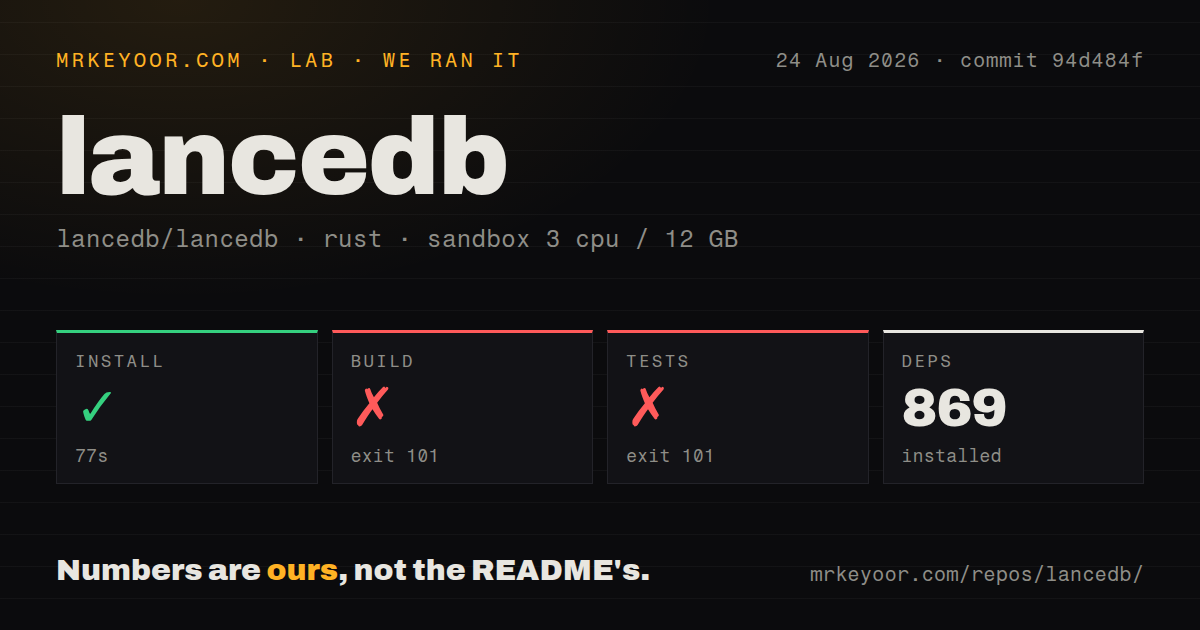
Our install fetched 869 Rust packages in 77 seconds. The later build ran for 806 seconds before the linker reported that it could not find -lpython3.11 while compiling the Python binding. The log does not say whether the correct remedy is a system package, another Python version, or a workspace selection, so we will not prescribe one from that evidence alone. It does show that the measured source checkout needs more than the supplied toolchain image.
What happened when we ran it
Our unprivileged lab-rust:1 sandbox completed dependency installation in 77 seconds. The build failed with exit code 101 after 806 seconds. Its final lines say rust-lld: error: unable to find library -lpython3.11, followed by could not compile lancedb-python. The container had 3 CPUs, 12 GB of RAM, no secrets, and commit 94d484f.
The test command also failed with exit code 101 after 758 seconds. Its log ends with the same missing -lpython3.11 linker library, this time while compiling the lancedb library test. No passing, failing, or skipped test count was produced in the supplied result. The useful conclusion is narrow: installation resolved, but both compilation gates stopped before the workspace could be evaluated.
Local and remote paths need separate acceptance tests
LanceDB presents open-source local tables and its managed cloud as one ecosystem, but they do not have identical transport or implementation paths. Release v0.37.1 includes fixes explicitly labeled Python, Node, Rust, and remote, alongside shared table and query changes. One release item says storage options could be ignored when opening a remote table; another covers HTTP2 stream errors. Treat SDK language and connection mode as two axes in the test matrix.
Our 758-second test attempt never reached a result summary, so it provides no evidence about embedded or remote queries. Build an application-level set around the chosen path: schema creation, append and merge behavior, vector dimensions, filters, full-text indexing, version reads, deletion, compaction, and error propagation. If development uses local tables but production uses cloud, run the same fixtures against both rather than assuming API similarity guarantees matching behavior.
JSON support still exposes Arrow details
Issue 4062 reports that a TypeScript insert into a JSON column fails unless the Arrow field carries the required extension metadata. Issue 4063 proposes a helper so users do not have to construct that field manually. Related issues request automatic conversion between native objects and JSON strings, plus indexing inside JSON paths and full-text search over JSON fields. The activity shows active work, while current users still need to understand the physical Arrow representation.
The repository installed 869 packages before our linker failure, reflecting a broad data stack rather than a tiny key-value library. Keep schemas explicit and versioned, especially across Python and TypeScript clients. Test nullable fields, nested data, JSON serialization, and Arrow metadata on the exact SDK release. A convenient vector API does not remove the need to understand how non-vector columns are encoded and returned.
v0.37.1 still carries breaking API changes
Release v0.37.1 was published on August 10, 2026. Its notes mark the Rust add_columns change as breaking because it now uses a builder. The release also adds full-text configuration, batched blob reads, streaming transform controls, index jobs, and LSM operations, with many fixes across language bindings. A pre-1.0 version can reasonably evolve, but downstream applications should pin packages and read language-specific notes before upgrading.
GitHub records a push on August 26, 2026, 11,284 stars, and 470 open issues excluding pull requests. The repository page's 607 combined issues and pull requests should not be called a bug count. Nineteen CI workflow files show considerable automation, yet our 806-second build failure proves that CI coverage does not make every fresh source environment self-sufficient. Published artifacts and contributor builds deserve different setup scores.
Choose embedded convenience or a server boundary
LanceDB is most persuasive when an application wants local retrieval without operating a database daemon, especially when Arrow, Pandas, Polars, or DuckDB already appear in the data flow. Qdrant and Milvus make the network-service boundary more explicit. Chroma offers another local-first retrieval model. None is a universal replacement because persistence, concurrency, filtering, scaling, and operational ownership differ.
Our failed build does not show that the published SDKs are unusable; it shows that the complete source workspace did not compile in the measured environment. Start with the exact SDK and storage path intended for production. If it works, then decide whether embedded state inside application processes simplifies ownership or merely hides a database concern that should live behind a service. For contributors, resolve and document the Python 3.11 linker requirement before trusting root-workspace checks.