Chroma reduces retrieval to collections and 4 core actions
Chroma's appeal is its small mental model. Create a collection, add records, query similar records, and retrieve them by ID. Documents can carry metadata for filtering, and the Python client can turn text into embeddings automatically through a chosen embedding function. Applications may also supply their own vectors. That is enough for a notebook, a retrieval-augmented assistant, semantic search, or a first pass at document recall without designing a separate index service.
The README calls the core API 4 functions, and the getting-started guide keeps the first example similarly compact. Python can create an in-memory client in the application process. A persistent client writes database files to a path. Client-server mode changes the constructor and points at a process on port 8000. TypeScript uses the server path even for local work, while the Rust client expects callers to generate embeddings themselves. The simplicity is real, although it differs by language.
Local and distributed Chroma do not yet have full parity
Chroma's open-source documentation says single-node local Chroma and distributed Chroma use different storage subsystems. Most current engineering effort goes into the distributed system and cloud service, so local mode may temporarily lack features or behavior. The team states that full feature and API parity is a goal, along with unifying storage. Buyers should read that as a current limitation and an aspiration, not a completed migration or a dated delivery plan.
The deployment choice therefore affects more than hosting. An in-memory Python client is excellent for experiments but loses all data at process exit. PersistentClient loads and saves local data automatically. A separate server supports multiple clients and language bindings, while Chroma Cloud adds a tenant, database, API key, and region endpoint. Moving between these shapes may expose behavioral differences. A realistic evaluation should run the same add, update, filter, delete, and query cases against the intended target.
What happened when we ran it
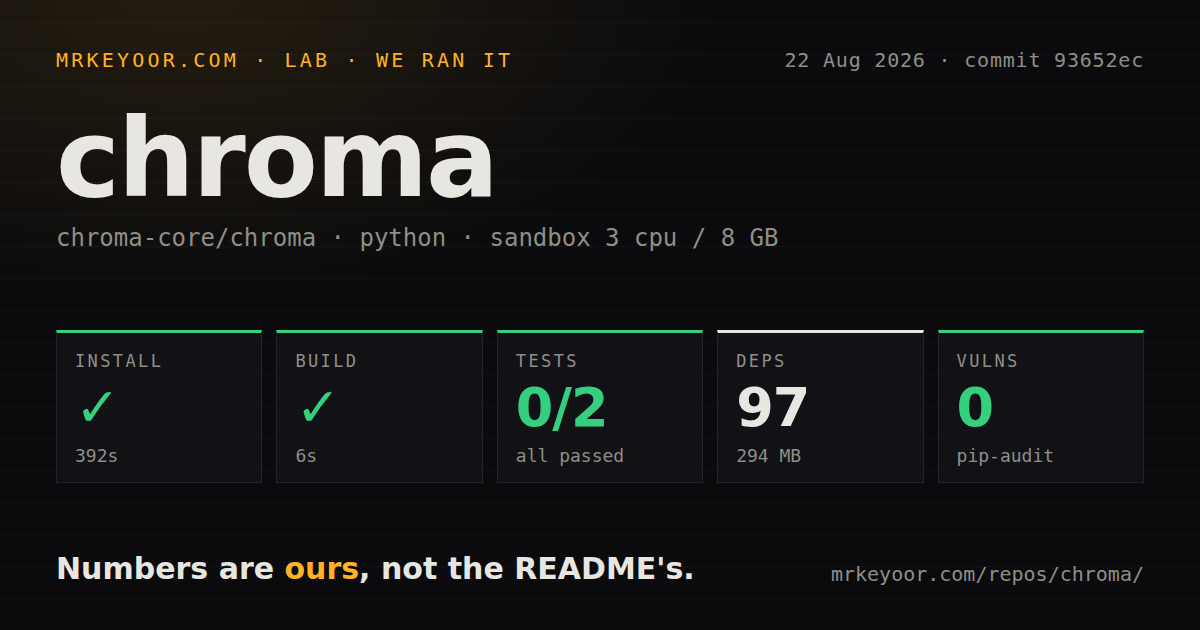
Our sandbox installed 97 packages in 392 seconds and consumed 294 MB. Building commit 93652ec succeeded in 6 seconds. The checkout contained 2,133 files and about 460,844 source lines, using 47.1 MB. We used an unprivileged Python 3.12 Debian container with 3 CPUs, 8 GB of RAM, and no secrets. pip-audit reported 0 known vulnerabilities in the environment that the harness installed.
pytest failed after 13 seconds before executing a test. The result was 0 passed, 0 failed, and 2 collection or setup errors. One error came from bin/rust_python_compat_test.py; the other came from chromadb/test, where importing hypothesis raised ModuleNotFoundError. pytest also warned that asyncio_mode was an unknown configuration option. The log does not show why those test dependencies or plugins were absent, so we report the setup failure without assigning blame.
Embedding convenience creates dependency edges
Automatic embedding is convenient because an application can add text and query text without managing vectors. Chroma also supports swapping embedding functions or providing embeddings directly. That interface connects the database to fast-moving model SDKs, which deserves separate version tests. Issue #7633 gives a current example: Chroma v1.5.9 reportedly checks for Mistral through an import path that no longer works with version 2 of the Mistral Python package.
The issue was opened August 24, 2026 after an earlier pull request saw no activity. It is one integration report, not proof that Chroma's core indexing is broken. It does show why an embedding provider belongs in an application's lockfile and smoke suite. Add a known document, generate an embedding, query it, and verify the returned ID during upgrades. Teams that want fewer SDK edges can generate vectors in a separate service and send only numeric embeddings to Chroma.
The project is active despite an older latest release
GitHub showed 29,147 stars, 803 open issues and pull requests, and a last push on August 24, 2026. The latest GitHub release we fetched was 1.5.9 from May 5. A release date alone is weak health evidence; the later push and current issue activity show ongoing work. The README also states that PyPI and npm packages follow a Monday release cadence, with hotfixes during the week, though repository tags and package publishing can differ.
Release 1.5.9 included sharded collection rebuilds, group-by work, garbage-collection fixes, sparse indexing work, multi-region testing, and separate Python, JavaScript, and CLI package versions. That list shows a system extending beyond the notebook use case. It also explains the large Rust and Python codebase behind the small client API. Operators should track client and server compatibility together rather than assuming one package number describes every component.
Chroma is best when easy experimentation matters first
The fastest useful trial is a Python process with a few documents and an in-memory collection. If retrieval quality looks promising, switch to PersistentClient and restart the process to prove data survives. A team planning shared access should test client-server mode early, including authentication, backups, failure recovery, and the exact metadata filters used by the application. Cloud users should generate the connection profile and confirm the correct regional host.
Chroma is easy to recommend for prototypes because the first successful query takes little code. Production confidence requires more work than that friendly API suggests. Our source run never reached a test assertion, local and distributed storage still differ, and embedding adapters can break when provider SDKs move. Those are manageable risks for a team with integration tests. Without them, a server-first vector database with narrower client behavior may be the safer decision.