The heartbeat logs a message without contacting the hub
Kryvora Node compiled in 15 seconds in our sandbox, but its heartbeat function does not send a request to the coordination hub. The daemon source at commit 985c96d checks for an empty token and writes a log message. There is no network call in that function. That gap decides the recommendation: I would not deploy this checkout expecting the distributed verification described in the README.
The documentation presents a worker daemon that checks peers and reports availability to Kryvora's hub. It requires a Genesis Node Key on Arbitrum One and directs operators to a wallet portal for a bootstrap token. That is a substantial commitment for software whose public entry point currently runs a timer and logs. An operator needs evidence of a real exchange with the hub before following the activation route.
What happened when we ran it
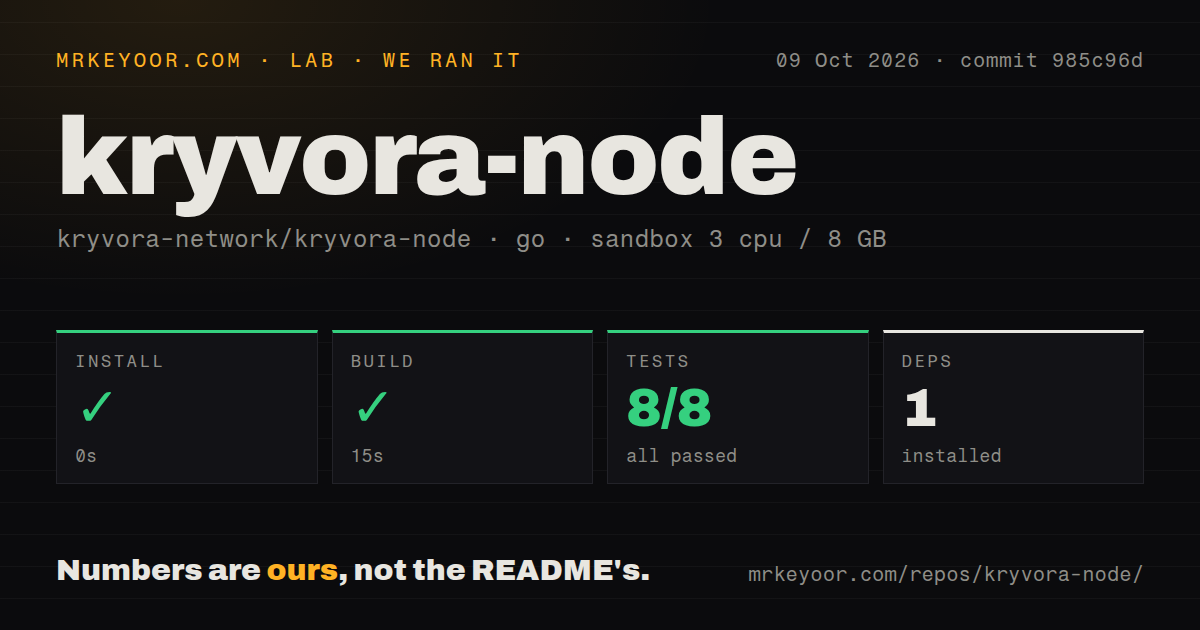
Our run installed commit 985c96d in 0 seconds, with the harness recording 1 package installed. The build passed in 15 seconds, and the Go test step passed in 3 seconds with 8 passed and 0 failed. We ran it on October 9, 2026, in an unprivileged golang:1.24-bookworm container with 3 CPUs, 8 GB of RAM, and no secrets. All measured steps succeeded.
The checkout contained 26 files and roughly 862 lines of source. Its recorded checkout size rounded to 0 MB, which should not be read as an empty repository. Our scan found 1 CI workflow, a Dockerfile, and a Compose file, with no dedicated tests directory. Go tests sit beside package code, so that directory finding is consistent with a passing suite. None of these measurements demonstrates wallet authentication, peer verification, or task execution.
The executable never starts the advertised telemetry listener
The 8 passing tests include checks of HTTP handlers, but main.go does not construct the telemetry server or start an HTTP listener. It loads configuration, checks the token, opens storage, and starts the daemon loop. The advertised health, status, and metrics routes therefore lack a serving path in this executable. Publishing a port in Compose cannot supply the missing listener.
The telemetry implementation also deserves caution on its own. Its status response sets the sync state to a fixed value, and the node-up metric is fixed too. These responses would describe handler behavior rather than verified hub connectivity, even if you connected the server yourself. A monitoring screen showing an active node would need an actual state source before it could guide an operator. A successful handler test cannot answer that operational question.
A nonempty token passes the local authentication check
The 3-second suite includes a daemon lifecycle check using a test token. In the executable and daemon, authentication checks whether the token string is empty. The code does not validate an on-chain credential or ask the hub to accept it, yet startup logs describe the Genesis Key as authenticated. Treat that wording as a local presence check. Our no-secrets run supplies no evidence that a real key can join the network.
Storage is similarly limited. Opening the store creates a directory, while its Sync and Close methods lock and return without persisting peer state or tasks. The README's diagram describes a state store and a Unix socket between components. The executable examined here does not wire those pieces into the advertised worker system. This is useful source to inspect for a scaffold, but too incomplete for an availability or verification service.
The shell quick start expects a checkout and elevated access
Our 15-second source build says nothing about the README's piped installer working on a bare host. The installation script uses a local binary or builds from the current directory, then copies local configuration and service files. It does not fetch the release binary as the quick-start description says. Running the downloaded script outside a checkout leaves those local inputs unavailable.
The systemd unit runs as root and the script writes to system locations. For source inspection, use an isolated environment rather than adopting that service configuration. Compose is more reviewable, but it mounts config.example.yaml even though the README tells you to edit config.yaml. The token environment variable still supplies authentication input. Other edits to the copied file need a corrected mount, or they will never reach the container.
September releases and closed PRs do not establish network operation
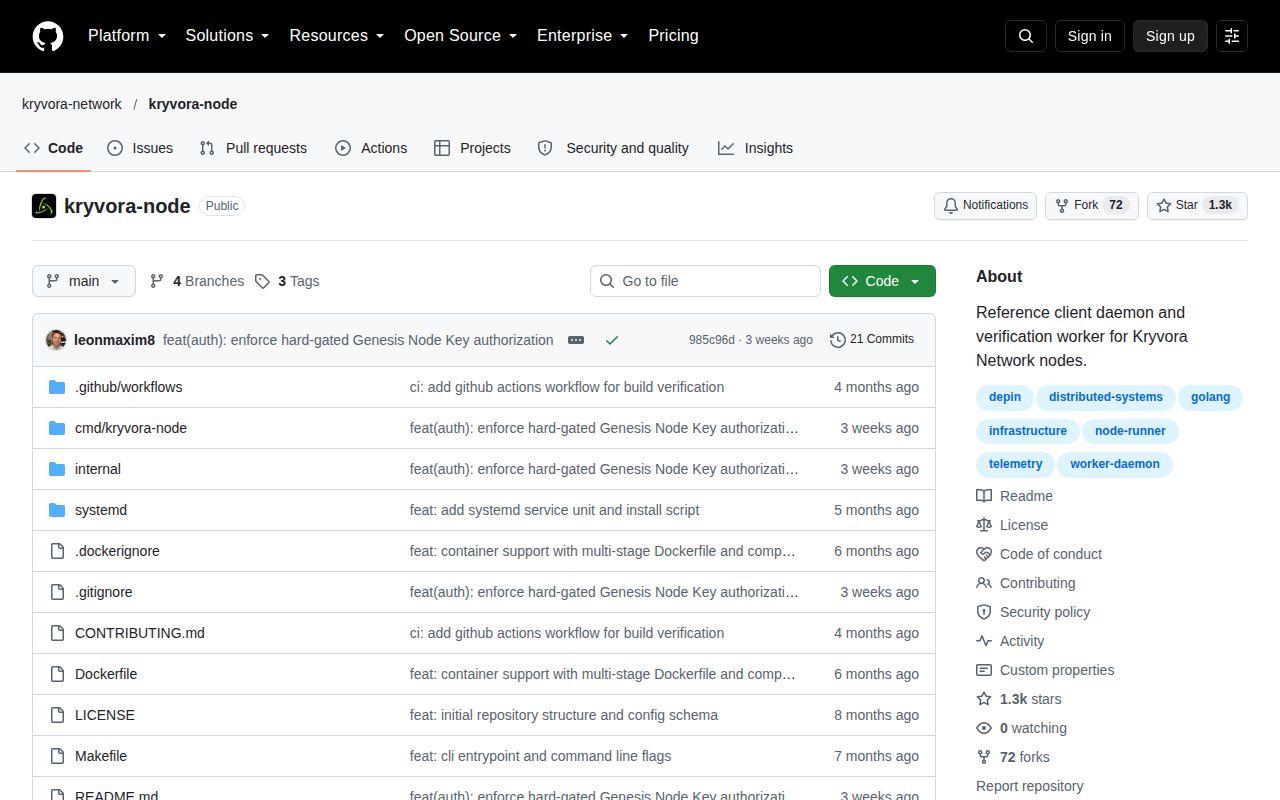
The repository was pushed on September 22, 2026, and GitHub showed 1,336 stars with no open issues or PRs on October 12. Release v0.2.0 was published September 22. Closed pull requests from that day address configuration wiring, telemetry backoff, and topology documentation. This is a recent development record with little visible subsequent discussion. The release notes' protocol-sync description does not resolve the missing network calls in the measured source.
The 1 CI workflow and green sandbox checks make this a tidy code scaffold, which is a different adoption reason from running a verification node. Choose Prometheus Node Exporter if your job is host telemetry, or assess Akash Node if you need software for participation in that separate network. Neither substitutes for Kryvora membership. Before using Kryvora for its stated purpose, require an executable path that contacts the hub and derives health from accepted work. A heartbeat log alone cannot provide that evidence.