
One browser gate covers five kinds of privileged access
JumpServer puts SSH, RDP, Kubernetes, database, and RemoteApp access behind a web interface. Administrators assign people to assets and accounts, while users connect without receiving the underlying credential directly. That is a useful boundary for teams that have outgrown shared root passwords, jump boxes with hand-maintained keys, or a VPN that grants more network reach than a job requires. Session access and operations can then be reviewed from the same product.
The breadth has a cost. JumpServer is a family of components rather than one Python daemon. Its README names separate projects for the web UI, browser terminal, character-protocol connector, graphical-protocol connector, database connector, and desktop clients. Our checkout of the core alone held 2,023 files and about 155,509 source lines. A buyer should evaluate the service as security infrastructure with several moving parts, even though the quick-start command looks simple.
Community users do not receive every named connector
The GPL-3.0 core covers the central PAM platform, but the component table draws a visible product boundary. Tinker, Panda, Razor, Magnus, Nec, and Facelive are marked private. Those entries include remote application, RDP proxy, database proxy, VNC proxy, and facial-recognition pieces. Before choosing JumpServer for one of those jobs, map the required protocol and deployment shape to the edition that supplies it. The word open-source does not mean every box in the architecture diagram is available in this repository.
The current v4.10.19-lts release is substantial. Published on August 20, 2026, it added clipboard controls for graphical sessions, account policies for file transfer, custom ticket workflows, SMTP certificate options, and visual maintenance through KOTL. It also changed database parsing, object-storage compatibility, and password-change automation. This is evidence of an actively maintained operations product, but the volume of behavior also raises the amount a security team must regression-test during upgrades.
What happened when we ran it
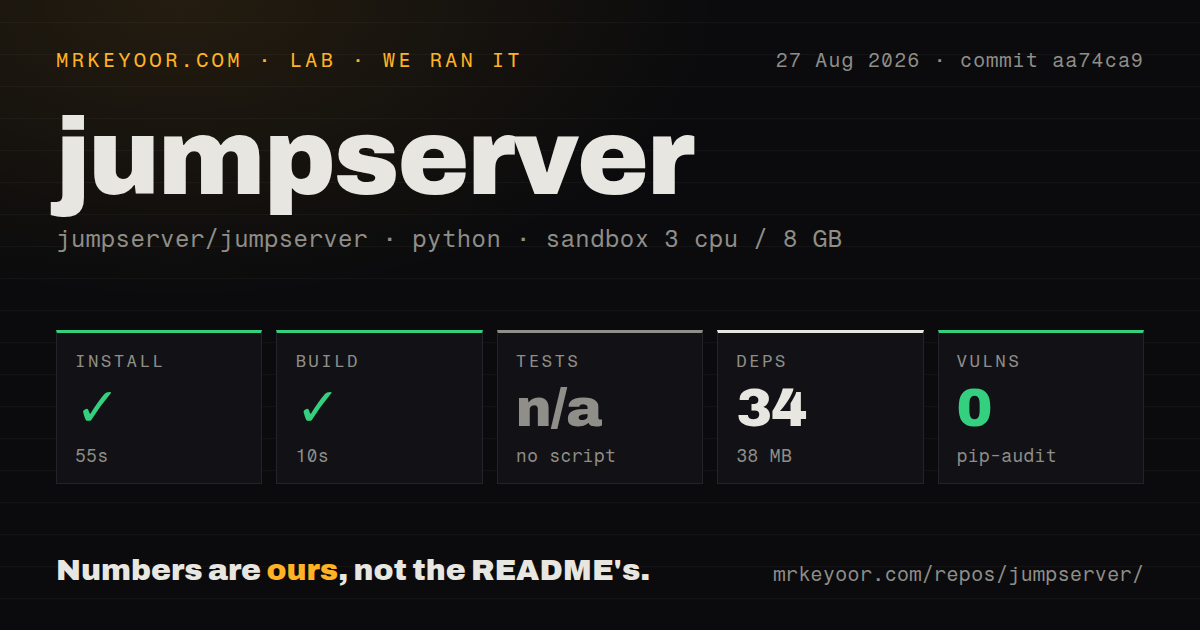
Our sandbox cloned commit aa74ca9 and installed 34 Python packages in 55 seconds, leaving 38 MB on disk. The source build completed successfully in another 10 seconds. Pip-audit found 0 known vulnerabilities in the installed packages. These are useful repository checks, though they do not represent the complete service with its web, proxy, database, and graphical-session components running together.
There was no test script or target for the harness to invoke, so tests were skipped. The checkout had 18 CI workflow files and a Dockerfile, yet no tests directory. That combination suggests automation exists outside the simple local path we inspected, but it does not let us claim a passing test suite for commit aa74ca9. For software that will mediate administrator access, prospective operators should identify the upstream integration checks and run their own protocol and upgrade tests.
The 16.1 MB repository and 10-second build can make source setup look light. The README's actual quick start asks for a clean 64-bit Linux server with at least 4 CPU cores and 8 GB of memory, then downloads and runs quick_start.sh through a shell. Review that script before execution, pin the release you intend to deploy, and place the service on a host whose network routes and backups match its security role.
Day-level reminders and current reports affect stricter policies
JumpServer's issue activity is useful because it exposes cases that a feature checklist misses. Issue 17343 asks for hour-level or minute-level expiration reminders, explaining that the current daily task cannot sensibly warn about a 2-hour authorization. If your access policy depends on a notice 15 minutes before expiry, the reported behavior does not meet it. Enforce expiry independently or verify a later release before relying on notifications.
Issue 17351 reports that Access Key signed POST requests returned HTTP 500 on v4.10.15 and still did so after an upgrade to v4.10.19-lts. The report names authentication and connection-token endpoints, which makes it directly relevant to API-driven access workflows. Issue 17325 describes slow web and SSH login against an audit table with 6 million rows. Neither report proves every installation is affected, but both supply concrete acceptance tests for an evaluation.
Active development deserves a controlled upgrade process
GitHub showed 31,457 stars, 79 combined issues and pull requests, and a last push on August 27, 2026. The latest release was only 7 days old. That is healthy activity, and the recent issue list also shows users testing community and enterprise editions across one-click, offline, all-in-one, and Kubernetes installs. The combined open count is not a defect count, so the dated release and issue traffic matter more than the raw number.
JumpServer makes sense once privileged access is an organizational system rather than an SSH configuration problem. The browser workflow, protocol coverage, and current LTS work are persuasive. The missing local test target, edition boundaries, 4-core and 8 GB starting point, and live access reports keep it out of casual-deployment territory. Put a narrow pilot in front of representative SSH, RDP, database, and API flows, then treat upgrades like changes to an authentication service.