JuiceFS puts POSIX metadata in a database and data in objects
JuiceFS separates a file system into pieces that cloud infrastructure already knows how to operate. A metadata engine stores names, permissions, directory structure, locks, and file layout. Object storage holds the data blocks. The JuiceFS client joins them and presents POSIX, Hadoop, Kubernetes, or S3-facing interfaces to applications. This design lets several machines share a namespace without rewriting software to speak an object API, which is the main reason to consider it over a plain bucket mount.
Separation also creates two failure domains. Our checkout contained 1,079 files, about 164,231 source lines, and measured 50.4 MB before dependency installation. In production, losing object data loses file contents, while losing or corrupting metadata can make those numbered objects unusable as files. The README says original source files do not appear in the bucket browser because JuiceFS splits them into chunks, slices, and blocks. Metadata backup and restore therefore deserve the same attention as object durability.
A working mount needs three independent pieces
The getting-started list requires a metadata engine, an object store, and the JuiceFS client. Supported metadata choices include Redis, MySQL, SQLite, and TiKV, while data can live in major public clouds, S3-compatible services, Ceph, MinIO, local disk, and other backends. The flexibility is useful, but every pairing has different latency, transaction, credential, and recovery behavior. A SQLite demonstration on one machine says little about a Redis-backed shared mount under concurrent writers.
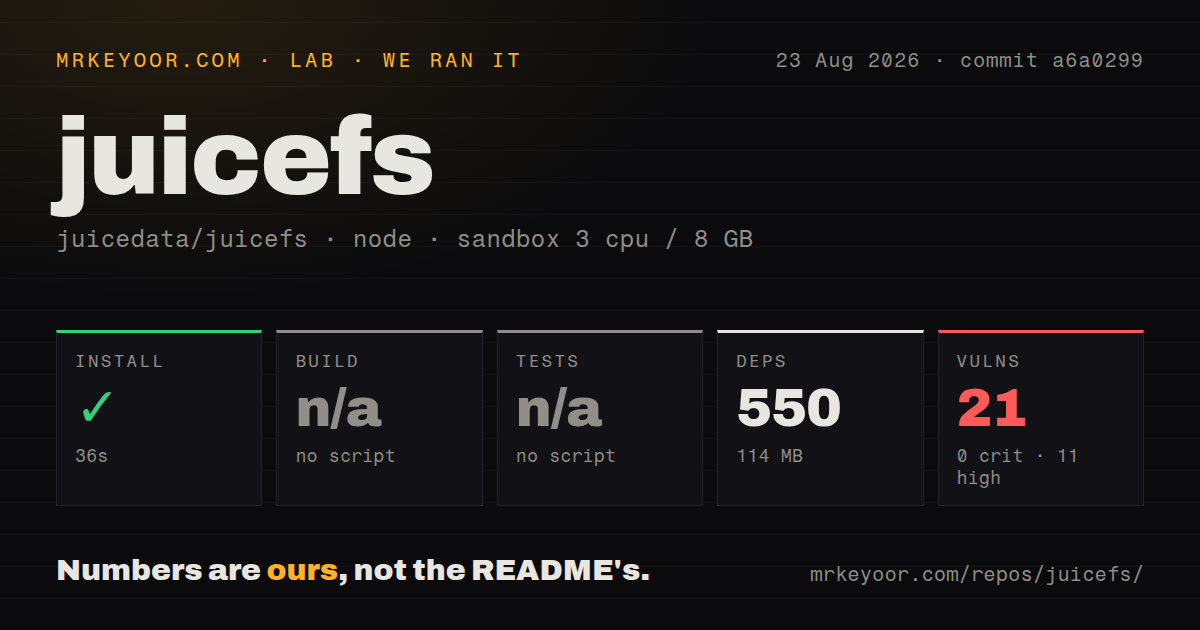
Deployment paths multiply from there. FUSE provides an ordinary mount, the CSI driver serves Kubernetes volumes, a Java SDK connects Hadoop, and an S3 gateway exposes an object interface. Our npm step used 114 MB after adding 550 packages, yet that result did not install a FUSE device, create a metadata database, configure object credentials, or mount a volume. Treat each interface as its own acceptance project, especially when permissions and locking affect existing applications.
What happened when we ran it
Our fresh unprivileged Debian sandbox installed the repository's npm dependency surface in 36 seconds. It added 550 packages and occupied 114 MB. The harness found no build script or target, so the build step was skipped. It also found no test script or target, so no project tests ran. Those are findings about commit a6a0299 and the command surface our Node-based harness discovered, not evidence that the core Go client builds or passes its own suites.
Npm audit reported 21 known vulnerabilities: 11 high, 7 moderate, and 3 low, with none critical. The repository has 39 CI workflow files and a tests directory, which shows that upstream validation exists outside the targets our run could invoke. That mismatch matters more than a cosmetic score. A buyer should run the documented Go, integration, FUSE, and chosen-backend checks before adoption instead of treating a completed 36-second package install as file-system validation.
Strong semantics depend on the metadata path
JuiceFS documents close-to-open consistency across clients, immediate visibility within one mount, atomic rename and metadata operations, file access after unlink, extended attributes, and global file locks. Those claims explain why the project is more ambitious than mapping object keys to paths. The README also says its storage format is stable and will remain supported. Applications built around normal file operations can therefore use object storage without learning multipart uploads or eventual job-specific staging logic.
The cost is that metadata behavior becomes central to correctness. Release v1.4.1 fixed setgid handling, changelog overflow in SQL metadata, repeated tier reloads, missing checksum protection for one object backend, and a Linux FUSE descriptor leak. It also enforced a minimum client version for tiered storage to prevent metadata corruption. Those are useful fixes and a warning: mixed client versions, metadata schema behavior, and backend-specific checks belong in upgrade planning.
Anonymous usage reporting is enabled by default
The README says JuiceFS reports anonymous usage information such as its version and excludes user data. Operators can disable the report with --no-usage-report on the mount command. That is clear documentation, but the choice needs to be carried into every service definition, CSI configuration, or automation path covered by organizational policy. An opt-out tested on a laptop does not prove that a separately managed Kubernetes deployment uses the same flag.
Security also spans more than telemetry. Object-store keys, metadata credentials, encryption settings, mount permissions, S3 gateway access, and backup credentials all need separate ownership. The 21 npm audit findings are concrete, though they concern the dependency surface measured by our harness rather than every Go component. Current pull requests also discuss authenticating distributed sync and SFTP peers and failing closed on service authentication. Check whether those paths exist in your design and which release contains the required controls.
August 2026 activity supports a careful production trial
GitHub showed 14,358 stars and 198 combined open issues and pull requests when fetched. The repository was pushed on August 26, 2026, less than a month after v1.4.1 on July 30. Current issue activity includes concurrency, permission, cache warmup, and CI reports, alongside proposed fixes. The queue is large because the project covers many backends and interfaces; it is still worth searching for the exact metadata engine, object store, and deployment mode you plan to use.
JuiceFS makes sense when shared POSIX behavior is worth operating a metadata plane in front of object storage. Its documentation exposes the architecture and many operational topics, and current maintenance is visible. Our own run is deliberately weaker evidence: 550 npm packages installed, while build and tests were unavailable to the harness. A real evaluation should fill that gap with failure injection, restore drills, mixed-client upgrade tests, and workload checks on the chosen storage pair before customer data moves.