PolyLedger puts market names and chain fills in one DuckDB file
Polymarket analysis usually starts with a join problem. The CLOB API knows the question, outcome labels, and token identifiers, while Polygon records the actual OrderFilled events. PolyLedger gathers both sides, decodes the current and older exchange contracts, and writes a ready-to-query trade view into DuckDB. You get human-readable markets beside maker, taker, price, shares, dollar size, fee, block time, and the raw event fields used to derive them.
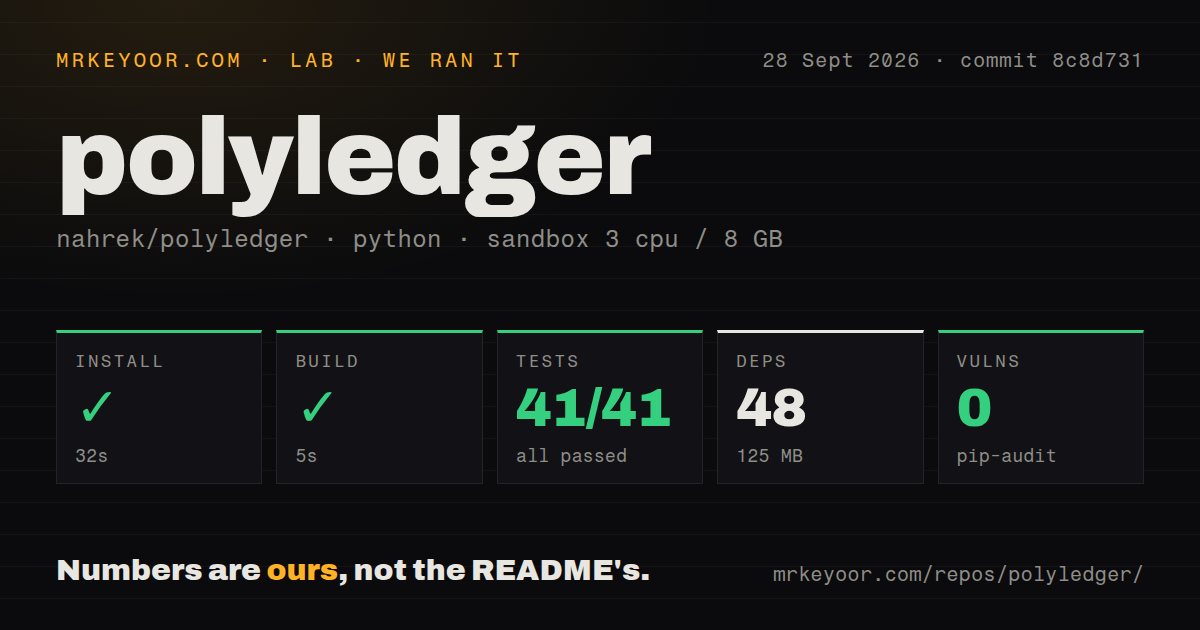
The codebase is unusually small for that job: 26 files, about 2,233 lines of source, and a 0.1 MB checkout at commit 8c8d731. Its CLI has separate commands for markets, chain events, joined trades, statistics, SQL, and Parquet export. Python 3.11 or newer is required. HyperSync supplies Polygon history, while Polymarket's public CLOB and Gamma APIs provide market metadata and fill gaps.
Rows and checkpoints commit in the same transaction
Resumption is the central design choice. PolyLedger writes each batch and its block cursor together, so a crash cannot leave data committed with an old checkpoint or advance the cursor past missing rows. A unique key on transaction hash and log index makes repeated ranges harmless. V1 and V2 contracts keep separate checkpoints, which lets an analyst add older history without corrupting the current exchange stream.
Network behavior is designed for a long backfill. The client validates API responses with Pydantic, follows Retry-After, adds exponential backoff with jitter, and shares an 8-request-per-second default limiter across REST sources. Missing token IDs remain visible as unmatched fills and can be backfilled from Gamma. The README says the first free-tier sync may take hours or days, so interruption safety is doing real work rather than decorating the feature list.
What happened when we ran it
Our sandbox installed PolyLedger in 32 seconds, adding 48 packages and consuming 125 MB. The build completed in 5 seconds. Pytest then passed all 41 tests in 24 seconds with 0 failures. Pip-audit found 0 known vulnerabilities. For a Python indexer that touches external APIs, ABI decoding, derived arithmetic, and local storage, that is a reassuring first run.
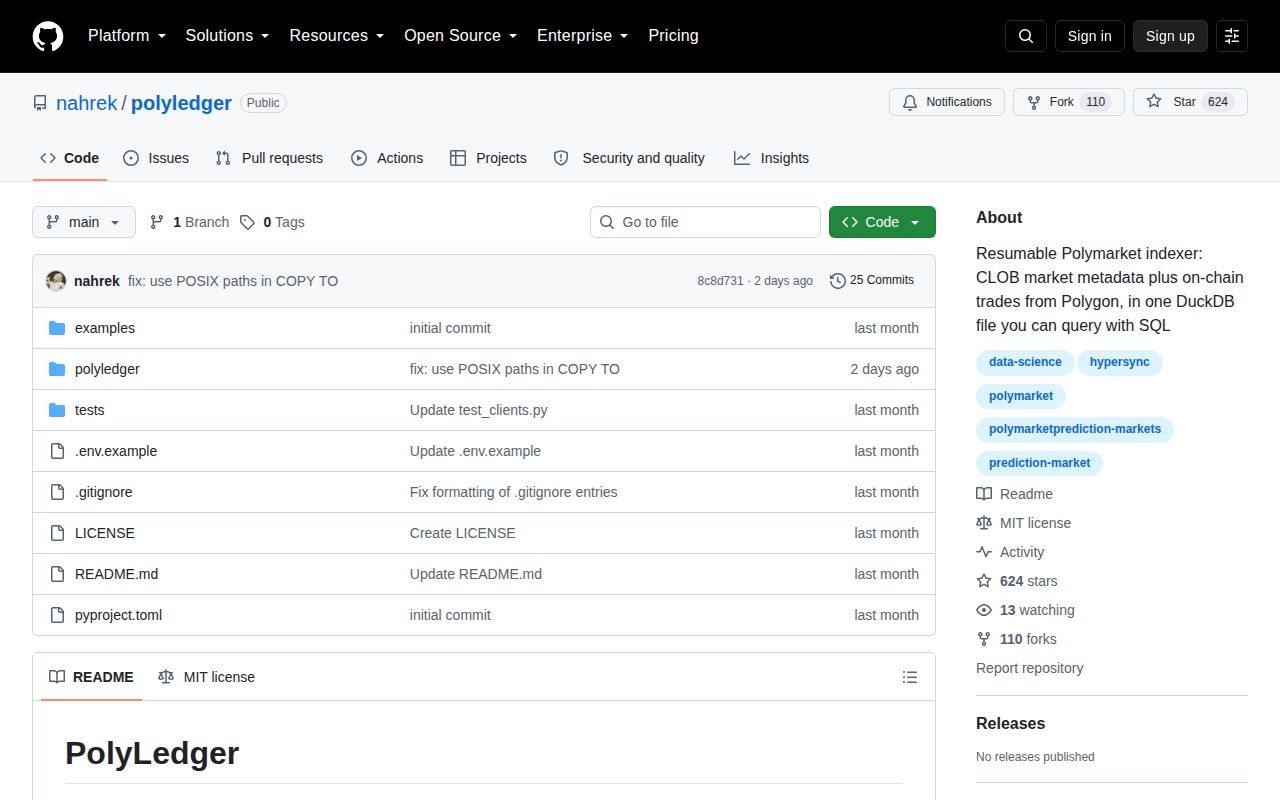
The tests do not need a network connection. According to the README, fixtures cover V1 and V2 decoding, duplicate inserts, transaction rollback, price and side math, pagination, a stuck-cursor guard, batching, rate limits, and retry timing. Our repository scan found a tests directory but 0 CI workflow files and no Dockerfile. The suite is present and healthy at the measured commit, though GitHub does not show it being enforced on every push.
Each trade keeps both sides of the fill
Price and share quantity are derived from the maker and taker amounts rather than stored directly on chain. PolyLedger records maker_side and taker_side, avoiding the ambiguous single side field common in exported trade datasets. It also retains raw fills in their own table. If you disagree with the interpretation, you can rebuild the join and arithmetic from source columns instead of accepting a transformation you cannot inspect.
That transparency matters across 2 contract generations. V2 emits the side explicitly. V1 requires inference from which asset leg is collateral, and token-for-token fills without a collateral leg are skipped because no useful price can be calculated. Example SQL covers daily volume, candles, VWAP, positions, and top traders. Materializing the joined view is optional for repeated queries, while Parquet export moves every table into other analytical systems.
A 64-block delay keeps this out of the trading loop
PolyLedger protects historical collection by stopping 64 blocks behind Polygon's head. It avoids writing fills from blocks most exposed to reorganization, but it does not reconcile rows already stored if a deeper reorg occurs. That contract is suitable for research and explicitly insufficient for live trading. A system placing orders should maintain a canonical-head process and repair orphaned events rather than treating the local file as immediate truth.
The data scope has another firm edge. Only filled trades reach this database. Quotes, open orders, and cancellations live in the CLOB order book and require a real-time WebSocket collector. Separate FeeCharged events are also omitted, with fees taken from the fill event field. Kalshi is absent because its settlement path needs a different collector. These omissions are documented, which makes it easier to decide without mistaking a 125 MB install for a complete market-data platform.
September activity is promising, with no release history yet
GitHub recorded a last push on September 26, 2026, 624 stars, and 0 combined open issues and pull requests. The repository was created on September 2 and has no tagged release. That is current activity, not evidence of long operating history. Pin a commit, keep the DuckDB file backed up, and run the 41-test suite before adopting schema or decoder updates.
The official Polymarket subgraph is a better fit for GraphQL and its wider set of activity, PnL, liquidity, and order-book entities. Envio's Polymarket V2 Indexer covers fees, pUSD flows, collateral operations, rewards, and aggregates, at the cost of a larger service stack. Squid SDK fits teams designing a custom multi-chain ETL system. PolyLedger wins when the desired artifact is simply a local SQL file that can resume.
Historical Polymarket research is the right job
PolyLedger has a narrow promise and meets it cleanly in our run. Forty-one passing tests support the decoder and transaction claims, while 0 audit findings lower the cost of a trial. The required HyperSync token is the only external gate before metadata and chain collection begin.
Keep it out of execution paths that need the current book. For notebooks, reproducible reports, and address-level fill studies, the atomic cursor and visible unmatched rows are exactly the controls an analyst needs. The decision turns on one question: can your answer tolerate being 64 blocks behind? If yes, this is the first project in the batch I would install without much hesitation.