mrkeyoor.com_
Mon 05 Oct 07:12 UTC
Automationevaluationupdated 05 Oct 2026

jianying-headless review

Jianying Headless is a mostly Chinese-documented automation toolkit that turns structured edit plans into editable Jianying Pro drafts, modifies copies of existing projects, and invokes the local macOS engine to export video. The Windows FFmpeg guide is in English, but the main getting-started and macOS documentation is Chinese; this is an unofficial integration that requires a tightly matched Jianying installation.

Verdict

Our Jianying Headless run built in 2 seconds but finished with 165 failed tests, 134 passed, 7 skipped, and 1 error, so this commit is not ready for unattended adoption. The narrow native workflow is interesting if editable Jianying handoff is nonnegotiable and you can reproduce the exact Mac environment, but every generated draft still needs real playback and export checks. Everyone else should choose a neutral timeline format or a scriptable renderer with fewer version and licensing constraints.

We ran it

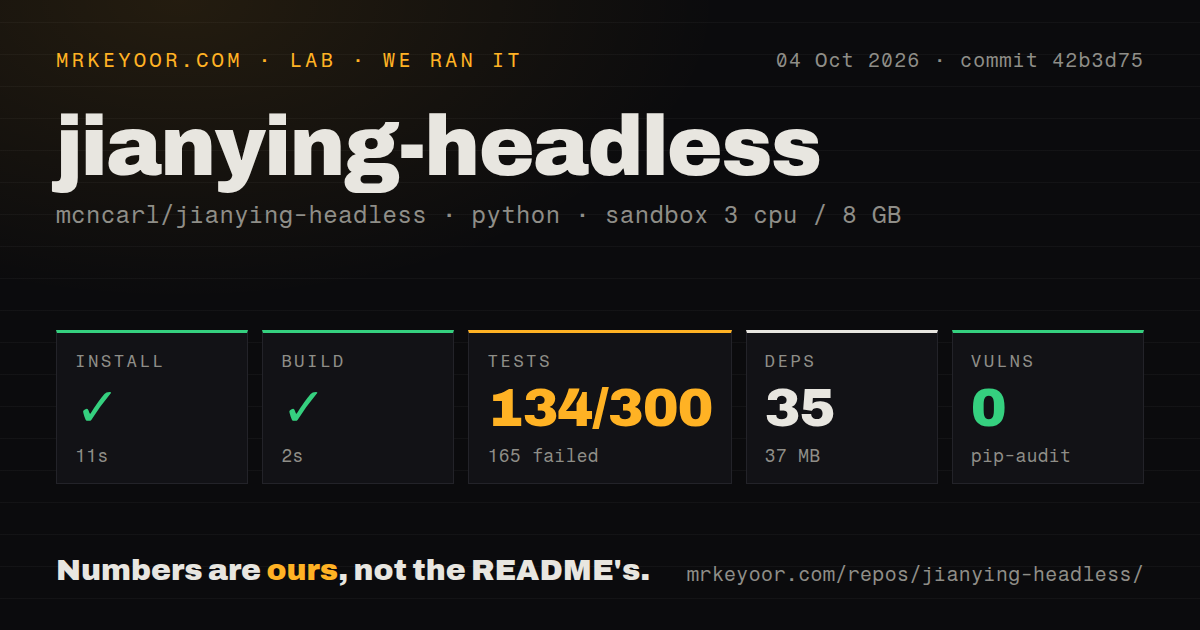
Lab card: what happened when we ran jianying-headlessScreenshot of jianying-headless (github.com/mcncarl/jianying-headless)
Install✓ · 11s35 packages · 37 MB
Build✓ · 2s
Tests✗ · 119s134 passed · 165 failed · 7 skipped · 1 errors of 300 (pytest)
Known vulns0(pip-audit)
Repo99 files~12,269 lines of source · 11.5 MB · 1 CI workflows · tests dir

Answers from our run

Does jianying-headless build from source?

Dependencies installed in 11 seconds (35 packages), and the build succeeded in 2 seconds. We cloned commit 42b3d75 into a clean Debian container with 3 CPUs and no project-specific setup.

Do jianying-headless's tests pass?

Not all of them: 134 of 300 passed and 165 failed when we ran the project's own test command (pytest), with 1 collection error. Some failures need services or credentials a bare container does not have.

Does jianying-headless have known vulnerabilities in its dependencies?

pip-audit found none in the dependency tree at the time of our run.

Who should not use jianying-headless?

Commercial teams without written permission: the original code is licensed for personal learning and noncommercial use, not under MIT or Apache-2.0.

What are the alternatives to jianying-headless?

OpenTimelineIO, MoviePy, MLT. Our Jianying Headless run built in 2 seconds but finished with 165 failed tests, 134 passed, 7 skipped, and 1 error, so this commit is not ready for unattended adoption.

Setup1/5Fast package setup hides exact Mac, app, SDK, and hash requirements
Docs4/5Detailed Chinese guides and caveats; English mainly covers Windows
Community3/52,969 stars with 7 issues and 6 pull requests open
Maturity1/5165 test failures, no release, and narrow verified environments

Who it’s for

Chinese-speaking video teams standardizing repeatable Jianying drafts from structured plans.
Agent builders who need editable timelines rather than only a rendered MP4.
Apple Silicon operators able to pin Jianying, macOS, SDK, and native-library identities.
Researchers willing to validate every draft by opening, playing, saving, reopening, and exporting it on the target Mac.
Windows users who only need the separate limited FFmpeg renderer and do not expect an editable Jianying project.

Who it’s NOT for

Commercial teams without written permission: the original code is licensed for personal learning and noncommercial use, not under MIT or Apache-2.0.
Users of CapCut International, Intel Macs, or arbitrary Jianying builds: the getting-started guide limits the native path to Apple Silicon, domestic Jianying 11.5.0 or a compatible 11.4.2 profile, and exact identity checks.
Release pipelines requiring a green fresh-container suite: our run ended with 165 failures and 1 error.
Buyers expecting any Hypit project to convert perfectly: the README calls its workflow one-way and project-specific and lists visual differences in the example.
Editors who need online templates, cloud projects, account entitlements, or arbitrary effects: the README explicitly excludes them.

Setup reality

Our fresh Debian sandbox installed commit 42b3d75 in 11 seconds, adding 35 packages and using 37 MB. The build passed in 2 seconds. Pytest failed after 119 seconds: 134 passed, 165 failed, 7 skipped, and 1 collection/setup error were reported in the 300-test run. Pip-audit found 0 known vulnerabilities.

The native workflow needs an Apple Silicon Mac, macOS 26.0 or newer, a supported domestic Jianying Pro build, Python 3.9 or newer, FFmpeg, FFprobe, Xcode Command Line Tools, and matching native library identities. The official engine, account data, effects, and source media are not included.

The failure tail repeatedly reports ValueError: Unstaged/unsupported export resource path: font_path; two text subtests show the same message with an empty path. The log does not establish why. Windows has a separate FFmpeg path, but it neither installs Jianying nor creates an editable Jianying draft.

Editable Jianying drafts are the reason to accept the constraints

Jianying Headless does more than render a video from a script. Its main macOS path builds a draft that can be opened and edited in Jianying Pro, supports multiple tracks, local media, text, basic keyframes, and a limited set of native effects, then exports through the installed Jianying engine. It can also inspect an existing project and modify an isolated copy rather than overwriting the source.

That editable handoff is the project's strongest reason to exist. MoviePy or FFmpeg can produce an MP4 with fewer moving parts, but they do not give an editor a Jianying timeline afterward. The cost is dependence on private application structures and native components that can change across builds. This repository is not an official SDK, and the README repeats that a version number alone does not establish compatibility.

The native path accepts specific Macs and Jianying builds

The getting-started guide calls for Apple Silicon, macOS 26.0 or newer, domestic Jianying Pro 11.5.0, or a compatible 11.4.2 profile. CapCut International is excluded. The documented environment also uses Python 3.9 or newer, FFmpeg, FFprobe, Xcode Command Line Tools, Apple clang 21.0.0, and the macOS 26.5 SDK. Native library hashes and signing identities are checked.

These checks are protective because silently accepting an unknown binary could create a corrupt draft or invoke the wrong component. They also make setup brittle. Issue 3 reports an exact native library hash mismatch on 11.5.0, while issue 27 requests support for 11.5.3. The README says clean-machine installation acceptance is still unfinished. A doctor pass proves only that the environment matches its rules, not that a particular edit looks or sounds correct.

What happened when we ran it

Our sandbox installed commit 42b3d75 in 11 seconds, adding 35 packages and occupying 37 MB. The build succeeded in 2 seconds. Pytest then failed after 119 seconds. The reported run ended with 134 passed, 165 failed, 7 skipped, and 1 collection/setup error out of 300, plus 403 passed subtests. The container had 3 CPUs, 8 GB of RAM, Python 3.12 on Debian, no secrets, and no elevated privileges.

The log tail repeatedly shows ValueError: Unstaged/unsupported export resource path: font_path in position-staging cases. It names audio, effect, filter, and text subtests, as well as checks for tampering, sidecar copies, wrapper fields, and zero-position behavior. Two text subtests show an empty resource path after the same message. That is what the log establishes. It does not tell us whether one defect, fixture state, or environment mismatch explains all 165 failures.

Pip-audit reported 0 known vulnerabilities. The checkout contained 99 files, about 12,269 lines of source, and occupied 11.5 MB. Our scan found 1 CI workflow, no Dockerfile, and a tests directory. A clean dependency audit and successful build are useful, but they do not outweigh a suite where more tests failed than passed.

The Windows route produces an MP4, not a Jianying project

Windows users get a separate FFmpeg backend with an English guide. It validates a render snapshot and can output H.264/AAC video with the documented video, audio, and basic text support. It does not install or call Jianying, and it does not create an editable Jianying draft. Treating it as platform parity would erase the feature that distinguishes this project.

The split can still be practical. A Windows worker can render a constrained plan, while a matching Mac handles the native draft path. Yet those outputs have different capabilities and acceptance criteria. The README notes an intermittent missing-frame problem for image and GIF samples, and issue 20 records 59 of 60 or 1506 of 1507 frames in affected exports. Strict checking rejects such output rather than hiding the mismatch.

The Hypit example proves one handoff, not a general converter

The published collaboration example lasts about 50.23 seconds and contains 23 tracks with 154 clips. The project says it built, opened, saved, cold-reopened, and exported that case in Jianying 11.5.0, with all 1507 frames present in its native export check. It also lists differences in fonts, word-level color animation, cropping, shadows, and one supplemental shot. Subjective audiovisual acceptance remains unfinished.

That honesty sets the right buying expectation. The converter is one-way and implemented per project. Manual edits in Jianying do not flow back to the original plan, and the repository does not promise lossless conversion of arbitrary Hypit work. Use the example as evidence that a specific structured handoff can work on the author's setup, not as a compatibility guarantee for your template library.

Noncommercial licensing changes the adoption decision

The original code uses a personal-learning and noncommercial license, with commercial use requiring written permission. The repository explicitly says it is not an MIT or Apache-2.0 package, and source licensing does not include Jianying integration rights, account entitlements, or media licenses. A company cannot treat the public GitHub checkout as approval for a production editing service.

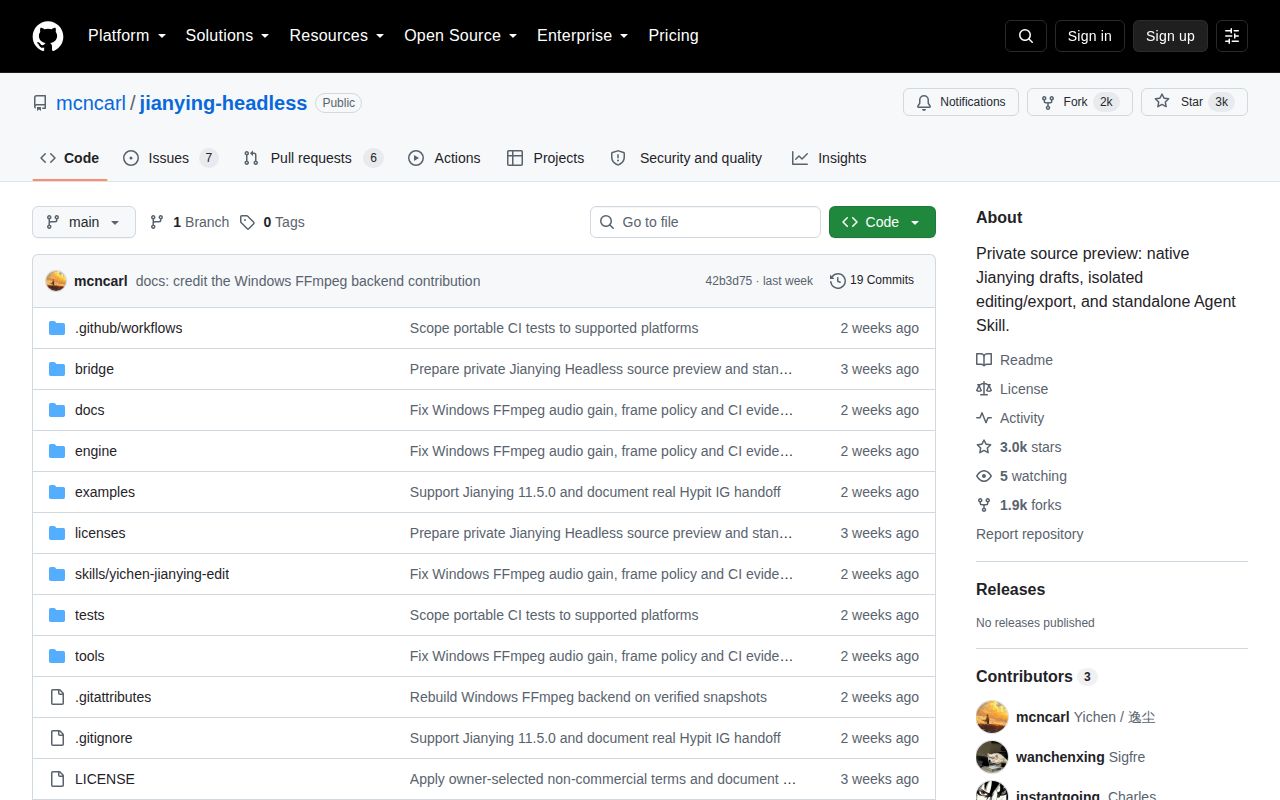
GitHub showed 2,969 stars and 13 open issues and pull requests, split into 7 issues and 6 pull requests. The branch was pushed on September 27, 2026, and issue activity continued through October 4. There is no tagged release. This is active source-preview work around a moving proprietary application. Pair that status with the 165 failures we saw: evaluate it in a dedicated Mac lab before letting it touch an editor's only project copy.

Alternatives

ProjectWhat it isPick it when
OpenTimelineIOA library and interchange format for editorial timeline data.pick this instead when portable timeline interchange matters more than direct Jianying draft generation or export.
MoviePyA Python library for scripted video editing and rendering.pick this instead when you only need a rendered video and do not need the result to remain editable in Jianying.
MLTA multimedia framework behind video editors and automated render pipelines.pick this instead when you want an editor-independent engine with a wider deployment surface.

What people are saying

  1. [velocity-scout] mcncarl/jianying-headless

Sources

  1. Jianying Headless README
  2. Getting started guide
  3. Windows FFmpeg guide
  4. Repository metadata
  5. Issue 3: native library hash mismatch
  6. Issue 20: intermittent missing frame
  7. Issue 27: Jianying 11.5.3 support request

More automation reviews

foreman · ok-wuthering-waves · jev-ultrafast · typesafe-computer-use · jev-trader · omniget · the whole board →