The 356,309-line repository is a CI controller with a plugin economy
Jenkins automates builds, tests, static analysis, and deployment from a server that you operate. The core provides scheduling, job configuration, credentials, a web interface, and connections to executors or remote agents. More than 2,000 plugins extend that base into source-control systems, build tools, cloud providers, and specialized enterprise software. It can coordinate old and new systems that will never share one tidy execution environment.
The measured checkout makes the scale visible. We counted 12,421 files and about 356,309 lines of source in a 29.7 MB repository. Jenkins is mainly Java, with a Node toolchain for its frontend assets. A small repository with ordinary Linux jobs may get the same result from its code host's CI without adding a controller, plugin catalog, backup plan, and another set of credentials.
Version 2.568.3 belongs to an LTS line alongside weekly releases
Jenkins publishes weekly and Long-Term Support release lines. Weekly builds receive new work first; selected fixes later move into LTS updates. The latest GitHub release we fetched was Jenkins 2.568.3, published September 2, 2026, with separate changelog and upgrade-guide links. That cadence gives conservative operators a supported route, but core changes and installed plugins still have to be tested together.
The plugin catalog is both capability and risk. Issue 27351 gives a current example: removing Apache Commons Lang 2.6 from Jenkins 2.579 triggered reports across several plugins, leading to a request to restore the library temporarily in the 2.580 LTS line. The issue was handled quickly, yet the episode shows why a staging controller and representative jobs belong in the upgrade process.
What happened when we ran it
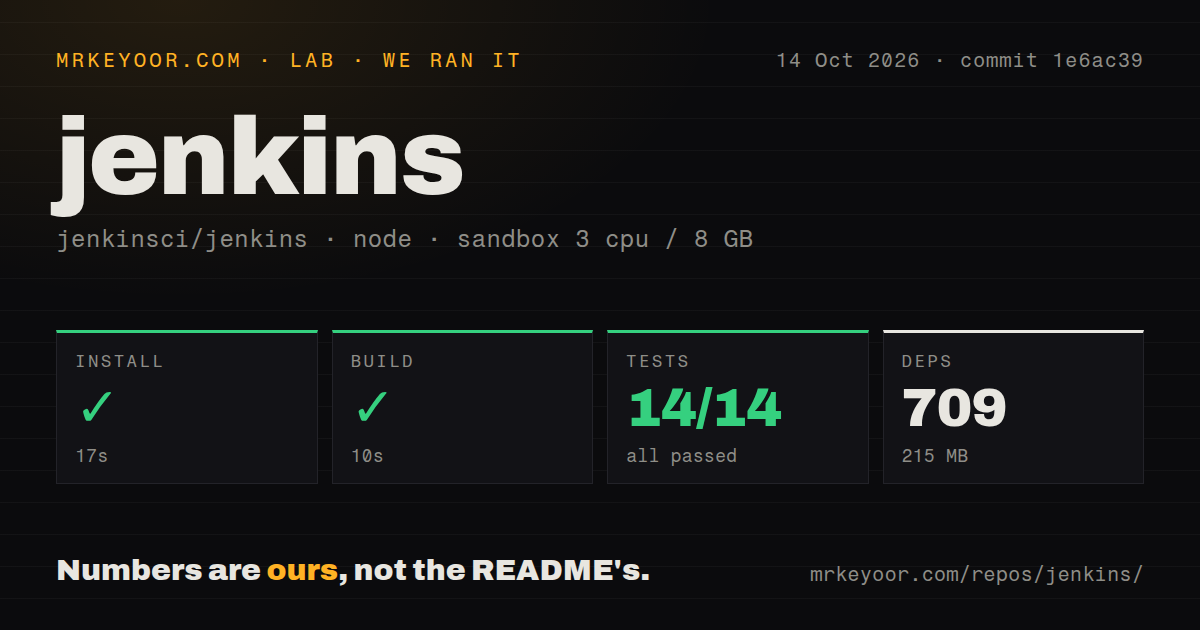
Our sandbox installed 715 Yarn packages in 57 seconds, using 218 MB on disk. The frontend production build then completed in 16 seconds. This was commit 2701fc6 in an unprivileged container with 3 CPUs and 8 GB of RAM. The result says the JavaScript assets were straightforward to install and compile in our environment. It does not say that the Jenkins WAR, Java core, or more than 2,000 plugins were built.
Vitest completed in 9 seconds with 5 passed and 0 failed. Those 5 tests are the repository's frontend test script. The contribution guide describes broader core checks separately: Maven profiles divide unit, smoke, and full tests, and complex UI changes may also need the Jenkins Acceptance Test Harness. A green Node result is useful for a frontend contributor, while a controller change needs evidence from the relevant Java and integration suites.
Our scan found 7 CI workflow files and a tests directory, with no Dockerfile in this checkout. Jenkins still distributes an official Docker image, WAR file, installers, and native packages, as the README explains. The missing Dockerfile is a repository-layout fact rather than evidence that containers are unsupported. The lab recorded no dependency-audit result, so this review makes no vulnerability claim about the 715 installed packages.
JDK 21 or 25 and Maven 3.9.6 are required for core work
Jenkins core development uses JDK 21 or 25 and Maven 3.9.6 or newer. The contribution guide provides a quick WAR build, a Maven command for starting a local controller, and separate frontend steps. The current frontend package asks for Node 24 and Yarn 4.18. A backend-only change can skip frontend installation when compiled assets already exist, but a clean full build connects both toolchains.
Running the product adds persistent controller storage, administration, backups, job definitions, worker capacity, and credentials for source control or deployment targets. Agents may sit on other operating systems or networks. Plugins fill integration gaps, then become part of the version set you must inventory. Jenkins gives an operator control over these choices; it does not remove the operating work.
Five frontend tests cannot represent the full controller
The 5 passing Vitest cases are credible evidence for the exact script we ran and nothing larger. Jenkins core has three documented Maven test profiles, and the contribution guide says functional tests can take substantial time even on server-grade machines. The project's CI adds acceptance and plugin-compatibility checks where needed. A change to scheduling, security, persistence, agents, or plugin APIs belongs in those suites instead of the 9-second frontend run.
A 16-second web build makes UI contribution pleasant, while the controller remains a large Java application with an ecosystem beyond this repository. Theme, navigation, and browser behavior start with Yarn. Controller behavior starts with Maven. An upgrade of a real installation ends with representative pipelines and installed plugins running in staging.
Seven workflows and same-day changes show active maintenance
Our repository scan counted 7 CI workflow files. GitHub showed 26,537 stars and 3,607 combined open issues and pull requests when fetched, a large queue that should not be called a bug count. The last push was September 8, 2026, and pull requests moved on that date. Version 2.568.3 had shipped six days earlier. Pushes, releases, and issue activity point in the same direction: Jenkins core is actively maintained.
Jenkins earns a shortlist spot when the company already has it, needs unusual integrations, or must keep automation on controlled infrastructure. Our 57-second install, 16-second build, and 5 passing tests lower the cost of frontend work. They do not lower the cost of controller ownership. For a greenfield team with uniform container jobs, Woodpecker or a hosted CI service may demand less attention. For Kubernetes-wide workflow primitives, Tekton is the cleaner comparison.