Chinese documentation defines who can operate it comfortably
JavBoss's README is Chinese and has no English section. Its deeper metadata tools center on JAV identifiers, performers, studios, series, and tags. Issue 186 reports that an English language choice disappeared after v1.9.0. Translation can expose the guide, but settings and issue discussions still demand extra effort.
JavBoss extracts numbers such as IPX-633, links files to works, and catalogs titles, dates, covers, performers, and tags. The 47.1 MB checkout held 372 files and roughly 80,463 source lines in our run. General video mode exists, though the adult-library model is the reason to choose it.
Port 8655 opens with an admin password that should be changed
The desktop packages run a local web application and open it in the browser. Docker publishes host port 8655, enables access from LAN devices, persists /app/data, and maps the host filesystem into /host as read-only. The documented password is admin. That default is acceptable for a first local login and poor for continued network use, so password replacement belongs in the initial setup rather than a later security pass.
The sample compose file gives the container read access to /, revealing every readable host path. Map only the needed media directories. Our 120-package install did not evaluate authentication, browser exposure, or container isolation, so the passing build cannot answer those deployment questions.
What happened when we ran it
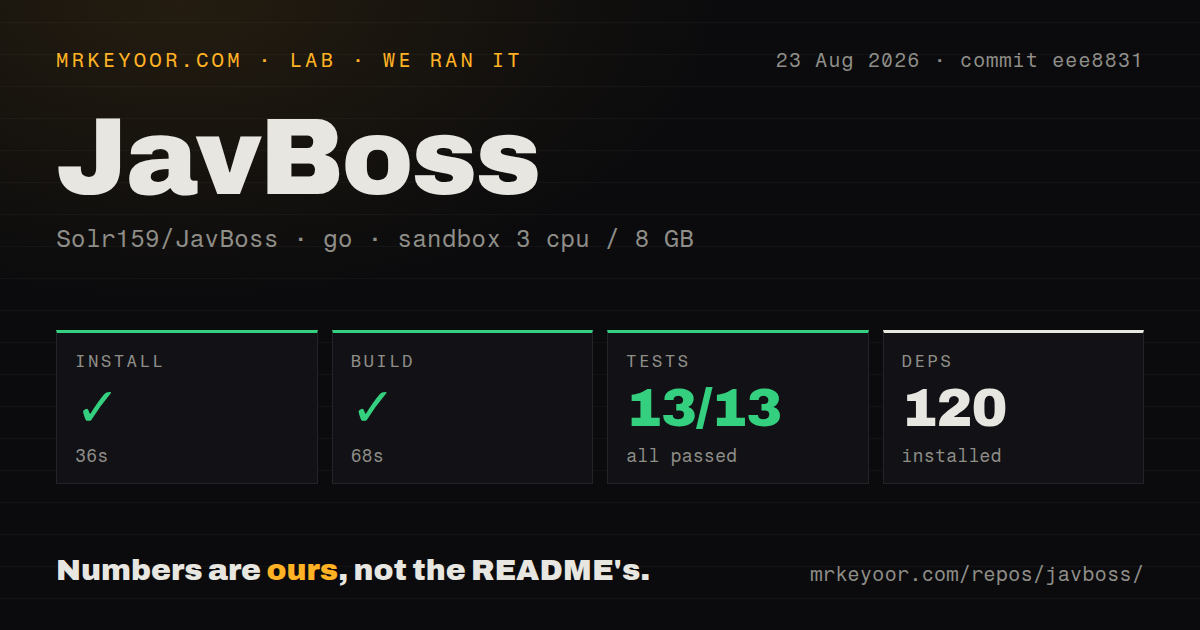
Our sandbox installed the Go dependencies in 36 seconds and added 120 packages. The build succeeded in 68 seconds. Tests then ran for 140 seconds and passed all 13 cases, with 0 failures. We used commit eee8831 in a fresh Debian container with 3 CPUs, 8 GB of RAM, no secrets, and no privileged access. This was the cleanest result among the mechanical checks: install, compile, and test all completed.
The repository measured 372 files, about 80,463 source lines, and 47.1 MB before the downloaded dependencies. Our scan found 4 CI workflow files and a Dockerfile, although there was no directory literally named tests. The 13 successful Go tests still count; Go commonly keeps _test.go files alongside the packages they exercise. We did not import a video library, scrape external metadata, render thumbnails, or play a media file in this sandbox.
External sites decide whether new metadata arrives
JavBoss reads existing catalog information from its own data/ directory, so previously stored records remain available without internet access. New JAV metadata and covers are different. The README names multiple outside sources and says external connectivity is required for initial scraping and later updates. It also warns that a single scan may miss some eligible files because each video gets one scraping attempt per pass and network or source-site controls can interrupt requests.
Scanning runs continuously by default, with 1 minute between passes. The README advises NAS owners to increase that interval or turn automatic scanning off to reduce disk wear. A directory change, deleted file, or moved video needs another scan before the catalog reflects it. Our 140-second test run does not measure scanning speed or scraping accuracy, and the project's own informal failure percentage is not a controlled benchmark, so buyers should test a copy of their naming scheme first.
Browser playback and mpv serve different machines
Desktop use integrates mpv for original local files, player shortcuts, screenshot capture, progress previews, and resuming from a saved image's timestamp. The system player is another choice. Docker cannot call mpv on the host, so video plays in the browser. That distinction matters for codecs and high-bitrate files, where browser compatibility and the desktop mpv path may behave differently.
Client mode handles one narrower remote case. Install JavBoss on the viewing computer, point config.toml at a server such as http://192.168.1.100:8655, and the local client can use local mpv while browsing the remote library. The feature assumes both machines can resolve the same media path arrangement. With 13 of 13 tests passing, the repository clears its suite, but our lab did not test this two-machine path or screenshot synchronization.
WebDAV and STRM collections still need another manager
The README's directory model expects accessible filesystems. Issue 253 asks for WebDAV so cloud and object-storage libraries can be scraped. Issues 160 and 242 ask for .strm file support, and pull request 249 proposes an implementation. Until that work lands in a release and is verified, a library built around pointer files or remote object storage is outside the documented happy path. Issue 203 also shows one NAS user struggling to enter a recognized Docker path.
JavBoss keeps its database, covers, thumbnails, and screenshots under data/ without modifying source videos. Preserve that folder across manual upgrades or Docker image pulls. A 68-second successful build says nothing about migration correctness, so copy the directory before upgrading.
August 2026 activity is fast, with documentation trailing the interface
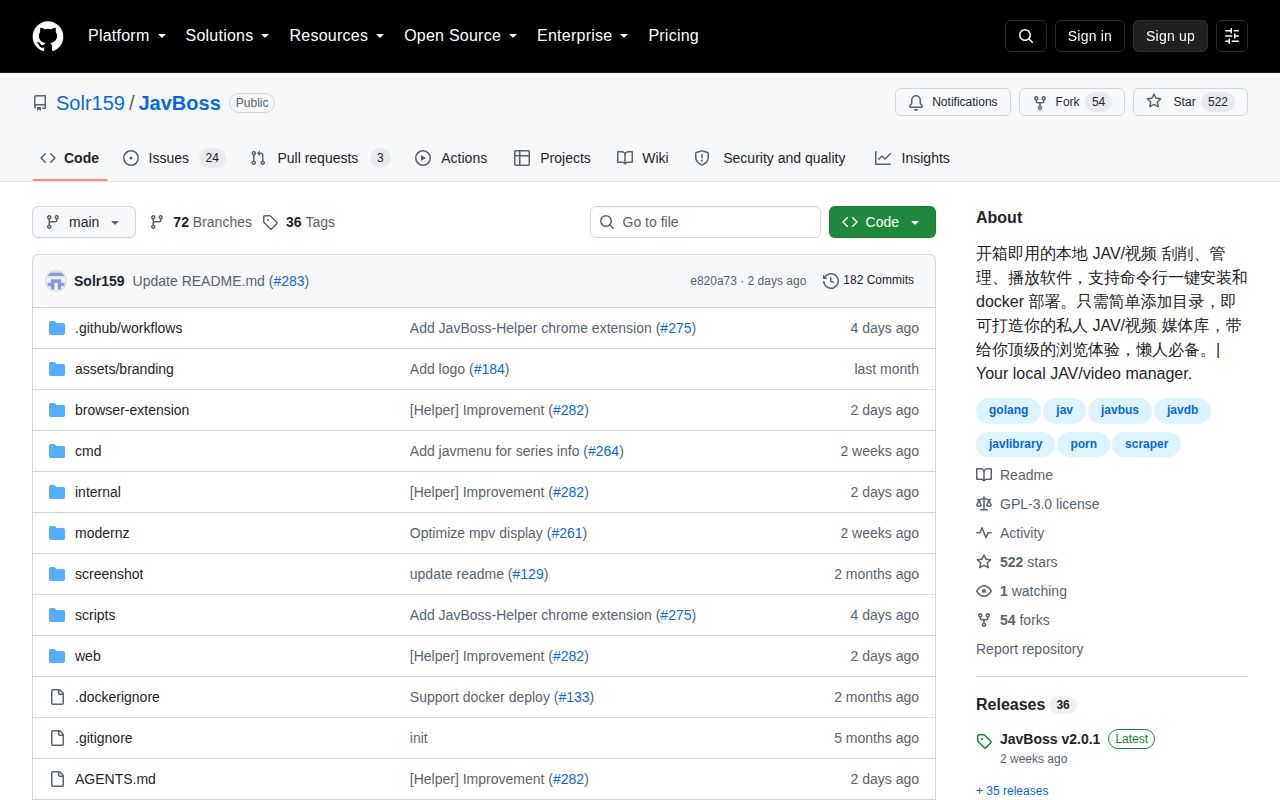
GitHub recorded 522 stars, 27 combined issues and pull requests, an August 25, 2026 push, and release v2.0.1 on August 16. The release added tag groups, custom sorting, keyboard shortcuts, performer filters, UI changes, and fixes. Current requests cover FC scraping, excluded directories, duplicate-file views, subtitles, WebDAV, and .strm sources. This is an active project with a feature set that is still moving quickly.
The README tells users to discover some batch deletion, manual scraping, directory organization, and export functions themselves. JavBoss fits when its Chinese interface matches the library you keep. Its 13 passing tests support a trial; the admin password, root mount, outside sources, and missing English guide demand a careful LAN deployment.