mrkeyoor.com_
Thu 10 Sept 13:43 UTC
Dev Toolsevaluationupdated 10 Sept 2026

Java review

TheAlgorithms/Java is a large, searchable collection of algorithms and data structures written in Java for study and contribution. It helps developers inspect working implementations by topic, but the project explicitly says its educational code may be less efficient than Java's standard library.

trackingstars / 7d
Verdict

Our Java run passed all 29,285 tests in 121 seconds, making TheAlgorithms/Java a strong code-reading resource for learners who want examples they can execute. Use it to study, compare approaches, and practice contributions. Do not treat its classes as a production utility library without your own review, because the project labels them educational and publishes no stable GitHub release.

We ran it

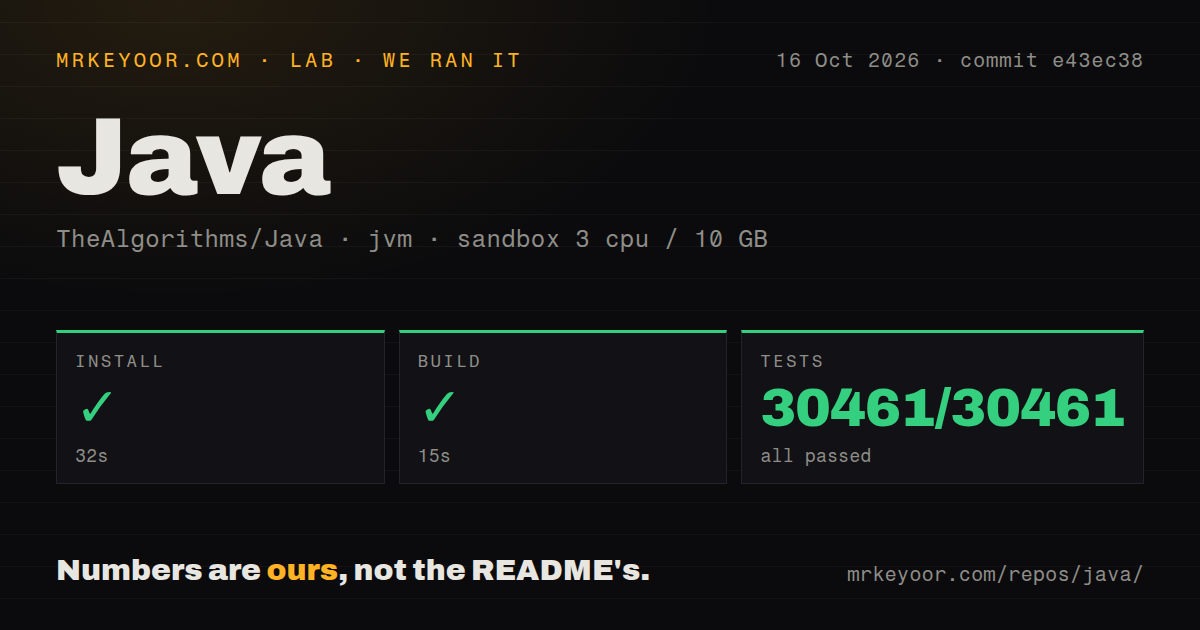
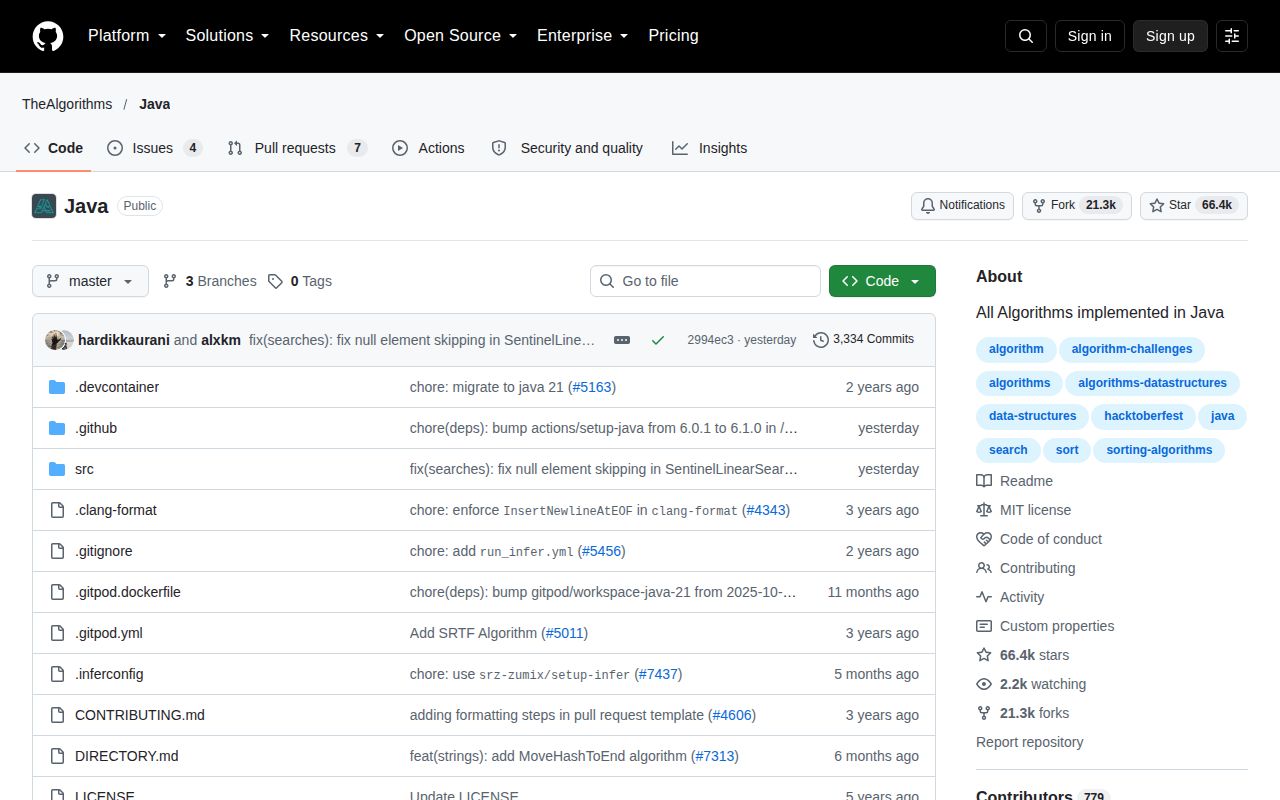
Lab card: what happened when we ran JavaScreenshot of Java (github.com/TheAlgorithms/Java)
Install✓ · 46s
Build✓ · 19s
Tests✓ · 121s29285 passed · 0 failed of 29285 (maven surefire)
Repo1645 files~143,758 lines of source · 5 MB · 8 CI workflows

Answers from our run

Does Java build from source?

Dependencies installed in 46 seconds, and the build succeeded in 19 seconds. We cloned commit 1f08afb into a clean Debian container with 3 CPUs and no project-specific setup.

Do Java's tests pass?

Yes: 29285 of 29285 passed when we ran the project's own test command (maven surefire). Some failures need services or credentials a bare container does not have.

Who should not use Java?

Production teams seeking drop-in replacements for Java collections or utilities: the README warns that these educational implementations may be less efficient than the standard library.

What are the alternatives to Java?

The Algorithms: Python, Algorithms, Coding Interview University. Our Java run passed all 29,285 tests in 121 seconds, making TheAlgorithms/Java a strong code-reading resource for learners who want examples they can execute.

Setup5/5Install and build passed; Java 21 is the main requirement
Docs3/5Excellent index, but little guided explanation in the README
Community5/566,238 stars and fresh issue and pull request activity
Maturity4/529,285 tests passed, though there is no stable release

Who it’s for

Java learners who understand an algorithm better by reading and running code.
Interview candidates who want implementations grouped by topic rather than a lesson sequence.
Teachers looking for small examples backed by a large automated test run.
Open-source contributors willing to add a test case and follow the repository's review rules.

Who it’s NOT for

Production teams seeking drop-in replacements for Java collections or utilities: the README warns that these educational implementations may be less efficient than the standard library.
Beginners who need a guided course with explanations and exercises: the README is brief, and the main directory is an index of source files rather than a curriculum.
Developers who need a versioned library dependency: the project had no published GitHub release, and its Maven version at commit 1f08afb was 1.0-SNAPSHOT.
Contributors planning to add LeetCode problem solutions: the contribution guide explicitly rejects those as applications of principles already covered.
Teams tied to an older Java runtime: the Maven build at the measured commit targets Java 21.

Setup reality

Our sandbox install succeeded in 46 seconds, the build succeeded in 19 seconds, and all 29,285 Maven Surefire tests passed in 121 seconds. Commit 1f08afb contained 1,645 files, about 143,758 source lines, and occupied 5 MB when checked out.

Running the code needs a Java 21 toolchain and Maven. It does not need accounts, credentials, a database, or an external service. Gitpod is an optional browser-based route linked from the README.

This is source to inspect and run, not a configured application. The checkout had 8 CI workflow files but no Dockerfile or tests directory; its tests live in the Maven source layout, and the compiler treats warnings as errors.

A 143,758-line catalog is useful for lookup, not guided study

TheAlgorithms/Java collects implementations under topic folders such as backtracking, bit manipulation, ciphers, compression, conversions, data structures, graphs, searches, and sorting. Our measured checkout contained 1,645 files and about 143,758 lines of source, yet occupied only 5 MB. The generated directory is the practical front door: choose a subject, open the linked class, and then find its tests. That works well when you already know the term you want to inspect.

The README makes a narrow promise. Every algorithm is implemented in Java for educational purposes, and the maintainers warn that an implementation may be less efficient than its Java standard library equivalent. That sentence should govern how you use the whole repository. The code can demonstrate control flow, data structures, edge cases, and tests. It is not an endorsement to replace Arrays.sort, production cryptography, or a maintained application dependency with the class you found here.

Java 21 and Maven keep the project conventional

The Maven file at commit 1f08afb targets Java 21 and packages the project as a 1.0-SNAPSHOT JAR. Its direct runtime dependencies are Apache Commons Lang and Commons Collections, while JUnit, AssertJ, and Mockito support testing. Compiler warnings fail the build. Checkstyle, PMD, SpotBugs, JaCoCo, and Find Security Bugs are configured in the same build file, which gives contributors a visible definition of acceptable code beyond whether an example returns the expected answer.

There is no account setup, database, API token, or service topology to understand. Clone it, use a Java 21 toolchain, and run Maven. Gitpod is linked for people who prefer a browser workspace. The absence of a Dockerfile is not a serious omission for this kind of repository, although teams that standardize development through containers will need to supply their own Java image. Our checkout included 8 CI workflow files, so automated project checks are present even though the README says little about them.

What happened when we ran it

Our sandbox installed TheAlgorithms/Java in 46 seconds and built it in 19 seconds. Maven Surefire then completed 29,285 tests in 121 seconds with 29,285 passed and 0 failed. Those are the cleanest results in this four-project batch: no install failure, compiler failure, or failed test appeared in the supplied run. The result applies to commit 1f08afb in an unprivileged Debian container with 3 CPUs, 10 GB of RAM, and Java 21.

The repository scan found no top-level tests directory, but that is a layout signal rather than missing coverage. Maven projects normally place tests under src/test, and Surefire found 29,285 of them. The checked-out source was also small in storage terms at 5 MB, despite the 143,758 source lines. Setup cost is therefore mostly toolchain and test time, not a large repository download or a collection of external services.

A passing suite does not certify every algorithm for production input, performance, or security. It tells us the repository's own expected behaviors held in our stated environment. That is still valuable for a teaching collection, where a copied example with no executable checks would leave readers guessing. When an implementation matters to an application, read its tests, check complexity, compare it with the Java platform, and add cases drawn from the application's actual data.

The directory gives breadth, while explanations stay close to code

The project directory lists individual classes rather than arranging material into lessons. In backtracking alone it links examples for N-Queens, Sudoku, word search, knight's tour, maze recursion, and other problems. The ciphers area mixes historical techniques with classes named AES, DES, RSA, Diffie-Hellman, and ECC. That breadth makes browsing productive, but a filename and implementation cannot explain security suitability, proof, history, or when a standard library API is safer.

This format favors readers who can interrogate code. A beginner may still learn plenty, especially by running a test and changing an input, but the repository does not supply the progression of a course. Coding Interview University is better when you want an ordered study plan. William Fiset's Algorithms is a closer Java alternative when companion lessons matter. TheAlgorithms/Python is the obvious parallel choice when language familiarity matters more than seeing Java types and conventions.

Contribution rules reject problem-site answer dumps

The contribution guide says the project does not add LeetCode problems because they apply principles covered by existing algorithms. New features should begin with an issue and include a clear description plus a test case. Bug reports are also expected to include a case showing the wrong behavior. Those rules keep the collection focused, and they make this a poor target for contributors who mainly want to upload a folder of interview-site answers.

Activity was current on September 9, 2026, when GitHub recorded the last push. The repository had 66,238 stars and 15 open issues and pull requests when fetched; the open list split into 5 issues and 10 pull requests. Recent entries covered a perceptron classifier, array rotation, test additions, and directory generation. Current pushes plus active review traffic are better health evidence than release cadence here, because GitHub returned no latest published release.

No stable release keeps production adoption manual

The MIT license is straightforward, but the absence of a published GitHub release and the 1.0-SNAPSHOT Maven version matter if another codebase wants to depend on this repository. There is no stable release marker in the fetched project data to pin as a supported library product. A production team would need to select a commit, copy or package only the required code, preserve the applicable license notice, and accept responsibility for its behavior.

For learning, that limitation barely hurts. The 29,285 passing tests, Java 21 build, generated directory, and current contribution activity make this one of the easier algorithm collections to inspect with confidence. Its value drops when the job changes from understanding an algorithm to owning a supported component. Read it, run it, and borrow ideas carefully; keep the Java standard library and specialist security libraries in charge of production work.

Alternatives

ProjectWhat it isPick it when
The Algorithms: Python gh↗The same educational idea with implementations written in Python.pick this instead when Python is the language you are learning or teaching.
AlgorithmsA Java algorithms and data structures repository paired with video lessons.pick this instead when explanations and a companion video course matter more than collection size.
Coding Interview UniversityA structured computer science study plan aimed at technical interviews.pick this instead when you need a curriculum and reading order rather than a Java code catalog.

What people are saying

  1. [velocity-scout] TheAlgorithms/Java

Sources

  1. TheAlgorithms/Java README
  2. TheAlgorithms/Java project directory
  3. TheAlgorithms/Java Maven build file
  4. TheAlgorithms/Java contribution guide
  5. TheAlgorithms/Java issues and pull requests
  6. TheAlgorithms/Java releases

More dev tools reviews

jadx · blender · maui · desktop · manim · LazyVim · the whole board →