Short answer: inspect the code before trusting the dog model
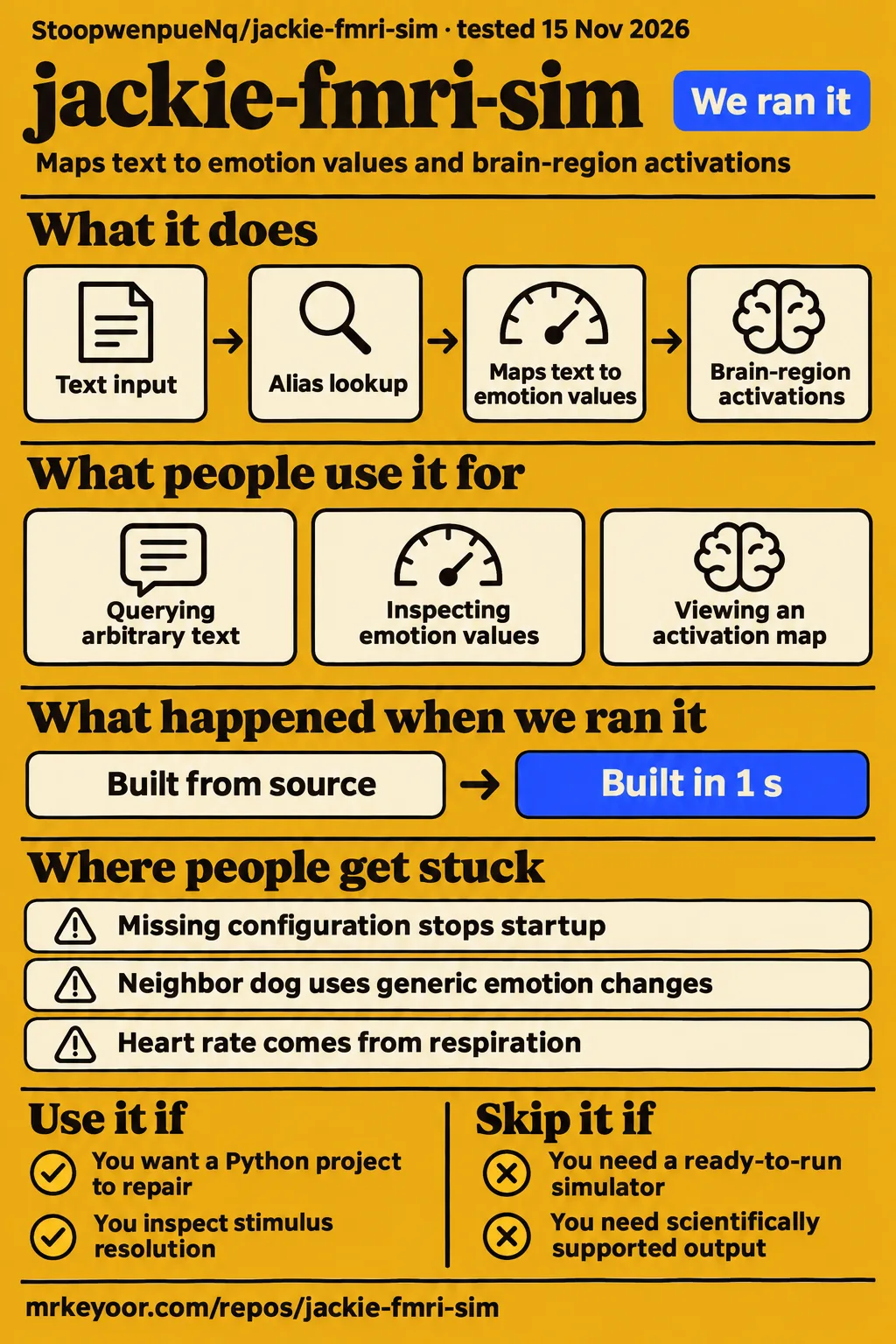
Issue #1 reports that a fresh clone stops immediately with a missing config module. Our sandbox install succeeded in 8 seconds and its build step succeeded in 1 second, but those results answer a narrower question than whether the advertised interactive program works. Use jackie-fmri-sim if you want a small Python project to inspect and repair. Skip it if you need a ready-to-run canine emotion simulator or outputs you can use as scientific evidence. Startup report
The repository's README calls the project jackie-brain-twin and presents it as a research prototype. It describes turning textual stimuli into emotion values and brain-region activations using sessions attributed to a dog named Jackie. That makes the code an interesting reading exercise: you can follow how a stimulus becomes a numerical response. The decision turns on whether that response follows the intended data path, and the issue reports give specific reasons to inspect it before drawing conclusions. Project README
What people use jackie-fmri-sim for
The supplied issue reporters attempted a fresh-clone startup and inspected stimulus resolution after supplying a stub for the missing configuration. Those are concrete encounters with the software. They give a prospective contributor useful starting points, although neither is a success story about using the model for research.
| Who tried it | What they did | What happened |
|---|---|---|
| GitHub issue #1 reporter | Started python3 main.py from a fresh clone |
Import failed because the required config module was absent. Issue #1 |
| GitHub issue #2 reporter | Stubbed configuration and checked the neighbor-dog stimulus against the derived mappings | The alias missed the learned mappings and selected generic emotion changes. Issue #2 |
The second encounter is especially useful. The reporter compared the neighbor input with random street dog and best friend dog. Those other names matched their session keys; neighbor dog did not. A demonstration can therefore print plausible-looking emotion labels while taking different computational paths for conditions a reader expects to be comparable. That is a reason to inspect the match result alongside the emotion output, rather than treating a printed label as the whole result. Alias investigation
The README advertises broader possibilities: querying arbitrary text, inspecting a six-component emotional vector, and viewing a 25-region activation map. Its named emotions include joy, curiosity, calm, excitement, anxiety and affection. These are the project's descriptions of its output. If your aim is to understand a compact stimulus-to-state program, those named structures give you something tangible to trace through the source. README's project summary
What happened when we ran it
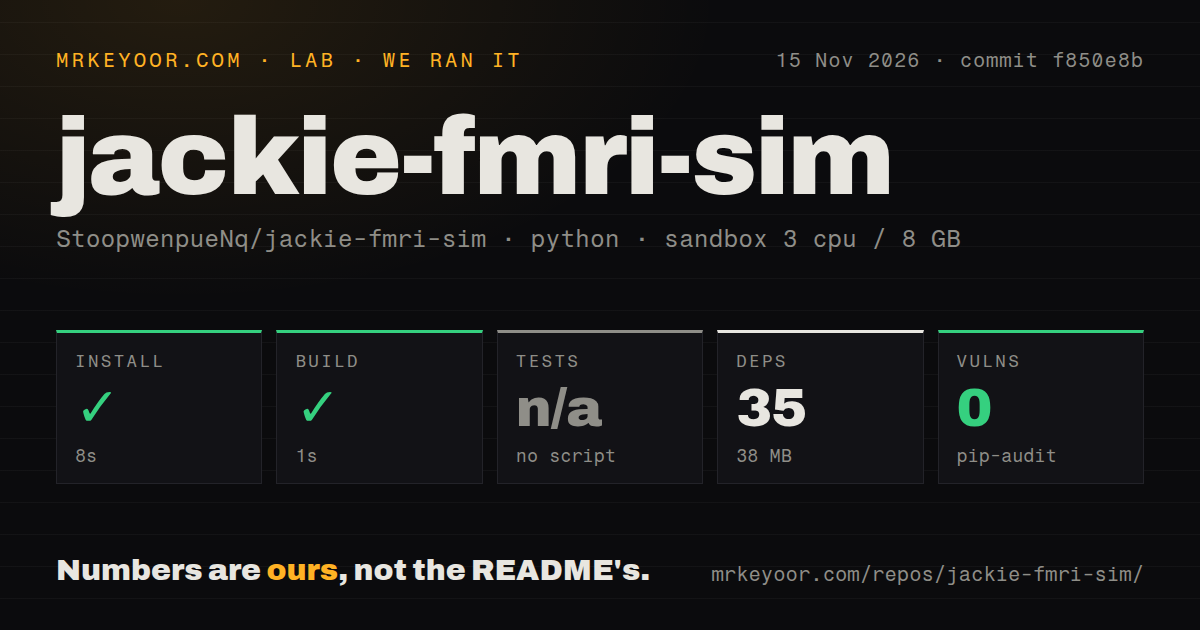
Our sandbox install succeeded in 8 seconds and the build succeeded in 1 second at commit f850e8b on 2026-11-15. A separate hands-on deployment attempt stopped at its safety check because the repository had no Compose file. The step lists compose.yaml, compose.yml, docker-compose.yaml and docker-compose.yml as absent. This was a lab deployment prerequisite, so the failure belongs to that deployment route.
| Sandbox observation | Recorded result |
|---|---|
| Install | Succeeded in 8 seconds |
| Installed dependencies | 35 recorded, 38 MB on disk |
| Build | Succeeded in 1 second |
| Tests | Skipped: no tests script or target |
| Dependency audit | pip-audit reported 0 known vulnerabilities |
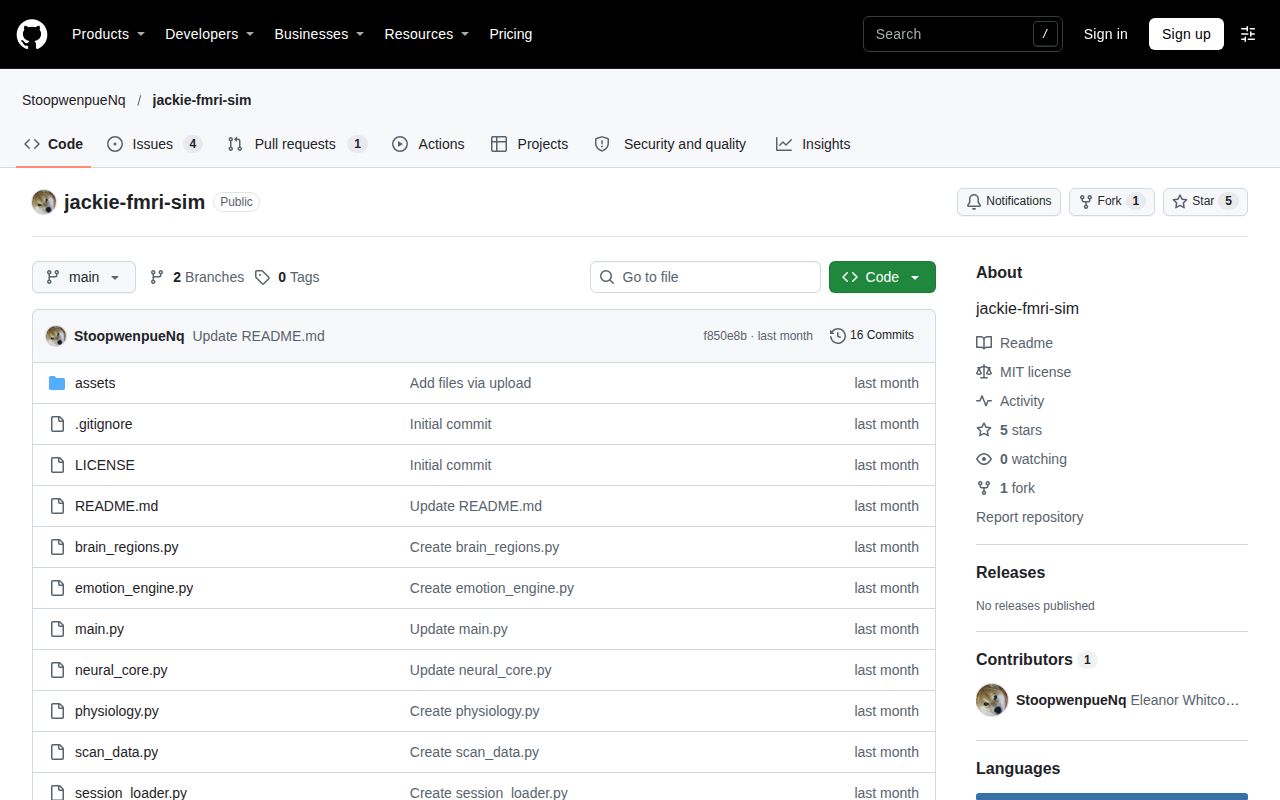
| Repository scan | 17 files, about 463 source lines, 1.1 MB checked out |
| Automation and packaging signals | 0 CI workflow files, no Dockerfile, no tests directory |
The sandbox configuration specified 3 CPUs, 8 GB of RAM and the image label ghcr.io/astral-sh/uv:python3.12-bookworm. Actual runtime and operating-system versions require the raw toolchain logs. Read the dependency figure as the harness's recorded environment: the README's standard-library-only comment does not explain which packages account for that environment, and we won't guess. The install and build results also supply no output-quality score.
The hands-on summary says the project was deployed with its own Docker Compose, but the detailed safety step records failure before that route could proceed. We give the failed step priority over that summary wording and make no claim of a working deployment. The teardown record says teardown: ok. For someone planning to reproduce the review, these records support preparing another execution route, not searching for a Compose service that this checkout never supplied.
Where people get stuck: configuration first, then misleading outputs
Issue #1 identifies two missing files: config.py, required by imports, and requirements.txt, referenced by the installation instructions. The reporter's traceback reaches neural_core.py, which imports constants including DECAY_RATE and REGION_BOOST. The visualizer imports image paths from the same absent module. Installing an unrelated package named config would not supply this project's intended constants. The report asks for the actual configuration or a documented example. Issue #1
| Report | Reader-visible consequence | Proposed repair in the report | Recorded status |
|---|---|---|---|
| #1: missing configuration and dependency file | Startup stops; the documented dependency-file command refers to an absent file | Commit the required constants or an example configuration, and supply the dependency file | Open, no completed fix recorded |
| #2: neighbor alias mismatch | The social demo uses generic changes for the neighbor condition | Register the neighbor alias in the derived mapping table | Open, no completed fix recorded |
| #3: physiological field mismatch | Heart rate comes from the field named respiration; session respiration never updates its state field | Separate hr and rr and pass both through processing |
Open, no completed fix recorded |
| #4: missing-image sentinel | Image checks report availability and output contains a dot | Use None for an absent image and update both callers |
Open, no completed fix recorded |
These repairs come from the issue authors. The records show proposals, not merged changes. For a contributor, the sensible order is to obtain the intended configuration, establish startup, then check each output path. A configuration stub can make isolated code reachable, as the reporter demonstrated, but any chosen constants become part of that local experiment. Keep them separate from claims about reproducing the repository's intended model. Configuration proposal
The neighbor report describes a consequential mismatch. Resolution turns neighbor-containing text into neighbor dog, while the learned table retains the longer first-exposure and later-session names. The reporter says the fallback makes joy decrease instead of applying the later session's learned increase. Even the advertised social command sends the alias. Repairing the import therefore leaves a second, quieter failure to address. Issue #2
The physiology and image reports change how to read a result
Issue #3 says PhysioState.hr is populated from Session.rr, while session respiration never reaches PhysioState.rr. The reporter adds an important qualification: the bundled numbers match the README's heart-rate column, so the current values happen to be on a heart-rate scale despite their field name. The danger appears when someone extends the dataset using an actual respiratory value in the field whose name suggests respiration. Issue #3
That distinction matters for a developer adding sessions. Renaming a field alone would clarify the existing data, but the reporter's proposed repair also carries a separate respiratory value through processing. Otherwise a future contributor could follow the apparent schema and feed breaths per minute into arithmetic that expects heartbeats per minute. Treat the field contract as part of the model, because the numerical result depends on it. The issue remains open in the supplied record. Physiology proposal
Issue #4 reports that an unmapped image becomes Path(""), which resolves to the current directory. That path exists, so the availability check returns true and the serialized fMRI field becomes .. A caller asking whether an image is available receives the wrong answer even though the filesystem check itself behaves normally. The proposed None sentinel makes absence explicit; the report also asks for matching changes to existence checks and output serialization. Issue #4
The practical reading rule is simple: a nonempty fMRI field does not by itself identify an image in the reported implementation. Inspect the mapped file, and keep the displayed emotion, physiological values and image association separate when reviewing a result. These reports are useful precisely because they explain how ordinary Python behavior can produce a misleading scientific-looking output without throwing an exception.
Security evidence stops at the dependency audit
Our sandbox's pip-audit result was 0 known vulnerabilities. That is a dependency-audit observation, not an assessment of the model's scientific claims or a certification for running the project as a service. The configuration described in issue #1 consists of model constants and image paths. The reported startup failure asks for those missing program inputs; the evidence does not identify an account, hosted model or API credential as its cause. Required configuration
For the reader considering a local code exercise, the useful next step is to review the required constants and data paths before attempting execution in an isolated environment. Do not invent configuration values merely to reproduce a screenshot from the README. A successful prompt response with substitute values would answer a different question from whether the original model is reproducible. The safety-step rejection also concerns the lab's deployment rule, so its word unsafe should not be read as a discovered exploit.
jackie-fmri-sim vs BrainIAK fmrisim and fMRI-Simulator
BrainIAK's fmrisim generates simulated fMRI datasets, while neurolabusc's fMRI-Simulator explores experiment designs. Those are different jobs from jackie-fmri-sim's advertised textual-stimulus dog model. The research synthesis contains no user comparison between them. This table separates their documented purposes so that a search for an fMRI simulator does not send you to the wrong kind of program.
| Project | Documented purpose | Choose it for |
|---|---|---|
| jackie-fmri-sim | Maps textual stimuli to a canine emotion vector and brain activation state, according to its README | Inspecting this specific dog's proposed stimulus model and repairing its reported paths |
| BrainIAK fmrisim | Creates synthetic data with noise properties extracted from real fMRI and a user-specified signal | A Python fMRI data-simulation task. fmrisim paper |
| neurolabusc/fMRI-Simulator | Generates convolved models for basic designs and accepts custom text files | Exploring experiment timing and relative design efficiency. Project documentation |
The fmrisim paper describes evaluating designs in terms of power. The fMRI-Simulator README says its efficiency measure is relative and changes with settings such as sampling interval and volume count. Those descriptions help narrow a shortlist, without supplying a winner on speed or accuracy. If your task is synthetic imaging data or experiment design, start with the matching project rather than repairing a canine emotion demo for a job its README never promises. Simulation paper, design documentation
What the other reviews get wrong
Gitnova describes the repository's star growth as organic, while OpenPulse records a loss of 464 stars over its 30-day observation window. Gitnova's explanation says stars arrive unevenly, but that heuristic leaves the recorded decline unexplained. The OpenPulse window runs from 16 October to 15 November 2026. The discrepancy warrants caution about the growth narrative; neither record proves fake stars or establishes why the count fell. Gitnova, OpenPulse
The more consequential distinction concerns what a directory summary knows. Mid or Real describes emotional reconstruction and session data, but marks its README-derived claims unchecked and identifies its summary as AI-written. Its adoption entry says there is insufficient data to rank the project. A reader choosing software gets more actionable information from the missing import and the alias reproduction than from that summary's confident description of a digital twin. Mid or Real's evidence labels
Questions people ask
A fresh clone fails with ModuleNotFoundError for config because the required local module is absent, according to issue #1. That report supplies the traceback and names the constants the project imports. The following answers distinguish the reported cause from the repair proposed by each reporter. Startup traceback
Why does jackie-fmri-sim fail with ModuleNotFoundError for config on a fresh clone?
The required config.py module is missing, says the issue #1 reporter. Both the neural core and visualizer import it. The proposed fix is to commit the module, or an example that the documentation tells users to copy, with the expected constants and image paths. The supplied issue is open and records no completed repair. Issue #1
How can I install jackie-fmri-sim when requirements.txt is missing?
The documented pip install -r requirements.txt command refers to a file absent from the repository, according to issue #1. The reporter proposes adding that file, even if it is empty for the documented standard-library-only program. Obtaining the intended configuration is a separate requirement: supplying an empty dependency file would not resolve the missing local module. Issue #1's installation finding
Why does neighbor dog use generic emotion changes instead of its learned session mappings?
The resolver produces neighbor dog, but the learned mapping table uses the longer session stimulus names. Issue #2 reports that this mismatch sends processing into the generic fallback and marks the result matched=False. The suggested alias registration would connect that input to a learned entry. The supplied report contains no completed implementation. Issue #2's reproduction
Does jackie-fmri-sim correctly distinguish heart rate from respiratory rate?
Issue #3 reports that the processing path conflates the two: the field named Session.rr feeds heart rate and session respiration never updates the respiratory state. The bundled values happen to match the README's heart-rate column. The proposed repair introduces separate fields and passes both values through, protecting future sessions from the misleading field name. Issue #3's field trace
Why does the visualizer report an fMRI image when no image is mapped?
The missing-image value is Path(""), which resolves to the existing current directory. Issue #4 reports that this makes availability true and prints a dot as the fMRI field. Its proposed repair uses None and changes the consumers of the path. The supplied issue remains open, so the proposal should not be mistaken for shipped behavior. Issue #4's path reproduction
What we have not tested yet
Our evidence establishes successful sandbox install and build steps, a skipped test step, and a separate deployment attempt blocked by its Compose prerequisite. We did not obtain a working interactive session or reproduce the issue authors' stubbed-configuration experiments. There are no known-answer model responses, latency measurements, memory-use measurements or screenshots from a completed application run in this pack. The summary's deployment wording cannot fill those gaps.
We have not independently established the provenance of the claimed original recordings or validated reconstruction of Jackie's emotional state. The README's assertions about real sessions and exact slices remain upstream claims. We also have no workload comparison against BrainIAK or fMRI-Simulator, no scaling result, and no evidence here of successful independent adoption. The sampled X search returned no posts; the video results do not supply a relevant execution demonstration. Those search results cannot establish that no users exist.
Gitnova's supplied record lists 14 October 2026 as the last push. Dated repository facts Combined with the sampled open bug reports, that supports asking for a corrected checkout before investing in the model; it does not prove abandonment. We have not assessed support responsiveness, a complete security model or cross-platform execution. For a contributor, the next useful artifact is a checkout with the intended configuration and recorded outputs for the reported edge cases. For a researcher choosing a tool today, choose the package whose documented job matches your experiment.