Istio moves service policy out of application code
Istio gives a platform team one place to describe service identity, traffic routing, authorization, and telemetry. Applications keep speaking ordinary network protocols while the mesh handles service-to-service concerns around them. The control plane, Istiod, distributes configuration and certificates. In sidecar mode, Envoy proxies sit beside workloads. Ambient mode uses a Rust proxy called ztunnel for secure connectivity and observation without adding a sidecar to every pod.
That architecture solves a real coordination problem once many teams own many services. Our checkout contained 6,631 files and about 613,430 lines of source, yet the value is organizational as much as technical: a security rule or traffic policy can apply across applications written in different languages. The cost is similar in scope. One platform layer now participates in requests, identity, debugging, rollouts, and incident response across the cluster.
Istio is a platform commitment, not an ingress upgrade
The README describes load balancing, service authentication, policy, telemetry, layer 7 routing, circuit breakers, and traffic control. These features overlap with gateways, application libraries, and the Kubernetes network, but Istio owns them at mesh scope. That is useful when dozens of workloads need consistent behavior. It is excessive when a team only wants to expose 2 services through HTTPS or split traffic for one deployment.
Istio also spans several repositories. The main repository contains Istiod, istioctl, security code, install artifacts, and samples, while API definitions, generated clients, Envoy extensions, and ztunnel live elsewhere. The README explicitly limits stable library interfaces to istio/api and istio/client-go. Developers importing internal packages from this repository are choosing code that the project does not promise as a stable application API.
What happened when we ran it
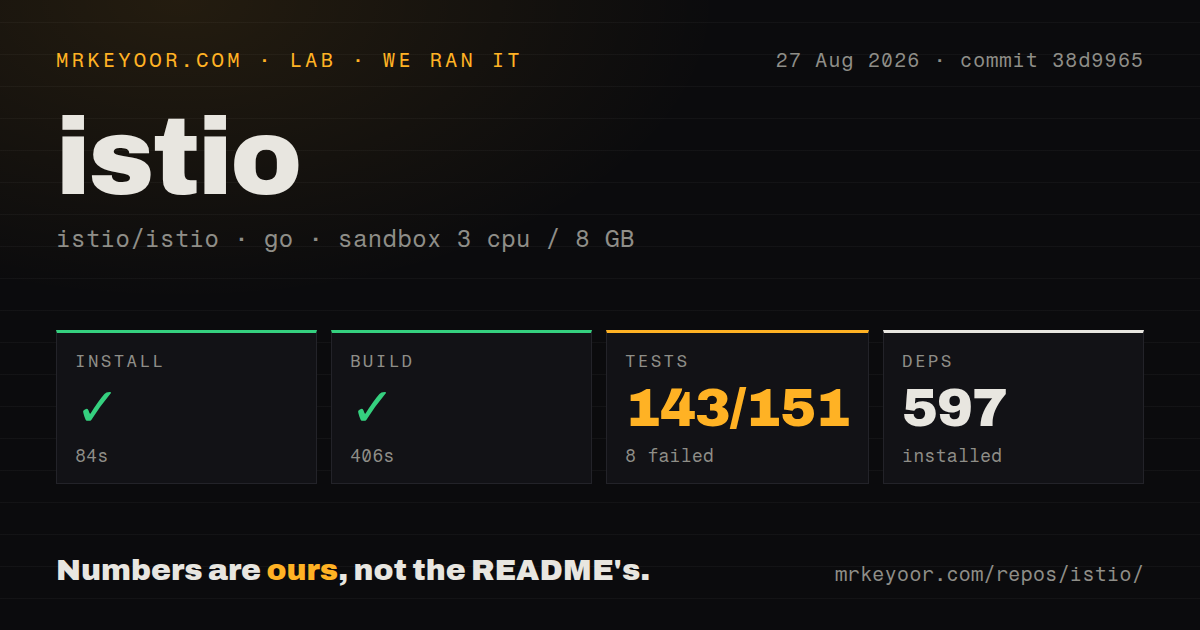
Our sandbox installed 597 Go packages in 84 seconds. The build completed successfully in 406 seconds, which made compilation the longest successful stage. We used commit 38d9965 in a fresh unprivileged Debian container with 3 CPUs, 8 GB of RAM, and no secrets. The checkout occupied 36.5 MB before the dependency work.
The test step exited with code 1 after 467 seconds. Go test reported 143 packages passed and 8 failed out of 151. The tail showed passing packages under bug-report and common configuration, then failures in tools/istio-iptables/pkg/capture, tools/istio-iptables/pkg/dependencies, and tools/istio-nftables/pkg/capture. The output supplied to us does not identify why those packages failed.
That distinction matters because the container was unprivileged, while these package names concern traffic capture and dependencies. The log does not prove that privileges caused the failures, and it does not prove a product defect either. Our finding is narrower: installation and build succeeded, but the complete command we ran did not pass. Reproduce the same packages on the build workers you intend to trust before treating them as an expected environmental exception.
Ambient mode removes sidecars but keeps network decisions
Ambient mode changes where the data plane runs. Ztunnel provides secure layer 4 connectivity and observability, while waypoint proxies can handle richer layer 7 policy where needed. Avoiding one proxy per pod can improve the deployment model for teams that dislike sidecar injection. It does not remove Istiod, node-level components, gateway choices, certificate management, or the need to understand how traffic enters and leaves a cluster.
Open issue 61454 gives a concrete example from version 1.30.3. The reporter installed the ambient profile on Kubernetes 1.36.2, saw Istiod, CNI nodes, and 3 ztunnel pods running, but the generated gateway service remained a LoadBalancer with its external address pending. That report does not show an Istio bug. It shows why cluster environment and load-balancer availability remain part of the setup even when the mesh itself appears healthy.
The 406-second build is only the start of an upgrade test
A source build proves that code compiles; it does not validate traffic behavior during a control-plane or data-plane rollout. An Istio evaluation should cover certificate rotation, policy denial, gateway failure, telemetry loss, and mixed-version upgrades. Test both ordinary requests and long-lived connections. A bad policy or traffic-capture change can affect many services at once, so rollback needs to work even when the mesh is the component in trouble.
Our scan found a tests directory but 0 GitHub Actions workflow files and no Dockerfile in this checkout. That is a repository signal, not evidence that Istio lacks automated release infrastructure. The project distributes work across multiple repositories and documents its own development process. A buyer building from source should locate the exact release jobs, artifact provenance, and checks relevant to the binaries it will deploy instead of substituting GitHub Actions presence for supply-chain review.
Current activity supports adoption, not casual operation
GitHub recorded 38,356 stars, 511 combined issues and pull requests, and a last push on August 27, 2026. Recent activity included dependency updates, ambient work, networking changes, and automated proxy and ztunnel version bumps. Release 1.30.3 was published on July 16, 2026. These dates show an active project and issue queue; the combined open count is not a count of unresolved bugs.
Istio deserves a shortlist when a company has a platform team and a mesh-sized problem. Its mature concepts and active maintenance do not make the system small. The 84-second dependency step, 406-second build, and 467-second failed test run give source contributors an early taste of that scale. Start with one bounded traffic path, define how success and rollback are measured, and expand only after the operators can explain every proxy and policy involved.