One command spans 4 failure-prone systems
iPadecrypt tries to turn a messy job into one desktop command. Give it a bundle ID, App Store ID, URL, or local IPA, and it coordinates the App Store client, a jailbroken iPhone, an embedded arm64 helper, and the final package assembly. The bootstrap wizard has 4 steps covering sign-in, SSH connection, dependency checks, and helper installation. That scope is the appeal. It is also why a successful Go build says little about a successful decryption.
The host can run on macOS, Linux, or Windows, but the useful work still depends on an iPhone. The README requires OpenSSH, AppSync Unified, and appinst on the jailbroken device. Its tested reference is iOS 16.7.11 on an iPhone 8 Plus using palera1n rootless and Dopamine. The author expects iOS 14 through 17 on A10 through A14 devices to work, which is an expectation rather than proof for every combination.
The 32-second install is the easy half
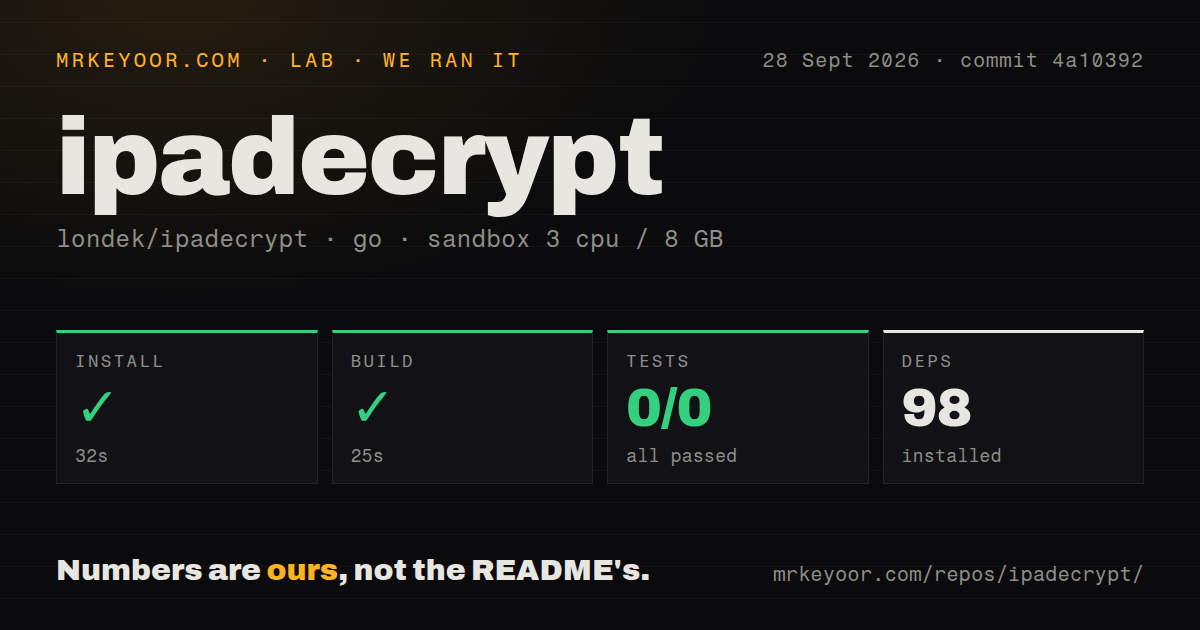
Our fresh Debian container installed 98 packages in 32 seconds, and the Go build passed in 25 seconds. A source build of the desktop CLI requires Go 1.25 or newer. The repository already commits the arm64 iOS helper and embeds it into the CLI, so ordinary contributors can compile the host program without an Apple SDK, a connected phone, or Docker. That is a sensible split for small changes to command handling and App Store code.
Changing the helper is heavier. BUILDING.md says its prebuilt container is about 750 MB and contains Clang, LLD, ldid, and a trimmed iPhoneOS SDK. CI rebuilds the helper with pinned inputs and byte-compares it with the committed binary. The lab scan found no top-level Dockerfile, while the source tree contains helper/Dockerfile for this specialized job. You still need a real jailbroken device to learn whether the helper survives the target app and jailbreak combination.
What happened when we ran it
Our sandbox cloned commit 4a10392 with 103 files, about 17,454 lines of source, and a 0.6 MB checkout. Installation succeeded in 32 seconds, and the build succeeded in 25 seconds. The container had 3 CPUs, 8 GB of RAM, Go 1.24 on Debian, no secrets, and no elevated privileges. Two CI workflow files were present, and the repository had no tests directory.
The test command returned success after 4 seconds with 0 passed and 0 failed out of 0. That result means the Go packages compiled under the test command. It does not show that login, downloading, SSH setup, helper upload, Mach-O decryption, assembly, cleanup, or output verification works. We could not exercise those paths in an unprivileged container without secrets or a jailbroken iPhone, and we will not treat a zero-test exit as end-to-end validation.
The config file holds passwords in plain JSON
Version 2 of the config schema includes the Apple email, password, password token, SSH password, private-key path, and key passphrase. The save function writes JSON through a temporary file with mode 0600, then renames it into place. That restricts other local users on a correctly behaved Unix system, but the values themselves are not encrypted by iPadecrypt. Windows permissions and backup handling deserve their own check before you enter a primary Apple account.
Release v0.8.0-rc.1 added a skip-login bootstrap option, so a local IPA or an app already installed on the device can avoid App Store credentials. That is the preferable route when downloading is outside the job. When sign-in is required, the README says credentials remain in ~/.ipadecrypt/config.json, and the source confirms that the password and returned token are stored there. Use a machine and account whose exposure you can contain.
iOS 26 support stops at the new SC_Info format
The README says the tool can decrypt iOS 26 apps, then names a direct exception. Issue 34 documents iOS 26-only binaries that ship newer .v4.supp and .v5.supf data without usable legacy key files. On a pre-iOS 26 kernel, those binaries fail. The issue lists Microsoft Remote Desktop 11.3.2 and GoPro 13.34.1 components as examples. This is a format and kernel boundary, not a switch the CLI can simply ignore.
Other open reports show how specific failures can get. Issue 48 describes successful binary decryption followed by assembly failure on checkra1n rootful iOS 14.8, while the same iPhone model worked with palera1n rootless on iOS 15.8.8. Issue 46 reports an empty App Store download response on v0.8.0-rc.1. Issue 23 tracks bundled frameworks that remain encrypted. A compatible phone does not guarantee that every app package is compatible.
Eight open issues define the current support boundary
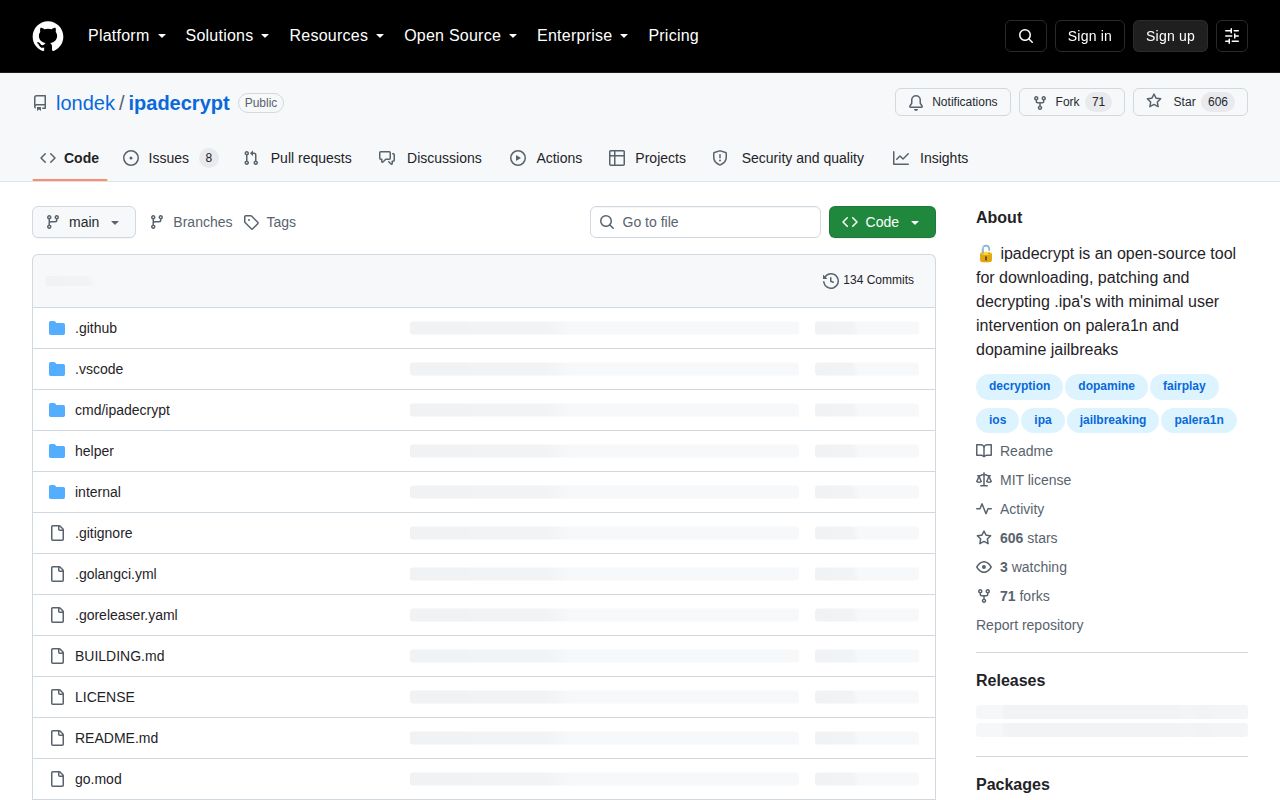
The last repository push was August 30, 2026, one day after v0.8.0-rc.1. Its release notes call the new SAP support experimental even though GitHub exposes the tag as the latest release. We found 8 open issues and no open pull requests in the API response. Several issue threads were created or updated in September, so user activity continued after the last code push. The project is young and receiving concrete field reports.
iPadecrypt is most useful as an integration script for a lab that already understands jailbreak quirks. It saves manual handoffs between downloading, installing, decrypting, and rebuilding an IPA, yet each handoff still exists underneath the command. With 0 automated tests in our run, your acceptance test is the artifact: inspect every Mach-O encryption flag, confirm bundled frameworks, and repeat on the exact iOS and jailbreak setup you intend to keep.