Coursebook is a 17-part C systems text, not a first programming book
Coursebook orders 17 subject areas between its introduction and post-mortems, including C, allocation, processes, threads, synchronization, networking, filesystems, signals, and security. The README says it is used in the University of Illinois CS 341 course and assumes that you have already taken a programming-language course and know assembly instructions. That starting line matters. A new C programmer may find useful explanations here, but the book does not promise to teach programming from zero.
Every code example and lesson is framed around C because the authors connect the language to Linux kernel work. That makes the material more coherent than a general computer-science survey. It also narrows the audience. If you want Python examples, application architecture, or a language-neutral operating-systems reference, another book will fit better. Coursebook is most useful when your next questions are about memory, processes, concurrency, files, and the machine behavior beneath ordinary programs.
Four reading formats come from two different build paths
Coursebook points readers to 4 outputs: PDF, wiki, HTML, and EPUB. That is a genuine advantage for a class because students can choose a browser, an e-reader, or one downloadable document. Contributors do not get one universal generator, though. The guide describes a Python and Pandoc route for wiki Markdown, then a separate Make and LaTeX route for the full PDF and individual chapter PDFs.
The split is manageable, and the instructions are unusually candid about it. Wiki work starts with a Python virtual environment, requirements.txt, an output directory, and _scripts/gen_wiki.py. PDF work asks for texlive-full; automatic recompilation adds inotify tools. The repository has no Dockerfile, so contributors must reproduce those host dependencies themselves. That is acceptable for an academic publishing project, but less convenient than a pinned container image.
What happened when we ran it
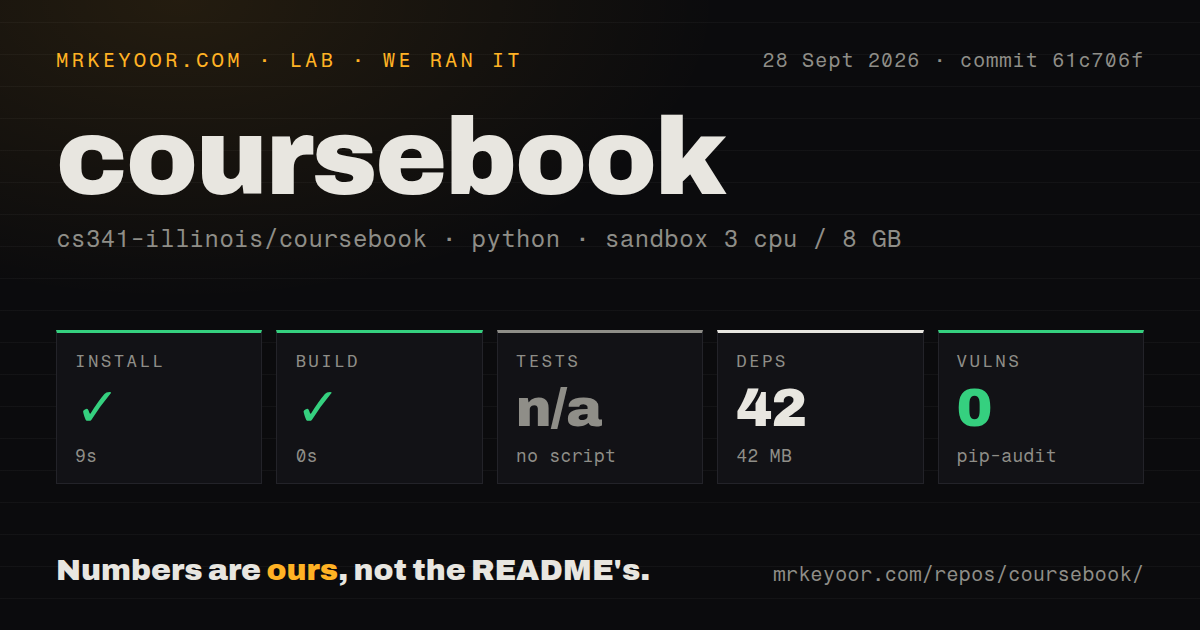
Our sandbox installed 42 Python packages in 9 seconds and used 42 MB on disk. The build step succeeded in 0 seconds at commit 61c706f. Pip-audit reported 0 known vulnerabilities. These numbers came from a fresh, unprivileged Debian container with 3 CPUs and 8 GB of RAM, so they describe the checked-out Python environment rather than every publishing service or a reader's laptop.
Coursebook did not expose a test script or target, so our test step was skipped. The repository had 242 files, about 854 lines of source, 2 CI workflow files, no Dockerfile, and no tests directory. The missing test command is more important than the instant build result: it leaves no single local check that proves the book's PDF, EPUB, HTML, wiki transformations, citations, and figures all survived an edit.
Forty-eight figures still lose their intended alt text
Open issue 238 says all 48 content figures now have alt text in their TeX source, but none of that text reaches a reader in the current outputs. The PDF is untagged, while the EPUB and wiki receive each figure's caption as image alt text. A caption such as a short label cannot replace the explanation of what a diagram shows. For a screen-reader user, this is a present limitation rather than a theoretical cleanup item.
The issue also shows why the publishing stack is harder to maintain than the 42 MB Python install suggests. Its proposed fix spans Pandoc and Panflute upgrades, citation ordering, EPUB checks, PDF tagging, LaTeX package compatibility, and regression comparisons across formats. A separate open report describes a C memory-model figure rendered incorrectly in one PDF. Instructors evaluating accessibility should inspect the actual artifacts they plan to distribute, not only the TeX source.
The 2019 release tag hides active work in September 2026
GitHub's latest release is fa19, published on August 18, 2019, but the default branch was pushed on September 26, 2026. The repository had 2,286 stars and 48 combined issues and pull requests when fetched. Recent commits corrected citations, diagrams, deadlock explanations, filesystem material, and post-mortems. That is credible maintenance activity, even though consumers who depend on release tags will see a seven-year gap.
Issue activity needs the same careful reading. Some open requests date to 2019 and 2020, while the detailed figure-accessibility plan was opened in September 2026. The project is neither frozen nor run like a frequently versioned software package. Treat the current branch and generated artifacts as the living book, and treat the old release page as a poor signal of the state students will actually read.
Choose the text first, then decide whether to adopt its toolchain
The 17-part syllabus is the reason to use Coursebook. It gives CS 341 students and independent learners one route through C systems topics, and the 4 published formats remove much of the friction of simply reading it. Our 9-second install also makes the Python side cheap to inspect before proposing a correction.
Maintaining a fork is a bigger commitment. There is no local test target, the PDF and wiki builders have different dependencies, and 48 figures still sit behind unresolved delivery work for alt text. Read the book if its prerequisites and syllabus match your needs. Fork its publishing system only if your team can own LaTeX, Pandoc, CI, and accessibility checks rather than assuming one successful build covers them all.