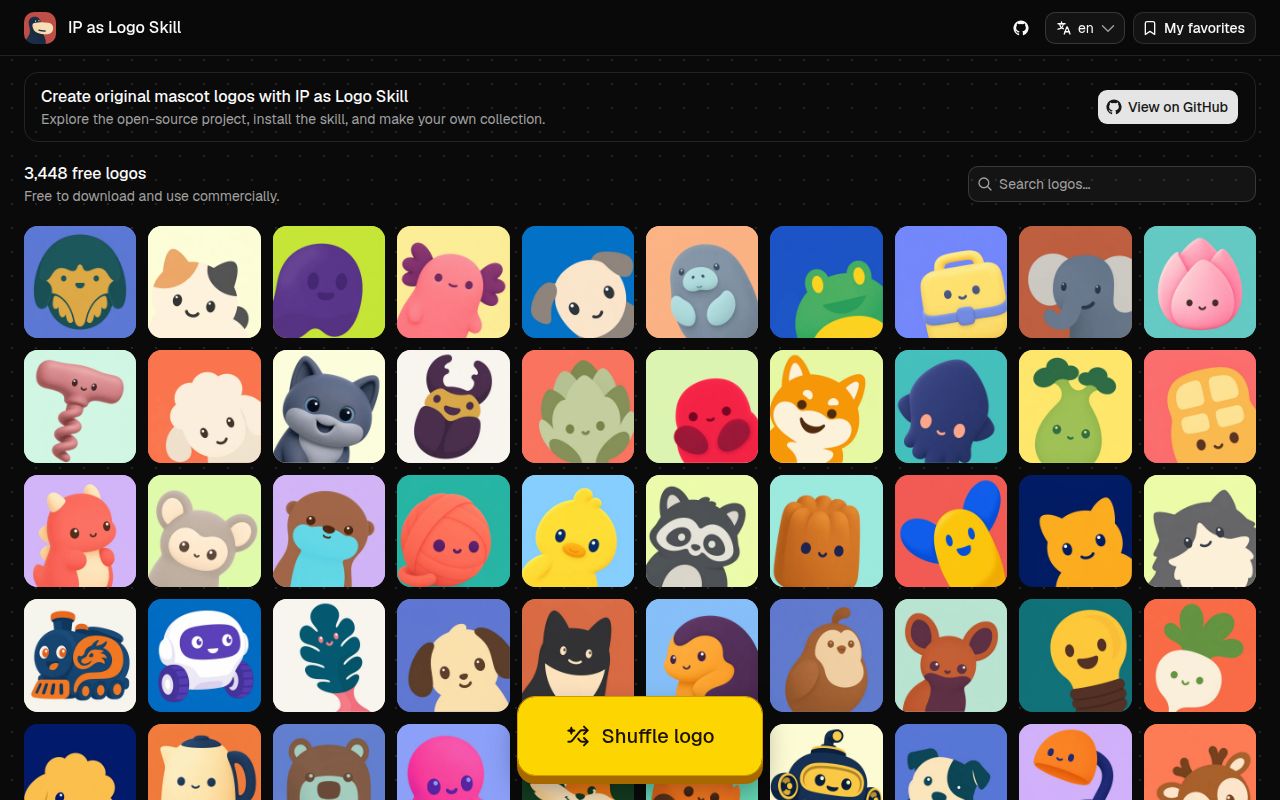
One instruction file imposes a recognizable mascot style
IP as Logo packages its entire workflow in 1 SKILL.md file. It asks an image model for a cute, simplified mascot with rounded forms, a dominant silhouette, and a solid named background. The subject emerges from a lower corner and fills most of a square. This is narrower than a general logo generator, and that narrowness is the point: it stops the model from producing a detailed illustration, a centered badge, or a page of unrelated brand concepts.
The default design uses roughly 4 to 7 large shapes and 3 semantic colors, two for the character and one for the background. Sharp details and extra lines are discouraged. When a user has not chosen a subject, familiar animals dominate the suggestions. Objects, vehicles, machines, obscure creatures, and fantasy artifacts need a direct connection to the product rather than novelty alone. Those rules produce a coherent family look, but they also make the output deliberately conventional.
Three directions come before six separate images
Once the skill has enough product context, it presents 3 concise directions and proposes 6 images. Accepting every direction yields A1, A2, B1, B2, C1, and C2. Each pair changes which lower corner the character emerges from, producing a three-left and three-right split. Selecting one direction keeps the same alternating corner pattern. Users can replace the quantity or distribution, so the structure guides the session without overruling an explicit request.
Each of the 6 candidates is generated as its own full-resolution square asset. The skill specifically forbids a contact sheet, which is a sensible detail because contact sheets make it harder to reuse or inspect an individual result. Compatible agents may create candidates in parallel through subagents. The prompt sent to the image model describes only a character image and avoids words such as logo, brand mark, and app icon, an attempt to keep the generator focused on the requested picture rather than stock logo conventions.
What happened when we ran it
The lab classified the repository as having no supported ecosystem, with language reported as null and no Dockerfile. That result matches the 4-item structure described in the README: SKILL.md, 1 WebP example, README.md, and LICENSE. There is no executable package whose dependencies or test suite could be assessed, so the harness has no install, build, or test result to report.
The repository declares 0 scripts and 0 generation dependencies. Our lab result can therefore confirm only that buyers are evaluating instructions rather than software behavior. It says nothing about image quality, prompt adherence, or consistency across models. Those results depend on the chosen agent, the available image generator, and stochastic output. A useful visual evaluation would need fixed brand briefs and human comparison of the returned images, which was outside this sandbox record.
No validation means all six draws reach the user
The skill applies 0 automatic validation gates. It does not inspect backgrounds, count colors, verify corner placement, reject transparency, or retry a candidate that violates the written rules. Every returned image is preserved and delivered. A user can request another draw or refine one later, but the workflow will not quietly replace a weak result. That policy is honest and avoids hiding model behavior, yet it transfers all quality control to the person reviewing the 6 outputs.
The lack of checks matters because the visual constraints are specific. Default characters should fill roughly 85 to 95 percent of the square, use the intended corner, and keep exactly 3 semantic colors. A model may miss any of those details. The README says different models interpret constraints differently and promises no equivalent quality when users choose an alternative model. Teams should budget time for selection and redraws even though the prompt workflow itself is short.
It makes mascot concepts, not a finished identity
The output stops at square character images and includes 0 vector deliverables. There is no SVG fallback, typography system, horizontal lockup, small-size legibility test, monochrome variant, spacing guide, or asset export pipeline. The website offers ready-made images for commercial use, while the repository itself is MIT licensed, but neither fact establishes that a newly generated mascot is unique enough to register or safe from similarity claims. A business still needs visual review and, where appropriate, legal clearance.
The last push was 2026-08-22, no GitHub release exists, and GitHub listed 9 open issues and pull requests combined. Recent activity includes small documentation corrections, a report about website image URLs returning 404, and community derivatives. That suggests attention around a young, compact project, while giving little evidence of a formal versioning or regression process.
IP as Logo is useful when a blank image prompt produces too much detail and too little consistency. Its 3-direction, 6-image routine gives a founder or designer a practical concept board in separate files. The stopping point is equally clear: select a direction, then hand it to someone who can redraw, test, clear, and extend the character into a real identity system.